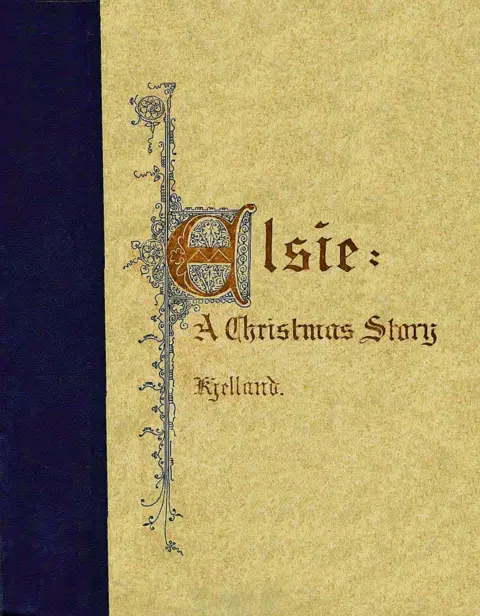
Elsie
Alexander Lange Kielland
THE CLASSIC COLLECTION · 1886
"Skipper Worse" by Alexander Lange Kielland is a novel written in the late 19th century. The story is centered around the character Jacob Worse, an accomplished sailor who returns home after a long voyage to Rio de Janeiro. The novel explores his interactions with the local community, his struggles with his past, and the complexities of societal norms that are intertwined with the religious revival movements prevalent on the Norwegian west coast. The opening of "Skipper Worse" introduces us to the titular character as he navigates his homecoming aboard his vessel, the "Hope of the Family". Upon arrival, he is met with a mixture of joy and tension, particularly with regard to his employer, Consul Garman, who is anxious about the financial state of his business amidst societal and personal losses. The narrative captures the contrast between the lively welcome from the crew's families and the somber relations that Worse has with others, highlighting themes of alienation and ambition. As Worse acclaimed his past achievements, we also glimpse his vulnerabilities and the expectations from the community that may weigh heavily on him as he seeks to find his place amidst changing social dynamics.
Introduction adapted from the source catalogue; source summaries may be automatically generated.
Free to read · English · 53,479 words · No account needed
MAKE TIME FOR A GOOD BOOK
On by default. Untick to stop anonymous reading totals. Each page counts after 10 seconds in view. How this works.
Anonymous counting is on unless you have switched it off.
Skipper Worse growled a little and rubbed his head, when Sivert Gesvint pressed his hand and welcomed him with effusion. There was an old affair between them about a consignment of salt, respecting which Skipper Worse declared that Sivert had cheated him; indeed, he had told him as much, to his face, many times, when they had met at the fishing. Sivert Gesvint, however, used only to smile, and pat him on the shoulder.
Madame Torvestad now led Worse to the armchair. He felt extremely ill at ease, and inwardly cursed both Madame Torvestad and Lauritz, which latter sat on a low stool behind two stout females, where he could catch a glimpse of Henrietta.
Sarah bashfully welcomed Skipper Worse, who patted her on the head; he had known her ever since she was a small child.
When they were all seated, and order was restored, Madame Torvestad said: "Now little Erik Pontoppidan, what was the subject discussed at the meeting?"
"Sanctification," said the pale boy near the door, in a prompt but
mechanical manner.
"What hymn did they sing, Henrietta," said her mother; "you remember
of course?"
Henrietta had indeed been at the meeting, but being quite absorbed by the sad news that Lauritz could not lodge with them, she had derived but scanty benefit from it. When she returned home and learnt that after all he had received permission, she was so delighted that now her mother's question came upon her like a bucket of cold water.
She turned very red, and felt as if her senses were leaving her.
Madame Torvestad looked severely at her for a while, and then turned to Erik Pontoppidan, who gave the first line of the hymn, without hesitation, the moment he caught her eye.
People nodded and smiled approvingly at the boy. His mother, a stout, pale woman, and his father, Endre Egeland, were proud of him. Erik Pontoppidan himself, however, took it very composedly.
Except Lauritz, no one looked at Henrietta, who felt very much ashamed, and crept behind her two friends. Madame Torvestad now struck up a hymn, in which all the company joined. To Jacob Worse's ear, all these voices in the low room, the subdued tones of the women, and the rough bass of the men, sounded weird and unpleasing.
They sang so very slowly that it seemed as if the hymn would never finish, especially as Sivert Jespersen, in a manner peculiar to him, threw in certain shakes and quavers at the end of each verse.
Your reading position is saved on this browser. Take it to another device with a library code. Reading pages adapt to text, rather than matching a printed edition.
Alexander Lange Kielland
Alexander Lange Kielland
Alexander Lange Kielland
BEHIND THE BOOK
This eBook is for the use of anyone anywhere in the United States and most other parts of the world at no cost and with almost no restrictions whatsoever. You may copy it, give it away or re-use it under the terms of the Project Gutenberg License included with this eBook or online at www.gutenberg.org. If you are not located in the United States, you will have to check the laws of the country where you are located before using this eBook. Read the source licence.
The original source file, including credits and licence, is retained by this library. Request an original-format copy at no charge. Please include the book title and Project Gutenberg identifier #30530.
KEEP YOUR CURIOSITY GOING
Coulson Kernahan

Maurice Baring
Frances Wright
Cécile Tormay

Frederic Jesup Stimson

W. H. P. (William Henry Pope) Jarvis