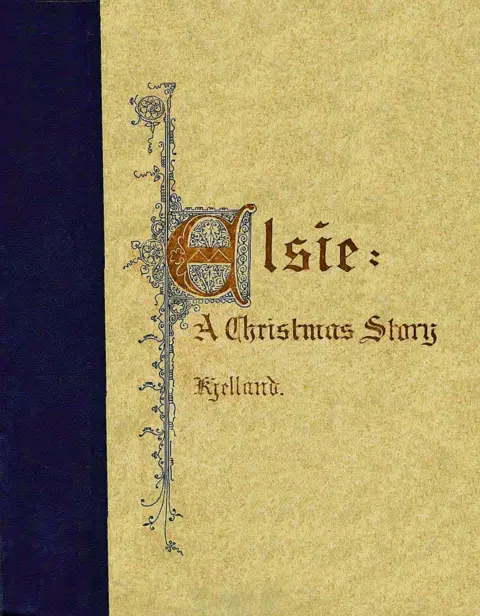
Elsie
Alexander Lange Kielland
THE CLASSIC COLLECTION · 1886
"Skipper Worse" by Alexander Lange Kielland is a novel written in the late 19th century. The story is centered around the character Jacob Worse, an accomplished sailor who returns home after a long voyage to Rio de Janeiro. The novel explores his interactions with the local community, his struggles with his past, and the complexities of societal norms that are intertwined with the religious revival movements prevalent on the Norwegian west coast. The opening of "Skipper Worse" introduces us to the titular character as he navigates his homecoming aboard his vessel, the "Hope of the Family". Upon arrival, he is met with a mixture of joy and tension, particularly with regard to his employer, Consul Garman, who is anxious about the financial state of his business amidst societal and personal losses. The narrative captures the contrast between the lively welcome from the crew's families and the somber relations that Worse has with others, highlighting themes of alienation and ambition. As Worse acclaimed his past achievements, we also glimpse his vulnerabilities and the expectations from the community that may weigh heavily on him as he seeks to find his place amidst changing social dynamics.
Introduction adapted from the source catalogue; source summaries may be automatically generated.
Free to read · English · 53,479 words · No account needed
MAKE TIME FOR A GOOD BOOK
On by default. Untick to stop anonymous reading totals. Each page counts after 10 seconds in view. How this works.
Anonymous counting is on unless you have switched it off.
Fennefos was rather taken by surprise, but, for the sake of peace, consented, and as soon as the dyer left, threw himself on the bed, and fell asleep.
Madame Torvestad stood for a moment, thoughtful as usual, when Hans Nilsen had departed; then, opening the door of the workroom, she said with a certain air of solemnity; "Henrietta, go to bed."
"Yes, mother," said Henrietta, who after the conversation with Fennefos, had fallen into the deepest despondency.
Trembling, she approached her mother to say "Good night," although the sun was still high in the heavens.
"I will not say 'Good night' to you, and you shall have no supper, either," said her mother, shutting the door.
This was the mode of applying correction in Gnadau, and Madame Torvestad remembered well how it would bend even the most refractory.
When Jacob Worse woke in the morning after the memorable birthday at Randulf's, he felt extremely unwell. His head was heavy and beating violently, and he felt the pain in his stomach.
His wife had long been up; and when Worse was really awakened, it was
by two of the warehouse people, who came in and began to remove her
bed.
"What are you about?" he inquired, petulantly.
"We are taking madame's bed into the other room."
"Nonsense!"
"Hush, hush!" said the old foreman. "The captain must not excite himself. You are ill, captain, and I was to tell you from madame that you must not talk."
Worse muttered something, and with sleepy eyes watched the departure
of the bed.
When his wife soon afterwards entered the room, he said: "I shall be all right to-morrow, Sarah; it is only the first day that is so confoundedly bad. Bah! I will never touch toddy again. It's beastly, that's what it is."
"You are more ill than you suppose, both in body and soul, and I think you should seek healing for both, especially for your soul, before it be too late."
"Yes, dear, you know I will; but you must help me. Come sit by me,
and read to me a little."
"Not to-day," she answered.
He lay in bed all that day, suffering much. The next day his head, at least, was clear, but the pains in his stomach troubled him, and he found it best to remain lying down.
From time to time Sarah visited his room, and he begged her piteously to come and sit by him; for when he was alone, he was troubled by many evil and dismal thoughts.
She seated herself by the window, with some small books--like her mother, she had also taken to small books.
Your reading position is saved on this browser. Take it to another device with a library code. Reading pages adapt to text, rather than matching a printed edition.
Alexander Lange Kielland
Alexander Lange Kielland
Alexander Lange Kielland
BEHIND THE BOOK
This eBook is for the use of anyone anywhere in the United States and most other parts of the world at no cost and with almost no restrictions whatsoever. You may copy it, give it away or re-use it under the terms of the Project Gutenberg License included with this eBook or online at www.gutenberg.org. If you are not located in the United States, you will have to check the laws of the country where you are located before using this eBook. Read the source licence.
The original source file, including credits and licence, is retained by this library. Request an original-format copy at no charge. Please include the book title and Project Gutenberg identifier #30530.
KEEP YOUR CURIOSITY GOING
Coulson Kernahan

Maurice Baring
Frances Wright
Cécile Tormay

Frederic Jesup Stimson

W. H. P. (William Henry Pope) Jarvis