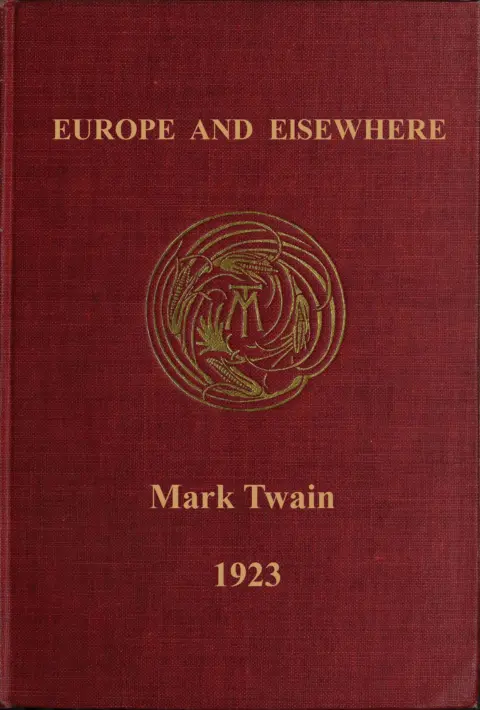
Europe and elsewhere
Mark Twain
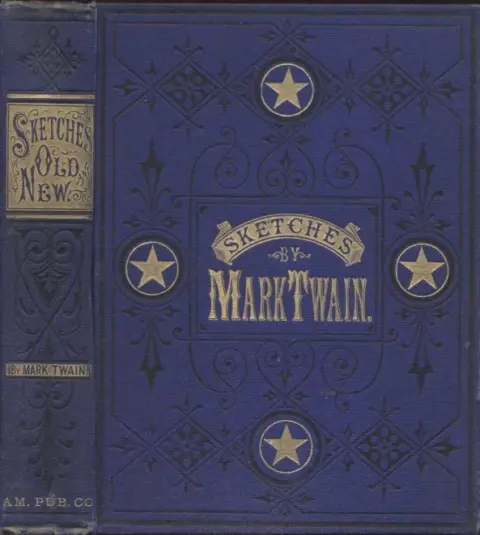
THE CLASSIC COLLECTION · 1875
"Sketches New and Old" by Mark Twain is a collection of short stories published in 1875. This diverse anthology gathers mostly fictional tales that showcase Twain's signature wit and humor. From the famous "The Jumping Frog" to "A Ghost Story," the collection spans topics including journalism, politics, childhood morality tales, and bizarre adventures. With over sixty pieces ranging from speeches to satirical sketches, it captures Twain's sharp observations on American life and human nature during the nineteenth century.
Introduction adapted from the source catalogue; source summaries may be automatically generated.
Free to read · English · 97,898 words · No account needed
MAKE TIME FOR A GOOD BOOK
On by default. Untick to stop anonymous reading totals. Each page counts after 10 seconds in view. How this works.
Anonymous counting is on unless you have switched it off.
You should set your affections on another also--or on several, if there are enough to go round. Also, do everything you can to make your former flame unhappy. There is an absurd idea disseminated in novels, that the happier a girl is with another man, the happier it makes the old lover she has blighted. Don't allow yourself to believe any such nonsense as that. The more cause that girl finds to regret that she did not marry you, the more comfortable you will feel over it. It isn't poetical, but it is mighty sound doctrine.
“ARITHMETICUS.” Virginia, Nevada.--“If it would take a cannon-ball 3 and 1/3 seconds to travel four miles, and 3 and 3/8 seconds to travel the next four, and 3 and 5/8 to travel the next four, and if its rate of progress continued to diminish in the same ratio, how long would it take it to go fifteen hundred million miles?”
I don't know.
“AMBITIOUS LEARNER,” Oakland.--Yes; you are right America was not discovered by Alexander Selkirk.
“DISCARDED LOVER.”--“I loved, and still love, the beautiful Edwitha Howard, and intended to marry her. Yet, during my temporary absence at Benicia, last week, alas! she married Jones. Is my happiness to be thus blasted for life? Have I no redress?”
Of course you have. All the law, written and unwritten, is on your side. The intention and not the act constitutes crime--in other words, constitutes the deed. If you call your bosom friend a fool, and intend it for an insult, it is an insult; but if you do it playfully, and meaning no insult, it is not an insult. If you discharge a pistol accidentally, and kill a man, you can go free, for you have done no murder; but if you try to kill a man, and manifestly intend to kill him, but fail utterly to do it, the law still holds that the intention constituted the crime, and you are guilty of murder. Ergo, if you had married Edwitha accidentally, and without really intending to do it, you would not actually be married to her at all, because the act of marriage could not be complete without the intention. And ergo, in the strict spirit of the law, since you deliberately intended to marry Edwitha, and didn't do it, you are married to her all the same--because, as I said before, the intention constitutes the crime. It is as clear as day that Edwitha is your wife, and your redress lies in taking a club and mutilating Jones with it as much as you can. Any man has a right to protect his own wife from the advances of other men. But you have another alternative--you were married to Edwitha first, because of your deliberate intention, and now you can prosecute her for bigamy, in subsequently marrying Jones. But there is another phase in this complicated case: You intended to marry Edwitha, and consequently, according to law, she is your wife--there is no getting around that; but she didn't marry you, and if she never intended to marry you, you are not her husband, of course. Ergo, in marrying Jones, she was guilty of bigamy, because she was the wife of another man at the time; which is all very well as far as it goes--but then, don't you see, she had no other husband when she married Jones, and consequently she was not guilty of bigamy. Now, according to this view of the case, Jones married a spinster, who was a widow at the same time and another man's wife at the same time, and yet who had no husband and never had one, and never had any intention of getting married, and therefore, of course, never had been married; and by the same reasoning you are a bachelor, because you have never been any one's husband; and a married man, because you have a wife living; and to all intents and purposes a widower, because you have been deprived of that wife; and a consummate ass for going off to Benicia in the first place, while things were so mixed. And by this time I have got myself so tangled up in the intricacies of this extraordinary case that I shall have to give up any further attempt to advise you--I might get confused and fail to make myself understood. I think I could take up the argument where I left off, and by following it closely awhile, perhaps I could prove to your satisfaction, either that you never existed at all, or that you are dead now, and consequently don't need the faithless Edwitha--I think I could do that, if it would afford you any comfort.
Your reading position is saved on this browser. Take it to another device with a library code. Reading pages adapt to text, rather than matching a printed edition.
BEHIND THE BOOK
This eBook is for the use of anyone anywhere in the United States and most other parts of the world at no cost and with almost no restrictions whatsoever. You may copy it, give it away or re-use it under the terms of the Project Gutenberg License included with this eBook or online at www.gutenberg.org. If you are not located in the United States, you will have to check the laws of the country where you are located before using this eBook. Read the source licence.
The original source file, including credits and licence, is retained by this library. Request an original-format copy at no charge. Please include the book title and Project Gutenberg identifier #3189.
KEEP YOUR CURIOSITY GOING
Coulson Kernahan

Maurice Baring
Frances Wright
Cécile Tormay

Frederic Jesup Stimson

W. H. P. (William Henry Pope) Jarvis