THE CLASSIC COLLECTION✦An outlaw’s diary: the CommuneCLASSIC FREE BOOKS
An outlaw’s diary: the Commune
Cécile Tormay
THE CLASSIC COLLECTION · 1892
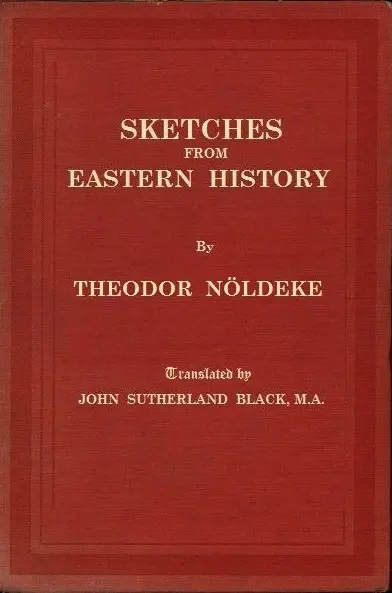
"Sketches from Eastern History" by Theodor Nöldeke is a historical account written in the late 19th century. This work provides a series of essays that explore key aspects of Eastern history, particularly focused on the Semitic races and the rise of Islam. The author, a noted orientalist, aims to provide insights into the culture, religion, and political dynamics of the region, enhancing the understanding of historical figures such as the Islamic prophet Mohammed and his works. At the start of the text, Nöldeke presents the complex task of depicting the moral and psychological characteristics of the Semitic races, acknowledging the challenges and contradictions involved. He critiques previous scholars who have portrayed these traits and outlines his intent to contribute meaningfully to the discourse. The opening engages the reader by elaborating on how geography, religion, and history have shaped the characteristics and civilizations of the Semitic peoples, and it sets the stage for a deeper examination that will unfold in subsequent chapters. Through his rigorous analysis, Nöldeke's work promises to be a valuable resource for both specialists and general readers interested in the history and influence of the Eastern world.
Introduction adapted from the source catalogue; source summaries may be automatically generated.
Free to read · English · 93,547 words · No account needed
MAKE TIME FOR A GOOD BOOK
On by default. Untick to stop anonymous reading totals. Each page counts after 10 seconds in view. How this works.
Anonymous counting is on unless you have switched it off.
The dynasty of the Omayyads once overthrown, the Alids saw that they had not gained much. It made no difference to them whether their nearer cousins, the descendants of Abbás,[28] or whether their slightly more distant kinsmen, those of Omayya, possessed the sovereignty; the name of Háshim was not enough. When the house of the Prophet had been canvassed for, every one in the first instance had thought of his actual descendants; these last now deemed, not unrightly, that they had been defrauded of their birthright. It is probable that even the Abbásids, in the secret negotiations, at an early stage had at one time freely acknowledged the Alid Mohammed, son of Abdalláh, as head of the entire house, and as the future Caliph. Why this particular man should have been selected from among the very numerous descendants of Alí, we are unable to say. One advantage, which fell into the scale when a legitimist claim was being urged, he undoubtedly had—namely, that the females also who came into his genealogy were all free Arabs of good family, and that the Hasanid Mohammed was through his grandmother a descendant also of Husain, and thus in a twofold way descended from the Prophet.[29] His father, who might have advanced still stronger claims, was perhaps over-timid or too little ambitious.
The Abbásids knew too well how it was that they themselves had reached the throne to be other than exceedingly jealous of the hereditary advantages of their cousins. One and another Alid now and again expressed tolerably openly his opinion of the situation. And the Mohammed just mentioned, as well as his brother Ibráhím, had betrayed themselves by refraining to come to pay their respects to Mansúr when he made the pilgrimage during the lifetime of his brother. If Mansúr actually had at one time acknowledged Mohammed’s right to the caliphate, this would be to him a further motive for effort to have them in his power. But neither promises nor threats availed; they hid themselves in various quarters of Arabia, and are said to have wandered about in even remoter lands. As their father when closely questioned persisted in declaring that he had no idea where his sons were living, Mansúr, when he came on pilgrimage once more to Mecca in April 758, caused him to be imprisoned. But even this did not avail. The governors in Medina either could not or would not find the fugitives. The inhabitants were attached to the Alids as being children of the Prophet and children of their city, and the majority of the officials even would doubtless have felt it to be a crime to deliver them up to destruction. Riyáh, however, of the tribe of Morra, who entered upon the governorship of Medina on 27th December 761, was free from any such weakness. He threatened the inhabitants with the same fate with which, sixty-eight years before, his fellow tribesman Moslim, son of Okba, had visited their rebellion against authority.[30] He caused all the nearer kinsmen of Mohammed’s family, and many of his adherents, to be imprisoned, and also a number of the Juhaina Bedouins, among whose mountains, to the west of Medina,[31] it was supposed that the claimant was in hiding. When, at the close of another pilgrimage (March 762), Mansúr visited Medina, he took these captive Alids, including the father of the two brothers, and various other persons of consideration, and carried them with him in chains into Babylonia. Amongst these exiles was the step-brother of Abdalláh, who secretly, and in violation of his plighted word, had given his daughter in marriage to his nephew, the claimant, and is said also to have himself seemed formidable by reason of his personal distinction as a descendant of Caliph Othmán. A son of Mohammed’s fell into the hands of the governor of Egypt, and was sent to the Caliph. We can readily believe what we read, that the treatment of these hostages was by no means indulgent;[32] several were put to death, many died in prison. But popular imagination, or personal hatred, has raised the colours of the picture; the story goes that the Caliph kept the bodies of all the murdered Alids in a great chamber to which no one had access but himself; in the ear of each was a label with his name and genealogy neatly written. Mansúr’s son Mahdí ventured to use the key after his father’s death, and, horrified at the discovery, caused them all to be buried.
Your reading position is saved on this browser. Take it to another device with a library code. Reading pages adapt to text, rather than matching a printed edition.
BEHIND THE BOOK
This eBook is for the use of anyone anywhere in the United States and most other parts of the world at no cost and with almost no restrictions whatsoever. You may copy it, give it away or re-use it under the terms of the Project Gutenberg License included with this eBook or online at www.gutenberg.org. If you are not located in the United States, you will have to check the laws of the country where you are located before using this eBook. Read the source licence.
The original source file, including credits and licence, is retained by this library. Request an original-format copy at no charge. Please include the book title and Project Gutenberg identifier #54782.
KEEP YOUR CURIOSITY GOING
Cécile Tormay

Moritz Busch
John L. Ransom
Frances Wright
Cécile Tormay

Mabel Potter Daggett