THE CLASSIC COLLECTION✦An outlaw’s diary: the CommuneCLASSIC FREE BOOKS
An outlaw’s diary: the Commune
Cécile Tormay
THE CLASSIC COLLECTION · 1892
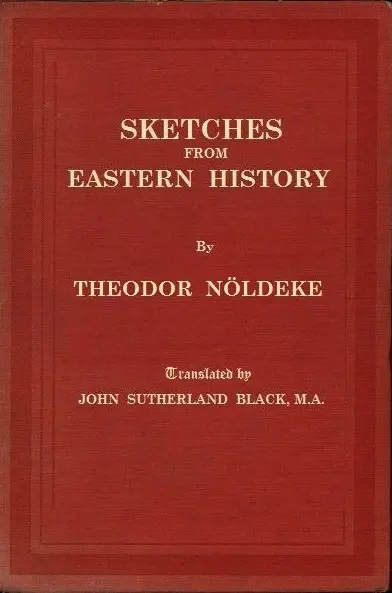
"Sketches from Eastern History" by Theodor Nöldeke is a historical account written in the late 19th century. This work provides a series of essays that explore key aspects of Eastern history, particularly focused on the Semitic races and the rise of Islam. The author, a noted orientalist, aims to provide insights into the culture, religion, and political dynamics of the region, enhancing the understanding of historical figures such as the Islamic prophet Mohammed and his works. At the start of the text, Nöldeke presents the complex task of depicting the moral and psychological characteristics of the Semitic races, acknowledging the challenges and contradictions involved. He critiques previous scholars who have portrayed these traits and outlines his intent to contribute meaningfully to the discourse. The opening engages the reader by elaborating on how geography, religion, and history have shaped the characteristics and civilizations of the Semitic peoples, and it sets the stage for a deeper examination that will unfold in subsequent chapters. Through his rigorous analysis, Nöldeke's work promises to be a valuable resource for both specialists and general readers interested in the history and influence of the Eastern world.
Introduction adapted from the source catalogue; source summaries may be automatically generated.
Free to read · English · 93,547 words · No account needed
MAKE TIME FOR A GOOD BOOK
On by default. Untick to stop anonymous reading totals. Each page counts after 10 seconds in view. How this works.
Anonymous counting is on unless you have switched it off.
The ground had long before been undermined by the efforts of a religious party hostile to the Omayyads. The descendants of Alí, who, as blood-relations, in fact descendants, of the Prophet (through his daughter Fátima), considered themselves to have the nearest right to the throne, alienated from the Omayyads the hearts of many of their subjects. There was an expectation that the house of Mohammed, should it once attain to the supreme authority, would fill the earth as full of righteousness as it was now full of iniquity. The pious professors and followers of the divine law had little liking for the rule of the reigning house, which, for all its forms of religion, was purely secular. And though the risings of the Alids were unsuccessful through the bungling of their leaders, the very failure cost the Omayyads dear; for the incapable grandchildren of the Apostle of God, who had fallen or been put to death, in the eyes of the people became martyrs, whose blood cried to heaven for vengeance.
In perfect quietness, meanwhile, another family was setting itself to work to gather in the fruits of the efforts of the Alids for its own behalf,—their cousins, the Abbásids. Abbás, from whom they traced their descent, had held a somewhat ambiguous attitude towards his nephew the Prophet. His son Abdalláh passes for one of the strongest pillars of religious tradition; but, in the eyes of unprejudiced European research, he is only a crafty liar. Abdalláh’s grandson Mohammed, and the sons of the latter, so far as they are known to us, combined considerable practical vigour with their hereditary cunning and duplicity. They lived in deep retirement in Humaima, a little place to the south of the Dead Sea, seemingly far withdrawn from the world, but which, on account of its proximity to the route by which Syrian pilgrims went to Mecca, afforded opportunities for communication with the remotest lands of Islam. From this centre they carried on the propaganda in their own behalf with the utmost skill. They had genius enough to see that the best soil for their efforts was the distant Khorásán,[20]—that is, the extensive north-eastern provinces of the old Persian empire. The majority of the people there had already gone over to Islam; many had embraced the new faith with ardour, and had even fought bravely on its behalf against the unbelieving populations to the north and east. But the converted Persians were held in little esteem by the dominant Arabs, who looked on them as “clients,”[21] and refused to accord to them the full rights to which they had a claim as Moslems. The internal wars of the Arabs, moreover, raged in those parts with exceptional violence. To the Persians it was a matter of indifference whether the Yemenites or Modarites or Rabía were victorious; but they keenly felt the devastation of their country, and their own subordinate position; and thus a great proportion of the newly-converted Persians were filled with hatred towards their Arab “brethren in the faith.” This hatred was easily turned against the reigning house, which was named as the source of all unrighteousness, and whose secular disposition must certainly have been very offensive to the truly pious. The Persians, moreover, were naturally inclined to legitimism, and to enthusiastic attachments to spiritual leaders. Accordingly they were drawn over in multitudes to the doctrine that “the house of the Prophet” alone is called to dominion over his kingdom and his Church. Well-chosen emissaries of the Abbásids canvassed for the family of the Prophet, for the Háshimids, by which expression were understood, in the first instance, the descendants of Alí. Other watchwords and fictitious sayings of Mohammed were also successfully put in circulation. Gradually and furtively the place of the Alids was taken by the Abbásids, who undoubtedly also were descendants of Háshim, and who, since descent from Mohammed in the female line was represented as unimportant, could claim to be just as nearly related to the Prophet as the others.[22] The main point was, that the adherents secured for the cause became entirely attached to the persons of the emissaries, so that the latter were able in the end to direct their followers as they pleased. To secure adherents there seems to have been no scruple about favouring all sorts of objectionable opinions (partly due to a mixing up of the old with the new religion) inconsistent with the fundamental laws of Islam. Of details of the progress of the agitation we know little; but so much is certain: that it was very active, that the emissaries had a regular organisation, and that frequent communication was maintained between Khorásán and the centres from which the wires were pulled—Cufa, the residence of the supreme agent, and Humaima, the home of the Abbásids. The yearly pilgrimages gave special opportunities for meeting without arousing suspicion; many important consultations may possibly have taken place in Mecca itself. Operations had long been carried on in this way, when the head of the Abbásids—either Mohammed, who died in 743, or his son Ibráhím, it is not quite certain which—discovered the man who was destined to bring the movement to a successful issue. This was Abú Moslim, a freedman whose country and descent are unknown, but who in any case was not of Arabian blood. This quondam slave united with an agitator’s adroitness and perfect unscrupulosity in the choice of his means the energy and clear outlook of a general and statesman, and even of a monarch. Within a few years he brought it about that the black banner of the Abbásids was openly unfurled (in the beginning of summer, 747). In a perfidious but masterly manner he contrived still further to foment the mutual antipathies of the Arab parties which were openly at war with each other, although Nasr, the governor, was not the only one who clearly saw that nothing less was at stake than the supremacy, and even the very life, of the Arabs. Ibráhím is even said to have given orders to Abú Moslim that, so far as possible, no Arab should be left alive in Khorásán. Soon the brave Nasr was compelled to quit the country; and immediately afterwards he died (November 748). The Khorásánians pressed steadily forwards. The chief control was in the hands of Abú Moslim, although he remained in Khorásán; not only the Persians, but also the Arab leaders, put themselves under the command of the freedman, a thing unheard-of for Arab pride. It should be added, that the Arabs of Khorásán undoubtedly had a strong strain of Persian blood, and that they had taken on much that was Persian.
Your reading position is saved on this browser. Take it to another device with a library code. Reading pages adapt to text, rather than matching a printed edition.
BEHIND THE BOOK
This eBook is for the use of anyone anywhere in the United States and most other parts of the world at no cost and with almost no restrictions whatsoever. You may copy it, give it away or re-use it under the terms of the Project Gutenberg License included with this eBook or online at www.gutenberg.org. If you are not located in the United States, you will have to check the laws of the country where you are located before using this eBook. Read the source licence.
The original source file, including credits and licence, is retained by this library. Request an original-format copy at no charge. Please include the book title and Project Gutenberg identifier #54782.
KEEP YOUR CURIOSITY GOING
Cécile Tormay

Moritz Busch
John L. Ransom
Frances Wright
Cécile Tormay

Mabel Potter Daggett