THE CLASSIC COLLECTION✦An outlaw’s diary: the CommuneCLASSIC FREE BOOKS
An outlaw’s diary: the Commune
Cécile Tormay
THE CLASSIC COLLECTION · 1892
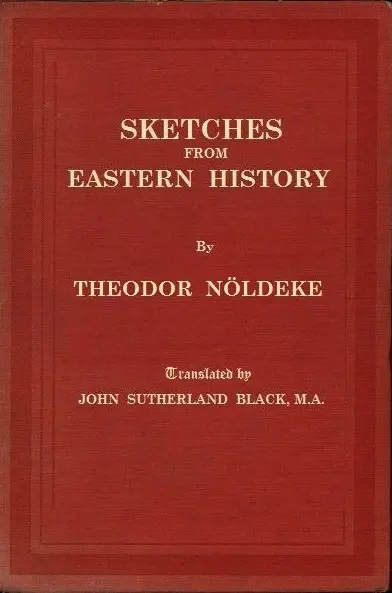
"Sketches from Eastern History" by Theodor Nöldeke is a historical account written in the late 19th century. This work provides a series of essays that explore key aspects of Eastern history, particularly focused on the Semitic races and the rise of Islam. The author, a noted orientalist, aims to provide insights into the culture, religion, and political dynamics of the region, enhancing the understanding of historical figures such as the Islamic prophet Mohammed and his works. At the start of the text, Nöldeke presents the complex task of depicting the moral and psychological characteristics of the Semitic races, acknowledging the challenges and contradictions involved. He critiques previous scholars who have portrayed these traits and outlines his intent to contribute meaningfully to the discourse. The opening engages the reader by elaborating on how geography, religion, and history have shaped the characteristics and civilizations of the Semitic peoples, and it sets the stage for a deeper examination that will unfold in subsequent chapters. Through his rigorous analysis, Nöldeke's work promises to be a valuable resource for both specialists and general readers interested in the history and influence of the Eastern world.
Introduction adapted from the source catalogue; source summaries may be automatically generated.
Free to read · English · 93,547 words · No account needed
MAKE TIME FOR A GOOD BOOK
On by default. Untick to stop anonymous reading totals. Each page counts after 10 seconds in view. How this works.
Anonymous counting is on unless you have switched it off.
In the history of Islamite peoples the politico-religious controversies which turned upon the right to the caliphate are by far the most important. But alongside of these there were a multitude of purely dogmatic disputes. Above all, Islam was agitated with the old and ever new question as to whether, and how far, man is a free or a determined agent in his purposes and actions. The Koran, generally speaking, teaches a rather crass determinism. According to the Koran, God is the author of everything, including the dispositions of men; He guides whom He wills, and leads into error whom He wills. But at a very early period some pious souls began to take offence at the horrible thought that God should thus have foreordained multitudes of men to sin and to the everlasting pains of hell. They could recognise a divine righteousness only if God leaves men free to choose between good and evil, and determines the retribution according to the character of the choice. They found points of support for this doctrine of theirs in the Koran itself; for Mohammed, who was anything but a consistent thinker, has in his revelations often treated man as free. A popular teacher of religion will, it is clear, whatever be his inclination to determinism, inevitably find himself ever and anon addressing himself to his hearers, in his exhortations to faith and virtue, as if they were in possession of freedom of will. The people who taught in this strain were called Kadarites. Possibly they were not wholly exempt from Christian influences. The procedure of their successors, the Mutazila (“Dissidents”), was more systematic. They constituted a school of a strongly rationalistic tendency, and with the aid of Greek dialectic, with which the Arabs became acquainted first in a limited degree, and afterwards much more fully, through the Syrians, reduced their orthodox opponents to desperation. They also opposed with special zeal the proposition that the Koran is uncreated.[18] This dogma was certainly in flagrant contradiction to the fundamental position of the Koran itself. On this point the Mutazila were in reality the orthodox; but it could hardly fail to happen that in the heat of debate some went further, and thought of the Koran altogether more lightly than befits a Moslem. The fair beginning of a truly progressive movement which was involved in this was inevitably checked within Islam at a very early stage. The school of the Mutazila could hardly have attained to any significance at all had it not been favoured by some of the earlier Abbásids. Mámún especially took sides with great zeal for the doctrine that the Koran is created. But that he is not on this account to be designated as in any sense a “friend of free thought,” is evident from the fact that he imposed severe punishments on those theologians who publicly avowed their adherence to the opposite doctrine then generally prevalent. So also his successors, down to Mutawakkil, who reversed the condition of matters, and caused it to be taught that the Koran is increate.—Another controversy had reference to the divine attributes. The Koran in its unsophisticated anthropomorphism attributes human qualities to God throughout, speaks also of His hands, of the throne on which He sits, and so forth. The original Moslems took this up simply as it was written; but, later, many were stumbled by it, and sought to put such a construction on the passages as would secure for the Koran a purer conception of God. Some denied all divine attributes whatever, inasmuch as, being eternal equally with Himself, they would, if granted, necessarily destroy the divine unity, and establish a real polytheism. Many conceded only certain abstract qualities. On the other hand, some positively maintained the corporeity of God,—in other words, an anthropomorphism of the crassest kind, which even Mohammed would have rejected. The Mutazila maintained their dialectical superiority until Ash‘arí (in the first third of the tenth century), who had been educated in their schools, took the dialectic method into the service of orthodoxy. It was he who created the system of orthodox dogmatic. Of course the later dogmatists did not in all points agree with him, and by some of them, on account of some remains of rationalism in his teaching, he was even regarded as heterodox. Since Ash‘arí’s time the commonly accepted doctrine on the three controverted points just mentioned has been:—(1) God produces the good as well as the evil deeds of man, although the latter has a certain measure of independence in his appropriation of them. (2) The Koran is eternal and increate. Some maintain this, indeed, only with regard to the original of the sacred book in heaven, but others hold it also of the words and letters of the book as it exists on earth. (3) God really has the attributes which are attributed to Him in the Koran; it is a matter of faith that He has hands and feet, sits on His throne, and so on, but it is profane curiosity to inquire as to how these things can be. Whatever be the exceptions that a man may take to any of these doctrines, the first and the third at least are in entire accord with the Koran—even in respect of their illogicality. The Mutazilite, like other rationalistic movements which make their appearance here and there in Islam, may awaken our sympathy, but they are too plainly in contradiction with the essence of a crassly supranaturalistic religion; and this explains how it is that at a later date only a few isolated after-effects of the Mutazila continue to be met with. We must be particularly careful not to attach undue importance to these controversies of the school. The Mohammedan people as a mass was hardly touched by them. The same holds good of other dogmatic differences, unless, perhaps, when they happened to have a political side also; as, for example, the dispute between the rigorists, who regarded every grave sin as “unbelief,” of which the punishment is hell; and those who, on the other side, gave prominence to the divine mercy. The former was the doctrine of the Kharijites, who declared Othmán, Alí, Aïsha, Moáwiya, and many other “Companions” of Mohammed to have been unbelievers; while their opponents, more in the spirit of the Prophet, left it with God to pronounce judgment on these as well as on others who might have fallen into sin.
Your reading position is saved on this browser. Take it to another device with a library code. Reading pages adapt to text, rather than matching a printed edition.
BEHIND THE BOOK
This eBook is for the use of anyone anywhere in the United States and most other parts of the world at no cost and with almost no restrictions whatsoever. You may copy it, give it away or re-use it under the terms of the Project Gutenberg License included with this eBook or online at www.gutenberg.org. If you are not located in the United States, you will have to check the laws of the country where you are located before using this eBook. Read the source licence.
The original source file, including credits and licence, is retained by this library. Request an original-format copy at no charge. Please include the book title and Project Gutenberg identifier #54782.
KEEP YOUR CURIOSITY GOING
Cécile Tormay

Moritz Busch
John L. Ransom
Frances Wright
Cécile Tormay

Mabel Potter Daggett