THE CLASSIC COLLECTION✦An outlaw’s diary: the CommuneCLASSIC FREE BOOKS
An outlaw’s diary: the Commune
Cécile Tormay
THE CLASSIC COLLECTION · 1892
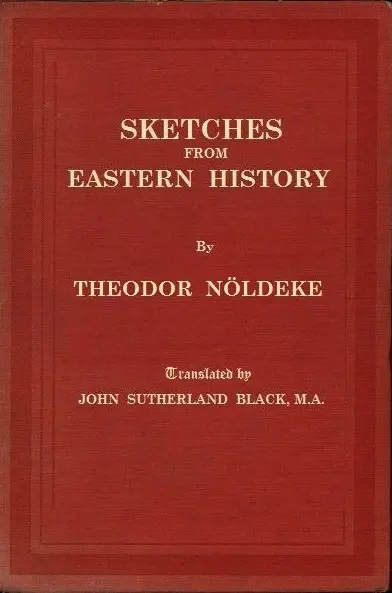
"Sketches from Eastern History" by Theodor Nöldeke is a historical account written in the late 19th century. This work provides a series of essays that explore key aspects of Eastern history, particularly focused on the Semitic races and the rise of Islam. The author, a noted orientalist, aims to provide insights into the culture, religion, and political dynamics of the region, enhancing the understanding of historical figures such as the Islamic prophet Mohammed and his works. At the start of the text, Nöldeke presents the complex task of depicting the moral and psychological characteristics of the Semitic races, acknowledging the challenges and contradictions involved. He critiques previous scholars who have portrayed these traits and outlines his intent to contribute meaningfully to the discourse. The opening engages the reader by elaborating on how geography, religion, and history have shaped the characteristics and civilizations of the Semitic peoples, and it sets the stage for a deeper examination that will unfold in subsequent chapters. Through his rigorous analysis, Nöldeke's work promises to be a valuable resource for both specialists and general readers interested in the history and influence of the Eastern world.
Introduction adapted from the source catalogue; source summaries may be automatically generated.
Free to read · English · 93,547 words · No account needed
MAKE TIME FOR A GOOD BOOK
On by default. Untick to stop anonymous reading totals. Each page counts after 10 seconds in view. How this works.
Anonymous counting is on unless you have switched it off.
Although the Omayyads produced great rulers, they failed, for various reasons, to establish an enduring empire. Their fall was inevitable when they themselves, and with them the Syrian troops on whose support they were wholly dependent, began to quarrel; and a rival family came upon the scene, that of the Abbásids. The descendants of Mohammed’s uncle Abbás, who became a convert to Islam only on the capture of Mecca, and who never had any conspicuous rôle, lived for a long time in obscurity. But now they had the wit to turn to account the powerful apparatus which the descendants of Alí had prepared for the undermining of the empire. Much was made of ambiguous expressions, such as “the right of the house of Háshim” (which included Abbás as well as Alí) and “the right of the family of the Prophet” (which might suggest his uncle quite as readily as his cousin and son-in-law); there was word also of an alleged transfer of the hereditary right by one of the descendants of Alí to the Abbásids. The chiefs of the latter family succeeded in winning over to their side a large portion of the troops in the remoter part of Eastern Persia (Khorásán), which could not be kept under firm control from Damascus. These troops consisted for the most part of Persians who had accepted Islam, but were anything but friendly to the Arabs. After severe struggles the Abbásids were victorious (750). Few members of the fallen house escaped the terrible massacre.
The triumph of the Abbásids made an end of the purely Arab, and at the same time of the purely Semitic, State; in it we see, in a great measure, a reaction of the Persian element, and a repristination of the old Asiatic world-empires, the structure of which had been at least a little more stable. It was not a mere casual circumstance that forthwith and from the first the seat of government was transferred to where it had been held successively by Achemenids, Arsacids, and Sásánians,—the plains of the lower Euphrates and Tigris. There arose the proud city of the Caliphs, Bagdad. The Abbásids paid more external respect to religion than the Omayyads had done, but they were in reality quite as worldly-minded. Over and above this, there showed itself in them a very unpleasing strain of insincerity. The first two Caliphs of the family were nevertheless very considerable men. The second in particular, Mansúr (754-775), was one of the greatest princes, one of the most unscrupulous also, that ever have guided a mighty empire. He it was who established the Mohammedan empire on a firm basis.[16] Under his grandson Hárún ar-Rashíd (786-809) the caliphate unquestionably enjoyed its period of greatest splendour, although Hárún himself was very far from being a great ruler. In his day almost all the lands from the Jaxartes and the Indus to near the Pillars of Hercules obeyed the Caliph. The Arabs had ceased to be the props of the empire, but the Arabic language had spread far and wide; it was the language of religion, of government, of poetry, and of the science that was just rising. On the banks of the Tigris there flourished a civilisation more brilliant than under the best of the Sásánians. A fair measure of quiet prevailed in most of the provinces, and thus the enormous prodigality of the court did not press upon the subjects beyond endurance. Syria and the adjoining lands found themselves in better circumstances than they had for a long time experienced. True, the administration was very defective if judged according to modern ideas; but good government in the East must be measured by a very modest standard. The Christian population had gone over to Islam en masse. The desire to stand on an equality with the conquerors in the eye of the law, and to pay diminished taxes, was, of course, a powerful motive to this; but no less strong an influence was the suitability of Islam to Oriental peasants and townsfolk of the humbler class, especially as God Himself had by the event declared Himself in its favour. The Christian Churches of the East have never been very persevering in their zeal to educate and elevate their adherents on the spiritual side; they have always attached the principal importance to the externalities of worship, confessional formulas, and the condemnation of heretics. A fact specially worthy of note is that Islam was accepted by a majority of the East-Syrian Christians even,—the Nestorians of the lands watered by the Tigris, whose ancestors could not be brought to apostasy by all the fierce persecutions of the Persian kings. In explaining this result, perhaps some weight ought to be assigned also to the consideration that, in adopting the priestless religion of Islam, the Christians got rid of the tutelage and oppression of their own clergy. Speaking generally, the civilisation of the Syrians, Copts, and other Oriental Christians lost but little by their change of faith. Islam, of course, severed many old associations that made for culture, but in compensation for these it called many new germs into life. Conversions were seldom due to direct compulsion. The pious rejoiced when Christians accepted Islam in crowds; but to the rulers these conversions were, for the most part, positively unwelcome, as the converts were thereby relieved from the heaviest of the taxes, and their change of faith thus meant a serious decrease of revenue. Nor were Christians systematically maltreated. They had indeed to suffer much repression and scorn, and to make up their minds to a position of inferiority; for, apart from the legal inferiority of non-Moslems as merely protected aliens, Islam gives to its followers a tone of haughty contempt for all outsiders.[17] Moreover, the lords, great and small, whose exactions pressed so hard even on their Moslem subjects, saw still less reason to spare unbelievers. But this is the Oriental way in everything. The different Christian Churches might keep up their controversies as before, if they chose, but they could no longer actually persecute one another. It was certainly easier for a man to live as a Christian under the rule of the Caliphs than as a Christian heretic within the Byzantine empire. The situation of the adherents of the old Persian religion in the East was similar to that of the Christians in the West, save that their legal position was not so firmly secured by unambiguous passages of the Koran. In some parts of the old Persian empire conversion to Islam on a large scale took place very early; but in others, and particularly in Persia proper, the national faith long persisted with great tenacity.
Your reading position is saved on this browser. Take it to another device with a library code. Reading pages adapt to text, rather than matching a printed edition.
BEHIND THE BOOK
This eBook is for the use of anyone anywhere in the United States and most other parts of the world at no cost and with almost no restrictions whatsoever. You may copy it, give it away or re-use it under the terms of the Project Gutenberg License included with this eBook or online at www.gutenberg.org. If you are not located in the United States, you will have to check the laws of the country where you are located before using this eBook. Read the source licence.
The original source file, including credits and licence, is retained by this library. Request an original-format copy at no charge. Please include the book title and Project Gutenberg identifier #54782.
KEEP YOUR CURIOSITY GOING
Cécile Tormay

Moritz Busch
John L. Ransom
Frances Wright
Cécile Tormay

Mabel Potter Daggett