THE CLASSIC COLLECTION✦An outlaw’s diary: the CommuneCLASSIC FREE BOOKS
An outlaw’s diary: the Commune
Cécile Tormay
THE CLASSIC COLLECTION · 1892
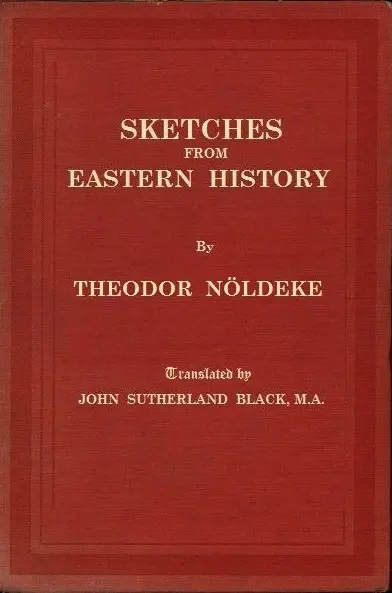
"Sketches from Eastern History" by Theodor Nöldeke is a historical account written in the late 19th century. This work provides a series of essays that explore key aspects of Eastern history, particularly focused on the Semitic races and the rise of Islam. The author, a noted orientalist, aims to provide insights into the culture, religion, and political dynamics of the region, enhancing the understanding of historical figures such as the Islamic prophet Mohammed and his works. At the start of the text, Nöldeke presents the complex task of depicting the moral and psychological characteristics of the Semitic races, acknowledging the challenges and contradictions involved. He critiques previous scholars who have portrayed these traits and outlines his intent to contribute meaningfully to the discourse. The opening engages the reader by elaborating on how geography, religion, and history have shaped the characteristics and civilizations of the Semitic peoples, and it sets the stage for a deeper examination that will unfold in subsequent chapters. Through his rigorous analysis, Nöldeke's work promises to be a valuable resource for both specialists and general readers interested in the history and influence of the Eastern world.
Introduction adapted from the source catalogue; source summaries may be automatically generated.
Free to read · English · 93,547 words · No account needed
MAKE TIME FOR A GOOD BOOK
On by default. Untick to stop anonymous reading totals. Each page counts after 10 seconds in view. How this works.
Anonymous counting is on unless you have switched it off.
In the supreme command there was no hereditary succession. Abú Bekr was, as we have seen, chosen to be Caliph by the most influential Meccan Companions of the Prophet. Abú Bekr himself had finally nominated as his successor Omar, his right-hand man, and the second most intimate friend and counsellor of the Prophet. Omar, himself the ideal of a Moslem ruler, clearly thought none of his own companions quite worthy of the command. He arranged accordingly that after his death five of the most distinguished of the old friends of Mohammed should decide as to who among themselves ought to succeed. After long deliberation they united upon Othmán. Now Othmán had been, it is true, one of the very first to acknowledge Mohammed as a prophet, and he had successively married two daughters of the latter; but he belonged to the Omayyads, one of the most prominent families of pre-Islamite Mecca, the head of which, Abú Sufyán, had for years been leader in the struggle against Mohammed and the Medinites. Preference for kinsmen is deeply seated in the blood of every genuine Arab, and the Prophet himself was not free from it. Omar, who in many respects was a more consistent exponent of Islam than Mohammed, never laid himself open to the smallest charge of nepotism, but Othmán was a weak man; he showed exorbitant favour to his relatives, and in a short time a number of the most important and profitable posts were in the hands of Omayyads—able men for the most part, but of an intensely worldly disposition. The good Othmán was not himself conscious of anything wrong in this; but many of his subjects saw the matter in another light. The righteous indignation of some strict Moslems, the tumultuary disposition of the mass of the people, and very specially also the instigations of three of the five men who had formed the electoral college after Omar’s death,—Alí, Talha, and Zubair,—as also of Aïsha, daughter of Abú Bekr, and the intriguing favourite of the Prophet, resulted in a rebellion, in which the grey-headed Othmán was put to death (17th June 656). This deed of violence was an evil precedent for many subsequent scenes of terror, the beginning of bloody civil wars, and eventual schisms. The slayers of Othmán called Alí to the caliphate; Talha and Zubair also acknowledged him, but soon broke their word, and united with Aïsha against him. Alí’s bravery was soon a match for these enemies; but already another and more formidable opponent had arisen in the person of the astute Moáwiya, son of the Abú Sufyán mentioned above, who had long been governor of Syria, and held sway there like a prince. The struggle was carried on with animosity for years. Moáwiya came forward as avenger of his kinsman Othmán. As the powerful head of the family, he was, according to old Arab ideas, well entitled, and indeed bound to do this, and Islam had not abolished this view of his duty. But, as successor of Mohammed, the son of the man who had led the heathen against him at Ohod and in the battle of the Fosse, could, of course, set up no other claim than the unconditional attachment of his troops and the superiority of his own genius. Alí also was without hereditary right, and the proclamation by Othmán’s slayers was a very doubtful title in law; but as kinsman, favourite, pupil, son-in-law of Mohammed, he might well seem better suited to represent the interests of religion than Moáwiya, who also, however, appears to have been an acceptable person with the Prophet in his declining years. The Moslems who were faithful to their convictions accordingly went over for the most part to Alí’s side, especially the Medinites, who (or their fathers) had once fought Mohammed’s battles, but were now being more and more thrust into the background by the lukewarm Moslems of Mecca. In the heat of controversy the view for the first time germinated that Alí had a divine right to the supreme power, and that even Abú Bekr, Omar, and Othmán had been usurpers. Those who hold this view are the Shíites proper, the partisans (shía) of Alí. The great majority of the Moslems, on the other hand, recognise, indeed, Alí’s right as against Moáwiya, but also hold the first three caliphs for legitimate. And, indeed, many good Moslems stood by Moáwiya in this struggle, and by other sovereigns of his family thereafter, though since the fall of the Omayyads few Moslems would justify Moáwiya’s appearance against Alí. In the disorders of this time there now arose also a new extreme radical party, who denied the right of all claimants, and awarded the command to “the best.” These people, the Kharijites (Khawárij, “dissenters”), certainly had hold of a fundamental idea of Moslem, which they developed to the utmost; they were in a certain sense in the right, but on such principles as theirs it would be impossible to establish any State, and least of all in the East. They were fanatics who sought to carry out their ideas with the wildest energy and the most desperate bravery, and to a certain extent they maintained a loyalty to conviction worthy of all admiration; but they only caused a great deal of suffering, and produced nothing. The controversy about the caliphate has long ago ceased to have any concrete bearings, but it still continues to divide the Mohammedan world. Historical tradition on the subject is very rich, but greatly coloured by party feeling. It is much too favourable to Alí, and fails to show Moáwiya quite in his full historical importance. Naturally it does not allow us to see, except dimly, that at bottom the struggles really had reference merely to the plunder, and were only the expression in another direction of the same wild warrior spirit which shortly before had gained the mastery over Persians and Romans. In the older time, however, people were sometimes able to see rather more clearly how much of human passion—very often passion of the lowest kind—was at work in these civil wars in spite of all the religious party cries. To a truly pious Moslem it must often have caused the gravest reflections to see how unworthily such persons as Talha, Zubair, Aïsha, and, essentially, Alí also had conducted themselves, while yet the Prophet had long before promised a place in heaven to them all.
Your reading position is saved on this browser. Take it to another device with a library code. Reading pages adapt to text, rather than matching a printed edition.
BEHIND THE BOOK
This eBook is for the use of anyone anywhere in the United States and most other parts of the world at no cost and with almost no restrictions whatsoever. You may copy it, give it away or re-use it under the terms of the Project Gutenberg License included with this eBook or online at www.gutenberg.org. If you are not located in the United States, you will have to check the laws of the country where you are located before using this eBook. Read the source licence.
The original source file, including credits and licence, is retained by this library. Request an original-format copy at no charge. Please include the book title and Project Gutenberg identifier #54782.
KEEP YOUR CURIOSITY GOING
Cécile Tormay

Moritz Busch
John L. Ransom
Frances Wright
Cécile Tormay

Mabel Potter Daggett