THE CLASSIC COLLECTION✦An outlaw’s diary: the CommuneCLASSIC FREE BOOKS
An outlaw’s diary: the Commune
Cécile Tormay
THE CLASSIC COLLECTION · 1892
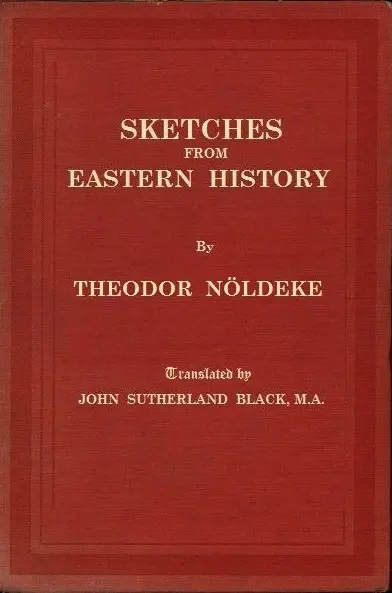
"Sketches from Eastern History" by Theodor Nöldeke is a historical account written in the late 19th century. This work provides a series of essays that explore key aspects of Eastern history, particularly focused on the Semitic races and the rise of Islam. The author, a noted orientalist, aims to provide insights into the culture, religion, and political dynamics of the region, enhancing the understanding of historical figures such as the Islamic prophet Mohammed and his works. At the start of the text, Nöldeke presents the complex task of depicting the moral and psychological characteristics of the Semitic races, acknowledging the challenges and contradictions involved. He critiques previous scholars who have portrayed these traits and outlines his intent to contribute meaningfully to the discourse. The opening engages the reader by elaborating on how geography, religion, and history have shaped the characteristics and civilizations of the Semitic peoples, and it sets the stage for a deeper examination that will unfold in subsequent chapters. Through his rigorous analysis, Nöldeke's work promises to be a valuable resource for both specialists and general readers interested in the history and influence of the Eastern world.
Introduction adapted from the source catalogue; source summaries may be automatically generated.
Free to read · English · 93,547 words · No account needed
MAKE TIME FOR A GOOD BOOK
On by default. Untick to stop anonymous reading totals. Each page counts after 10 seconds in view. How this works.
Anonymous counting is on unless you have switched it off.
After Mohammed’s death (8th June 632) the most prominent of his companions united to elect as his successor Abú Bekr, who had been his most trusted friend. At first, indeed, it had cost some trouble to get the Medinites, the old “helpers” of Mohammed, off the idea that one of themselves ought to become the leader. But no attention was paid to the sulking of Alí, whose wife, Fátima, was the only surviving child of his cousin Mohammed. There was no doubt that the choice of Abú Bekr was what the Prophet himself would have desired. But hardly had the Arabs heard of Mohammed’s death when they rebelled en masse. Many renounced Islam entirely; many attached themselves to new prophets who arose here and there after the pattern of the Prophet of Mecca; others were willing to retain Moslem prayer indeed, but not to pay taxes; in a word, Mohammed’s whole work was brought into question. Then it was that the strength of Islam, and of a firm will, was shown. Abú Bekr, assured as he was in his own faith, scorned, even in the hour of most pressing need, to make any concession whatever to the insurgents; he insisted on absolute submission to the commands of Islam. The insurrections, which were unconnected with each other, were for the most part easily quelled by the Moslems, led as they were by a single will; but in some instances torrents of blood had first to be shed. The military merit of these deeds belongs chiefly to Khálid, “the sword of God,” a man of Koraish, like almost all the prominent warriors and statesmen of that time, the same who nine years before had turned the battle in favour of the unbelieving Meccans against Mohammed at Mount Ohod.
As soon as all Arabia had been again brought into subjection, the great wars of conquest began. It was certainly good policy to turn the recently subdued tribes of the wilderness towards an external aim in which they might at once satisfy their lust for booty on a grand scale, maintain their warlike feeling, and strengthen themselves in their attachment to the new faith. But I do not believe those undertakings to have been mainly the result of cool political calculation. Mohammed himself had already sent expeditions across the Roman frontier, and thereby had pointed out the way to his successors. To follow in his footsteps was in accordance with the innermost being of the youthful Islam, already grown great amid the tumult of arms. The Bedouins knew uncommonly little Koran, but on such children of nature it is success that makes the deepest impression. That faith which had subdued themselves, and which was now leading them on to victory and plunder, must be true; very soon there was no one to doubt this. Though the nomads among the Arabs have naturally few religious needs, they yet possess as the purest of all Semites a deeply-seated religious disposition; and this simple religion, which corresponded to their inclinations and flattered their self-esteem, soon took entire possession of them. Under the sagacious, clear-headed, and strong-handed Omar (634-644), the fresh force of the new faith, and the warlike disposition of the Arab people, now united for the first time, and led by great generals, speedily achieved successes against the Romans and the Persians of which Mohammed had never so much as dreamed. This astonishing overturn is, when all has been said, not easy of explanation. It is indeed true that both empires were in a state of decay. Both were at the moment terribly weakened by the wars they had waged with each other during the first three decades of the century. The Persian empire, which had finally been vanquished after long years of victory, had, moreover, been shaken both before and after the conclusion of the peace by bloody struggles about the succession to the throne. On the other hand, both Byzantium and Persia had at their command genuine soldiers regularly armed and disciplined. The traditions of Roman warfare were not yet entirely lost, and the Persians still possessed their dreaded cuirassiers, before whom, in better times, even the armies of Rome had often fled. The reduction of the fortified towns must in any case have been at least as severe a task to the Arabs as it was to the Goths and Huns, who were by nature much more warlike peoples. Moreover, Persia, when the chief attack upon its territory was made, happened to have come once more under the rule of a firm hand. Its king, indeed, Yezdegerd III., was a boy; but the royal power and the command of the army were held by a man of energy and bravery—Rustem, the head of one of the first princely houses of the empire. Yet these wretchedly armed Arabs, fighting, not in regularly organised military divisions, but by families and clans, and under leaders who never before had faced disciplined troops, after long struggle overcame Rustem and his mighty hosts (636); soon afterwards took the fortified capital, Ctesiphon (637); and, a few years later, by the decisive battle of Neháwend (640, 641, or 642), brought the empire itself to the ground. How was such a thing possible? The Arabs’ own explanation indeed was very simple: “God took away the courage of the uncircumcised;” “God smote the Persians;” “God slew Rustem.” In such words, so thoroughly like those of the Old Testament, we can only recognise how great a force lies in the rudest religious conviction. Almost more marvellous are the conquests they gained on Roman territory. The emperor Heraclius was certainly the greatest man who had held the empire since Constantine and Julian. He was an astute diplomatist, a very competent general, and, as a soldier, bold even to rashness. How could it come about that he of all men was compelled to yield up to the sons of the desert the territories he had wrested back from the Persians? We certainly are aware of one or two circumstances which made their conquests easier to the Arabs. Most of the inhabitants of Syria, and almost all the Egyptians, were Monophysite heretics, and as such had experienced great oppression at the hands of the Orthodox Byzantines; they accordingly aided and abetted the Arabs as occasion offered, especially as they might promise themselves some relief of the burden of taxation through the latter. The Syrian Nestorians also, who formed the majority of the inhabitants of the richest lands of the Persian empire (those on the Tigris and on the lower Euphrates), we may believe to have been more favourably inclined to the Arabs than to the Persians. But in connection with conquests like these, much weight is hardly to be assigned to the sympathies and antipathies of unwarlike peasants and townsmen. More important, perhaps, is the circumstance that the numerous Arab tribes, which had been subject to the Roman and Persian rule although for the most part nominally Christian, appear to have gone over to the Moslems almost unanimously soon after the first victories. It would be possible to multiply explanations still further, yet the phenomenon continues mysterious as before. Rhetorical expressions about the decaying condition of both empires, and the youthful energy of the Moslems, are unsatisfying to the inquirer who keeps the concrete facts before him.
Your reading position is saved on this browser. Take it to another device with a library code. Reading pages adapt to text, rather than matching a printed edition.
BEHIND THE BOOK
This eBook is for the use of anyone anywhere in the United States and most other parts of the world at no cost and with almost no restrictions whatsoever. You may copy it, give it away or re-use it under the terms of the Project Gutenberg License included with this eBook or online at www.gutenberg.org. If you are not located in the United States, you will have to check the laws of the country where you are located before using this eBook. Read the source licence.
The original source file, including credits and licence, is retained by this library. Request an original-format copy at no charge. Please include the book title and Project Gutenberg identifier #54782.
KEEP YOUR CURIOSITY GOING
Cécile Tormay

Moritz Busch
John L. Ransom
Frances Wright
Cécile Tormay

Mabel Potter Daggett