THE CLASSIC COLLECTION✦An outlaw’s diary: the CommuneCLASSIC FREE BOOKS
An outlaw’s diary: the Commune
Cécile Tormay
THE CLASSIC COLLECTION · 1892
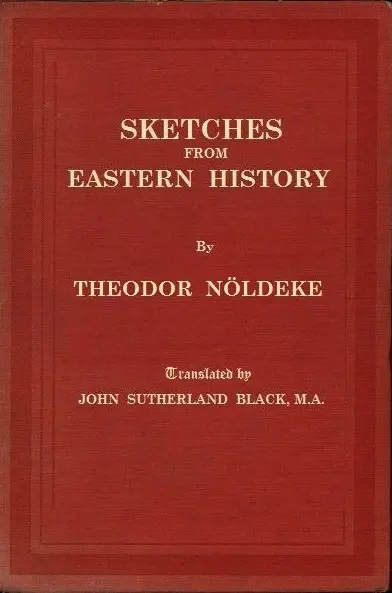
"Sketches from Eastern History" by Theodor Nöldeke is a historical account written in the late 19th century. This work provides a series of essays that explore key aspects of Eastern history, particularly focused on the Semitic races and the rise of Islam. The author, a noted orientalist, aims to provide insights into the culture, religion, and political dynamics of the region, enhancing the understanding of historical figures such as the Islamic prophet Mohammed and his works. At the start of the text, Nöldeke presents the complex task of depicting the moral and psychological characteristics of the Semitic races, acknowledging the challenges and contradictions involved. He critiques previous scholars who have portrayed these traits and outlines his intent to contribute meaningfully to the discourse. The opening engages the reader by elaborating on how geography, religion, and history have shaped the characteristics and civilizations of the Semitic peoples, and it sets the stage for a deeper examination that will unfold in subsequent chapters. Through his rigorous analysis, Nöldeke's work promises to be a valuable resource for both specialists and general readers interested in the history and influence of the Eastern world.
Introduction adapted from the source catalogue; source summaries may be automatically generated.
Free to read · English · 93,547 words · No account needed
MAKE TIME FOR A GOOD BOOK
On by default. Untick to stop anonymous reading totals. Each page counts after 10 seconds in view. How this works.
Anonymous counting is on unless you have switched it off.
On the whole, while many parts of the Koran undoubtedly have considerable rhetorical power, even over an unbelieving reader, the book, æsthetically considered, is by no means a first-rate performance. To begin with what we are most competent to criticise, let us look at some of the more extended narratives. It has already been noticed how vehement and abrupt they are where they ought to be characterised by epic repose. Indispensable links, both in expression and in the sequence of events, are often omitted, so that to understand these histories is sometimes far easier for us than for those who heard them first, because we know most of them from better sources. Along with this, there is a great deal of superfluous verbiage; and nowhere do we find a steady advance in the narration. Contrast, in these respects, “the most beautiful tale,” the history of Joseph (xii.), and its glaring improprieties, with the story in Genesis, so admirably conceived and so admirably executed in spite of some slight discrepancies. Similar faults are found in the non-narrative portions of the Koran. The connection of ideas is extremely loose, and even the syntax betrays great awkwardness. Anacolutha are of frequent occurrence, and cannot be explained as conscious literary devices. Many sentences begin with a “when” or “on the day when,” which seems to hover in the air, so that the commentators are driven to supply a “think of this” or some such ellipsis. Again, there is no great literary skill evinced in the frequent and needless harping on the same words and phrases; in xviii., for example, “till that” (hattá idhá) occurs no fewer than eight times. Mohammed, in short, is not in any sense a master of style. This opinion will be endorsed by any European who reads through the book with an impartial spirit and some knowledge of the language, without taking into account the tiresome effect of its endless iterations. But in the ears of every pious Moslem such a judgment will sound almost as shocking as downright atheism or polytheism. Among the Moslems, the Koran has always been looked on as the most perfect model of style and language. This feature of it is in their dogmatic the greatest of all miracles, the incontestable proof of its divine origin. Such a view on the part of men who knew Arabic infinitely better than the most accomplished European Arabist will ever do, may well startle us. In fact, the Koran boldly challenged its opponents to produce ten súras, or even a single one, like those of the sacred book, and they never did so. That, to be sure, on calm reflection, is not so very surprising. Revelations of the kind which Mohammed uttered, no unbeliever could produce without making himself a laughing-stock. However little real originality there is in Mohammed’s doctrines, as against his own countrymen he was thoroughly original, even in the form of his oracles. To compose such revelations at will was beyond the power of the most expert literary artist; it would have required either a prophet or a shameless impostor. And if such a character appeared after Mohammed, still he could never be anything but an imitator, like the false prophets who arose about the time of his death and afterwards. That the adversaries should produce any sample whatsoever of poetry or rhetoric equal to the Koran is not at all what the Prophet demands. In that case he would have been put to shame, even in the eyes of many of his own followers, by the first poem that came to hand. Nevertheless, it is on such a false interpretation of this challenge that the dogma of the incomparable excellence of the style and diction of the Koran is based. The rest has been accomplished by dogmatic prejudice, which is quite capable of working other miracles besides turning a defective literary production into an unrivalled masterpiece in the eyes of believers. This view once accepted, the next step was to find everywhere evidence of the perfection of the style and language. And if here and there, as one can scarcely doubt, there was among the old Moslems a lover of poetry who had his difficulties about this dogma, he had to beware of uttering an opinion which might have cost him his head. We know of at least one rationalistic theologian who defined the dogma in such a way that we can see he did not believe it (Shahrastání, p. 39). The truth is, it would have been a miracle indeed if the style of the Koran had been perfect. For although there was at that time a recognised poetical style, already degenerating to mannerism, a prose style did not exist. All beginnings are difficult; and it can never be esteemed a serious charge against Mohammed that his book, the first prose work of a high order in the language, testifies to the awkwardness of the beginner. And further, we must always remember that entertainment and æsthetic effect were at most subsidiary objects. The great aim was persuasion and conversion; and, say what we will, that aim has been realised on the most imposing scale.
Your reading position is saved on this browser. Take it to another device with a library code. Reading pages adapt to text, rather than matching a printed edition.
BEHIND THE BOOK
This eBook is for the use of anyone anywhere in the United States and most other parts of the world at no cost and with almost no restrictions whatsoever. You may copy it, give it away or re-use it under the terms of the Project Gutenberg License included with this eBook or online at www.gutenberg.org. If you are not located in the United States, you will have to check the laws of the country where you are located before using this eBook. Read the source licence.
The original source file, including credits and licence, is retained by this library. Request an original-format copy at no charge. Please include the book title and Project Gutenberg identifier #54782.
KEEP YOUR CURIOSITY GOING
Cécile Tormay

Moritz Busch
John L. Ransom
Frances Wright
Cécile Tormay

Mabel Potter Daggett