THE CLASSIC COLLECTION✦An outlaw’s diary: the CommuneCLASSIC FREE BOOKS
An outlaw’s diary: the Commune
Cécile Tormay
THE CLASSIC COLLECTION · 1892
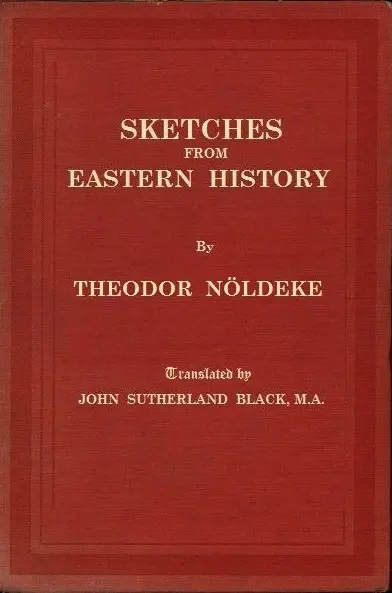
"Sketches from Eastern History" by Theodor Nöldeke is a historical account written in the late 19th century. This work provides a series of essays that explore key aspects of Eastern history, particularly focused on the Semitic races and the rise of Islam. The author, a noted orientalist, aims to provide insights into the culture, religion, and political dynamics of the region, enhancing the understanding of historical figures such as the Islamic prophet Mohammed and his works. At the start of the text, Nöldeke presents the complex task of depicting the moral and psychological characteristics of the Semitic races, acknowledging the challenges and contradictions involved. He critiques previous scholars who have portrayed these traits and outlines his intent to contribute meaningfully to the discourse. The opening engages the reader by elaborating on how geography, religion, and history have shaped the characteristics and civilizations of the Semitic peoples, and it sets the stage for a deeper examination that will unfold in subsequent chapters. Through his rigorous analysis, Nöldeke's work promises to be a valuable resource for both specialists and general readers interested in the history and influence of the Eastern world.
Introduction adapted from the source catalogue; source summaries may be automatically generated.
Free to read · English · 93,547 words · No account needed
MAKE TIME FOR A GOOD BOOK
On by default. Untick to stop anonymous reading totals. Each page counts after 10 seconds in view. How this works.
Anonymous counting is on unless you have switched it off.
It is no more true of Theodore than of any other extraordinary man, that his whole character was suddenly transformed. All his faults showed themselves at an early period, some of them in a very marked way; but in late years his bad qualities became more and more prominent, and overgrew his better nature. Terunesh, the proud daughter of the aged Ubié, whom he married some five years after the death of the beloved Tewabetch, was unable to hold his affections; and with the full consciousness that he was doing wrong he abandoned himself to the usual polygamy of the native princes. Like most of the Abyssinian grandees, he had always been a heavy drinker; but in his last years, contrary to his earlier practice, he often got drunk, and when in this condition gave orders of the most bloody description, which he afterwards bitterly repented. But this man, who sometimes in anger or drunkenness, sometimes with the clear conscience of a ruler or judge sacrificing to the public weal or to the cause of righteousness, butchered thousands of people, and burned churches and cities to the ground—this very man played in the most genial way with little children, in his expeditions was scrupulously careful that the women and children, numbers of whom always accompany an Abyssinian army, should come to no harm, and was ready to assist personally the exhausted soldier who had fallen out of the ranks.
It would serve no purpose to go into details of the embroilment with England in which Theodore ultimately met his death. It was a singular combination of unfortunate circumstances, misunderstandings, blunders, and crimes. Consul Cameron, a man worthy of all respect, was not acquainted with Abyssinia and Theodore as Plowden, his predecessor, had been, neither does he seem to have been a persona grata to the king. In the letter of which he was the bearer (October 1862), Earl Russell thanked Theodore courteously and coldly for his treatment of Plowden, when the king felt entitled to expect a direct communication from the sovereign as between equals. Theodore lost no time in expressing to Cameron the hatred he felt against his hereditary enemies, the Turks. But Cameron had instructions to enter into communication with the Egyptian authorities, and this presently made him hateful to Theodore. The king himself, the servant of Christ, had refused all friendly agreement with the unbelieving Egyptians, although the Viceroy Saíd Pasha had taken much pains in this direction, and it was incomprehensible to him how Christian Europe could hold alliance with Turks, or leave them in possession of lands formerly Christian. We smile at his narrowness; but how long is it since similar views prevailed all over Europe? And did not Russia in her last Eastern war succeed in reviving in Europe, and especially in England, the antipathy of Christians against the unchristian Turks, and in making it serve her own policy of conquest? It was inexcusable that Theodore’s letter to the Queen, delivered to the consul, received no answer; the neglect was felt profoundly. Incautious oral, written, or printed utterances of Europeans, communicated idly or in malice, further embittered him. He was well aware that Europeans were his superiors in civilisation; but he had a just sense of his personal dignity, and it stung him to the quick to hear that he was spoken of as a savage. What irritated him above all was to learn that his mother, on whom he rested his claim as a legitimate sovereign, had been spoken of as a kousso-seller.[122] The Jewish missionary Stern made himself particularly obnoxious by utterances of this kind. Theodore had never conceded to the foreign consuls the privilege of inviolability, which is quite unknown to the Abyssinians. He claimed for himself a perfect right to treat discourteous guests exactly as he would treat his own subjects. Thus in 1863 he put in irons the French consul Lejean who had offended him, and afterwards expelled him. In like manner, in January 1864, he put consul Cameron in irons. The other Europeans also, who were under his control, were either imprisoned or kept under prison surveillance. These were for the most part Germans, some of them missionaries, others of them artisans, who had been sent into Abyssinia in the missionary interest, but had been employed by Theodore in cannon-founding and other works not of a particularly evangelistic character; there were, besides, a few travellers and adventurers of various descriptions. Most of them seem to have been worthy persons.
Your reading position is saved on this browser. Take it to another device with a library code. Reading pages adapt to text, rather than matching a printed edition.
BEHIND THE BOOK
This eBook is for the use of anyone anywhere in the United States and most other parts of the world at no cost and with almost no restrictions whatsoever. You may copy it, give it away or re-use it under the terms of the Project Gutenberg License included with this eBook or online at www.gutenberg.org. If you are not located in the United States, you will have to check the laws of the country where you are located before using this eBook. Read the source licence.
The original source file, including credits and licence, is retained by this library. Request an original-format copy at no charge. Please include the book title and Project Gutenberg identifier #54782.
KEEP YOUR CURIOSITY GOING
Cécile Tormay

Moritz Busch
John L. Ransom
Frances Wright
Cécile Tormay

Mabel Potter Daggett