THE CLASSIC COLLECTION✦An outlaw’s diary: the CommuneCLASSIC FREE BOOKS
An outlaw’s diary: the Commune
Cécile Tormay
THE CLASSIC COLLECTION · 1892
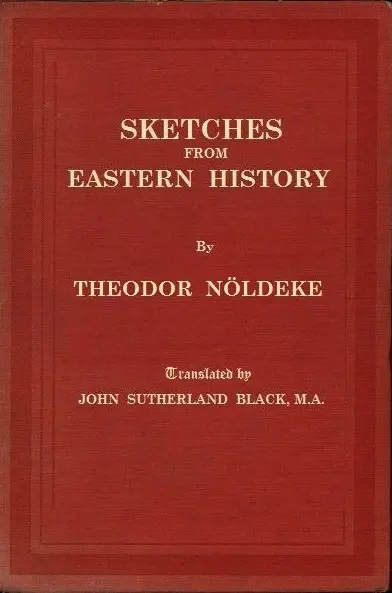
"Sketches from Eastern History" by Theodor Nöldeke is a historical account written in the late 19th century. This work provides a series of essays that explore key aspects of Eastern history, particularly focused on the Semitic races and the rise of Islam. The author, a noted orientalist, aims to provide insights into the culture, religion, and political dynamics of the region, enhancing the understanding of historical figures such as the Islamic prophet Mohammed and his works. At the start of the text, Nöldeke presents the complex task of depicting the moral and psychological characteristics of the Semitic races, acknowledging the challenges and contradictions involved. He critiques previous scholars who have portrayed these traits and outlines his intent to contribute meaningfully to the discourse. The opening engages the reader by elaborating on how geography, religion, and history have shaped the characteristics and civilizations of the Semitic peoples, and it sets the stage for a deeper examination that will unfold in subsequent chapters. Through his rigorous analysis, Nöldeke's work promises to be a valuable resource for both specialists and general readers interested in the history and influence of the Eastern world.
Introduction adapted from the source catalogue; source summaries may be automatically generated.
Free to read · English · 93,547 words · No account needed
MAKE TIME FOR A GOOD BOOK
On by default. Untick to stop anonymous reading totals. Each page counts after 10 seconds in view. How this works.
Anonymous counting is on unless you have switched it off.
Meanwhile arose, now in one province, now in another, various rebels, some of them members of old princely families, sometimes bold soldiers of fortune. None of them was at all a match for him. Wherever he made his appearance the armies of the insurgents were scattered like dust. By force or by artifice he succeeded in getting several of them into his power, and among them one who, as it seemed, was the most formidable of all—Negusié of Tigré (beginning of 1861), with whom France had already entered into relations as “King of Abyssinia.” Others took refuge in inaccessible deserts, or in steep rocky fastnesses, of which so many are found in Abyssinia. Had he not been hampered by the Wollos, he would doubtless have got the better of them all; but his war of extermination against these savages crippled him completely. He found no exceptional difficulty indeed in recruiting his armies, decimated though they were by the sword, and still more by periodical pestilence; for Abyssinia has no lack of men with a taste for war and plunder, and Theodore’s name acted like a charm. The very size of his armies was his misfortune. He could not feed them in any regular way. Though at the outset he strictly repressed all plundering in friendly districts, he soon had to concede everything to his hungry soldiers, and even to order the systematic robbery of prosperous regions. In this way the veneration of his people was turned into hatred; the poverty-stricken peasants went to swell the ranks of the rebels, or, at least, robbed and murdered in secret.
Theodore’s embarrassments were further increased by his relations with the ecclesiastical authorities. At the head of the Abyssinian Church, a branch of the Coptic (the whole civilisation of Abyssinia, so far as it is Christian, is derived from the impure Coptic source), stands a bishop, who must be, not a native, but a Copt, sent by the (Monophysite) patriarch of Alexandria. This “Abuna,” in power and consideration, stands almost on a level with the king, has much larger revenues, and is reverenced by the masses as a god. Since November 1841 this position had been occupied by Abba Selama, mentioned above, a man of about the same age as Kasa-Theodore. Having as a child attended an English mission school, many English and German Protestants cherished great hopes regarding him; but other Europeans who happened to be in Abyssinia at the time of his arrival there,—Ferret and Galinier (French), and Mansfield Parkins (English),—who had no ecclesiastical preoccupations, at once perceived him to be an insignificant, narrow-minded individual. Nowhere, moreover, could a prelate, with any serious inclination to reformation, have a more difficult position than in the wretched Church of Abyssinia: to make any progress with the laity would be difficult; with the priesthood, impossible. As Abba Selama at the outset had the immeasurable advantage over the natives of a somewhat higher education and a much greater knowledge of the world, he ought certainly to have been able, in conjunction with such a man as Theodore, to improve many things, had he shown intelligence and adaptability. But he cared for nothing except his own spiritual independence. The king was very amenable to good advice, and had also laid him under special obligations by forcibly repressing a large party of the priests that for dogmatic reasons was hostile to him; but instead of exercising a moderating influence upon him, the prelate soon brought matters to a complete breach. When the German missionary Krapf met the king in the heyday of his victorious career, in the spring of 1855, he still appeared to be in heart and soul at one with the Abuna; but any one who is acquainted with the quarrels that subsequently arose can mark the root of them in the jealous temper which the language of the bishop, reported by Krapf, even then revealed. Soon afterwards a mutiny broke out in the army in Shoa, which to all appearance had been stirred up by the Abuna and the second spiritual authority in the kingdom, the supreme head of the monks. This was repressed without leading to an open conflict with the clerics. But soon a worse controversy arose. The king began to lay hands on the vast revenues of the Church to meet the demands of his army,—a measure certainly contrary to every usage of the country, and dictated only by sheerest necessity. Further, he required the priests to uncover in his presence (he being filled with the Spirit of God), just as they uncovered in presence of the ark (or altar), which was the Seat of God. In these controversies the king had to give way at first, but soon it went hard with the clergy. The biographer, though as respectful in his feeling towards the bishop as towards the king, accumulates all sorts of details fitted to make plain the contempt and hatred which Theodore gradually and increasingly came to feel towards the haughty head of the Church and the entire clergy. Even the supreme head of that Church, the patriarch of Alexandria, on one occasion when he visited Abyssinia, had seriously compromised himself in the king’s eyes. Moreover, the Abuna appears to have been far from exemplary in his private life. Theodore, accordingly, in the course of time, broke loose from all clerical restraints. In his later years he deliberately set fire to sacred buildings, burned down the town of Gondar precisely because it was “the city of the priests,” threw the Abuna into prison, and finally even, on his own authority, issued to himself and his soldiers a dispensation from fasting, perhaps the most important duty of Abyssinian Christianity; and all this the priesthood had silently to endure. On the other hand, of course, their hatred helped to alienate the people from the king, and the Abuna in his prison maintained close relations with the more important rebels.
Your reading position is saved on this browser. Take it to another device with a library code. Reading pages adapt to text, rather than matching a printed edition.
BEHIND THE BOOK
This eBook is for the use of anyone anywhere in the United States and most other parts of the world at no cost and with almost no restrictions whatsoever. You may copy it, give it away or re-use it under the terms of the Project Gutenberg License included with this eBook or online at www.gutenberg.org. If you are not located in the United States, you will have to check the laws of the country where you are located before using this eBook. Read the source licence.
The original source file, including credits and licence, is retained by this library. Request an original-format copy at no charge. Please include the book title and Project Gutenberg identifier #54782.
KEEP YOUR CURIOSITY GOING
Cécile Tormay

Moritz Busch
John L. Ransom
Frances Wright
Cécile Tormay

Mabel Potter Daggett