THE CLASSIC COLLECTION✦An outlaw’s diary: the CommuneCLASSIC FREE BOOKS
An outlaw’s diary: the Commune
Cécile Tormay
THE CLASSIC COLLECTION · 1892
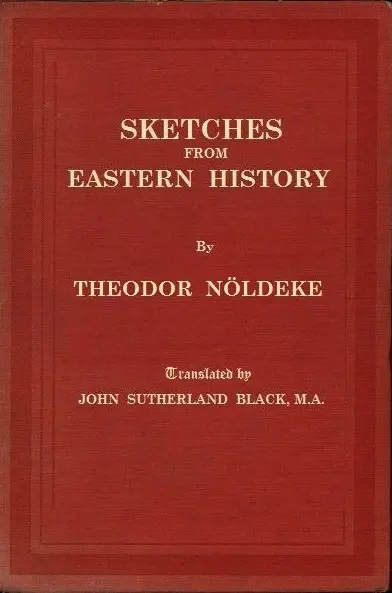
"Sketches from Eastern History" by Theodor Nöldeke is a historical account written in the late 19th century. This work provides a series of essays that explore key aspects of Eastern history, particularly focused on the Semitic races and the rise of Islam. The author, a noted orientalist, aims to provide insights into the culture, religion, and political dynamics of the region, enhancing the understanding of historical figures such as the Islamic prophet Mohammed and his works. At the start of the text, Nöldeke presents the complex task of depicting the moral and psychological characteristics of the Semitic races, acknowledging the challenges and contradictions involved. He critiques previous scholars who have portrayed these traits and outlines his intent to contribute meaningfully to the discourse. The opening engages the reader by elaborating on how geography, religion, and history have shaped the characteristics and civilizations of the Semitic peoples, and it sets the stage for a deeper examination that will unfold in subsequent chapters. Through his rigorous analysis, Nöldeke's work promises to be a valuable resource for both specialists and general readers interested in the history and influence of the Eastern world.
Introduction adapted from the source catalogue; source summaries may be automatically generated.
Free to read · English · 93,547 words · No account needed
MAKE TIME FOR A GOOD BOOK
On by default. Untick to stop anonymous reading totals. Each page counts after 10 seconds in view. How this works.
Anonymous counting is on unless you have switched it off.
Aaron and his family after this removed to Antioch, which was still in the hands of the Franks. Here his son became a monk, doubtless with a view to the episcopal dignity, the higher ecclesiastical charges being in the Oriental Churches accessible only to monks. Soon afterwards we find Barhebræus in Tripoli, also still in the hands of the Crusaders. Along with a companion[105] he here studied dialectic and medicine under a Nestorian. This may have had something to do with the tolerance which he afterwards showed towards Christians of different creed, though indeed it was not unusual for a Syrian to frequent the lectures of a man whose doctrine he regarded as heretical. Barhebræus probably had Moslem teachers also, for he could hardly otherwise have acquired his good knowledge of the Arabic language and literature. He wrote Arabic almost as fluently as Syriac, and not much more incorrectly than most Mohammedan writers of his time. He could also make use of Persian books without difficulty, at least in his later years. He spoke Arabic well, of course; and presumably he had acquired a colloquial knowledge of Turkish also. But he seems never to have been brought into close relations with the Franks.
Talented and industrious, he must very soon have attracted the notice of the ecclesiastical authorities, and while still a youth of only twenty he was ordained by the Jacobite patriarch (12th September 1246) to be Bishop of Gubos, near Melatia, on which occasion he assumed the ecclesiastical name of Gregory. Not long afterwards he exchanged this bishopric for that of Lakabín, in the same region.[106]
As bishop he took part in the synod held at the monastery of Barsaumá, after the death of Ignatius (14th June 1252), for the election of a new patriarch. At this juncture there arrived in the neighbourhood of Melatia a body of Mongols, a detachment of the great hordes which in those years made an end of the caliphate, and devastated on all hands with fire and sword. Barhebræus’s aged father, who had again returned to his home, fled with his little son Barsaumá from the village of Margá to a rocky region beside the Euphrates, and remained there in hiding for six weeks, until the barbarians had gone. The world was trembling in its courses, but this made little impression on the Jacobite dignitaries; they went on intriguing and quarrelling just as usual. Dionysius of Melatia, who has been already mentioned, and John, surnamed Barmadeni, the maphrián or primate of the eastward dioceses,[107] a man of high repute as a scholar, were competitors for the patriarchate. By the laws of that Church no valid election could take place without the presence of the maphrián; but Dionysius procured his own election in September 1252 in defiance of this rule, and in a very thinly attended synod. The youthful Barhebræus was sent into Mesopotamia to convey to John the apologies of the synod, and to beg his concurrence. But John had meantime gone to Aleppo, where, on 4th December of the same year, he got himself chosen to the patriarchate,—an election which certainly has a greater apparent claim to validity than the other. But the all-important question was as to which patriarch the Moslem rulers would recognise. There began accordingly a scandalous competition between the rivals (not a rare occurrence in the Eastern Churches). On both sides the effort was made to gain over princes and potentates, as well as individual bishops and other ecclesiastics of influence, by money or fair words. Along with his nephew, a monk, Barhebræus was sent into the mountains of Túr Abdín, in northern Mesopotamia, which were mostly inhabited by Jacobites, to collect funds in the monasteries and villages for gaining over to Dionysius the local prince, to whom John had promised a sum of money for recognition, but had as yet failed to pay it. The mission was successful. It is well worth noticing, though not very edifying, to see how coolly Barhebræus, certainly one of the most respectable persons of his class, relates these transactions. It must be remembered that the laity, from whom the money was drawn, were for the most part exceedingly poor; bright prospects of a reward in heaven[108] were, to be sure, held out to them by way of compensation, and all the proceedings were carried on in the most approved Christian phraseology. The Eastern Churches were, of course, unable to secure immunity from the caprice and violence of the Moslem authorities without a skilful use of the mammon of unrighteousness, but it is a very different matter when the faithful are taxed that one of their own spiritual heads may be able to secure an effectual triumph over another. Occurrences of the kind have not been wholly unknown in the West, but the abuse attained far larger proportions in the East.
Your reading position is saved on this browser. Take it to another device with a library code. Reading pages adapt to text, rather than matching a printed edition.
BEHIND THE BOOK
This eBook is for the use of anyone anywhere in the United States and most other parts of the world at no cost and with almost no restrictions whatsoever. You may copy it, give it away or re-use it under the terms of the Project Gutenberg License included with this eBook or online at www.gutenberg.org. If you are not located in the United States, you will have to check the laws of the country where you are located before using this eBook. Read the source licence.
The original source file, including credits and licence, is retained by this library. Request an original-format copy at no charge. Please include the book title and Project Gutenberg identifier #54782.
KEEP YOUR CURIOSITY GOING
Cécile Tormay

Moritz Busch
John L. Ransom
Frances Wright
Cécile Tormay

Mabel Potter Daggett