THE CLASSIC COLLECTION✦An outlaw’s diary: the CommuneCLASSIC FREE BOOKS
An outlaw’s diary: the Commune
Cécile Tormay
THE CLASSIC COLLECTION · 1892
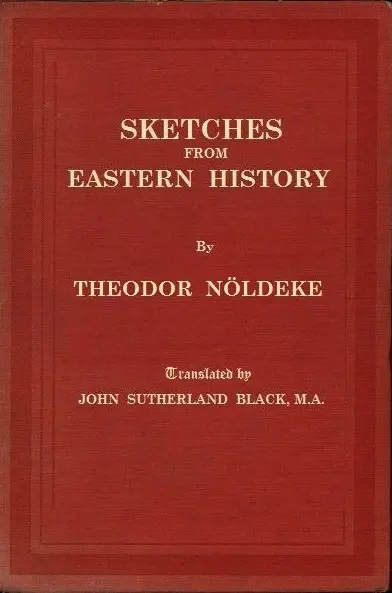
"Sketches from Eastern History" by Theodor Nöldeke is a historical account written in the late 19th century. This work provides a series of essays that explore key aspects of Eastern history, particularly focused on the Semitic races and the rise of Islam. The author, a noted orientalist, aims to provide insights into the culture, religion, and political dynamics of the region, enhancing the understanding of historical figures such as the Islamic prophet Mohammed and his works. At the start of the text, Nöldeke presents the complex task of depicting the moral and psychological characteristics of the Semitic races, acknowledging the challenges and contradictions involved. He critiques previous scholars who have portrayed these traits and outlines his intent to contribute meaningfully to the discourse. The opening engages the reader by elaborating on how geography, religion, and history have shaped the characteristics and civilizations of the Semitic peoples, and it sets the stage for a deeper examination that will unfold in subsequent chapters. Through his rigorous analysis, Nöldeke's work promises to be a valuable resource for both specialists and general readers interested in the history and influence of the Eastern world.
Introduction adapted from the source catalogue; source summaries may be automatically generated.
Free to read · English · 93,547 words · No account needed
MAKE TIME FOR A GOOD BOOK
On by default. Untick to stop anonymous reading totals. Each page counts after 10 seconds in view. How this works.
Anonymous counting is on unless you have switched it off.
In religion the one-sidedness of the Semitic mind was a creative power; but it was highly prejudicial to the development of science. A keen eye for particulars, a sobriety of apprehension (justly dwelt on by Chwolson), are undoubtedly talents of great service in the beginnings of science. Accordingly we find at a comparatively early period amongst Hebrews and Arabs an intelligent system of chronicles such as was never attained by (let us say) the dreamy Hindoos; and from the firm lapidary style in which king Mesha recounts his exploits we can infer that in his time (about 900 B.C.) some beginnings of historic narrative existed even in that remote land. But, as already remarked, the Semite is deficient in the power of taking a general view, in the gift of comprehensive intelligence, of large and, at the same time, logical thought, and therefore, speaking generally, he has only in a few cases contributed anything of importance to science. The ideas of monotheism and of a creation are by no means products of philosophical reflection; the naïve intelligence of the Israelite has not the faintest suspicion of the enormous difficulties which the assumption of a creation out of nothing presents to the reflecting mind; to him the proposition is self-evident. The speculation of the Arabs on the freedom of the will and similar subjects, continued to be very unsystematic and unscientific as long as it was only superficially affected by Greek thought. And even after they had been trained by Greek philosophy, the Arabs, so far as I am able to judge from what I freely confess to be a very limited knowledge, produced little that was new in this field. On the whole, it becomes increasingly apparent that the Syrians and Arabs, whatever their merit in keeping up and handing on the sciences of the Greeks, were not very fruitful in their own cultivation of these, though it must be admitted that the Arabs at least made advances in some matters of detail. Besides, we must not assume that everything written in Arabic must necessarily be Arab and Semitic; one might as well ascribe all the Latin literature of the Middle Ages to the Italians. There are, however, undeniably certain fields of knowledge in which the Arabs distinguished themselves without stimulus from without; Arabian philology in particular, in its various branches, is a brilliant achievement. Many Persians, it is true, had a share in it, but it is almost entirely Arabian in its first origin, and thoroughly so in spirit. It evinces an exceedingly keen observation of the phenomena of language, and though breadth of view and genuine systematic method are frequently wanting, and the wisdom of the school seeks to improve upon the facts, the Arabic language (of course the Arabic only) is examined from all sides with a subtlety worthy of all admiration. But how any one could ever have thought of finding among the ancient Israelites long before Aristotle’s time anything of the nature of natural science is, I confess, incomprehensible to me. When we read that Solomon “spake of trees” and of animals (1 Kings iv. 33; [Heb. v. 13]), the expression admits perhaps of more than one interpretation, but certainly we are not to understand that botany and zoology are meant. Neither should I be disposed to reckon under Semitic science the agricultural treatises of the Carthaginian Mago. We shall be safe in asserting that these did not stand on a higher level than the corresponding Roman and Greek works on that subject, which were directed exclusively to practical ends; but if we are to regard such writings as scientific, we must do the same with cookery books. The discovery of the alphabet, or rather the separation of a true alphabet out of a highly complicated system of writing, has proved infinitely important for science, and bears decisive testimony to the intellectual powers of the Semites,[8] but I hesitate to call this an achievement of science in the proper sense of the word. The science of the Babylonians, on the other hand, deserves high recognition. What they did for astronomy and the measurement of time in particular at a very early period is of the very greatest value, and is even now not wholly out of date; just as, in another aspect, the astrological superstition connected with it dominated succeeding ages. The conspicuous services to science of modern Jewish savants clearly cannot come into the account here; for these men belong to civilised Europe.
Your reading position is saved on this browser. Take it to another device with a library code. Reading pages adapt to text, rather than matching a printed edition.
BEHIND THE BOOK
This eBook is for the use of anyone anywhere in the United States and most other parts of the world at no cost and with almost no restrictions whatsoever. You may copy it, give it away or re-use it under the terms of the Project Gutenberg License included with this eBook or online at www.gutenberg.org. If you are not located in the United States, you will have to check the laws of the country where you are located before using this eBook. Read the source licence.
The original source file, including credits and licence, is retained by this library. Request an original-format copy at no charge. Please include the book title and Project Gutenberg identifier #54782.
KEEP YOUR CURIOSITY GOING
Cécile Tormay

Moritz Busch
John L. Ransom
Frances Wright
Cécile Tormay

Mabel Potter Daggett