THE CLASSIC COLLECTION✦An outlaw’s diary: the CommuneCLASSIC FREE BOOKS
An outlaw’s diary: the Commune
Cécile Tormay
THE CLASSIC COLLECTION · 1892
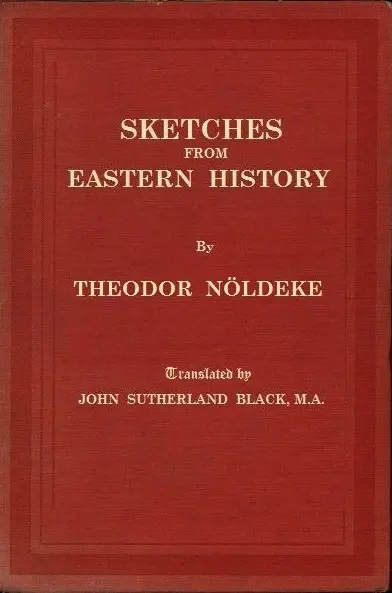
"Sketches from Eastern History" by Theodor Nöldeke is a historical account written in the late 19th century. This work provides a series of essays that explore key aspects of Eastern history, particularly focused on the Semitic races and the rise of Islam. The author, a noted orientalist, aims to provide insights into the culture, religion, and political dynamics of the region, enhancing the understanding of historical figures such as the Islamic prophet Mohammed and his works. At the start of the text, Nöldeke presents the complex task of depicting the moral and psychological characteristics of the Semitic races, acknowledging the challenges and contradictions involved. He critiques previous scholars who have portrayed these traits and outlines his intent to contribute meaningfully to the discourse. The opening engages the reader by elaborating on how geography, religion, and history have shaped the characteristics and civilizations of the Semitic peoples, and it sets the stage for a deeper examination that will unfold in subsequent chapters. Through his rigorous analysis, Nöldeke's work promises to be a valuable resource for both specialists and general readers interested in the history and influence of the Eastern world.
Introduction adapted from the source catalogue; source summaries may be automatically generated.
Free to read · English · 93,547 words · No account needed
MAKE TIME FOR A GOOD BOOK
On by default. Untick to stop anonymous reading totals. Each page counts after 10 seconds in view. How this works.
Anonymous counting is on unless you have switched it off.
In the height of summer 875, Yakúb entered Párs. Mohammed, son of Wásil, hastened up from Susiana, sought to throw him off the scent by negotiations, kept back his messengers, and then pressed forward with all speed so as to surprise him. But as-Saffár was duly informed of his movements, fell upon his assailant when exhausted by heat and thirst, and at once put him to flight (August or September). The great treasure of the enemy fell into his hand. It is not to be supposed that the whole country forthwith became his without dispute; but he nevertheless ruled as lord of Párs, and among other things severely punished a tribe of Kurds who had zealously supported the son of Wásil. He did not, however, stay long, but pressed westwards to Susiana. In October he was already at Rámhormuz in the low plain of Susiana, in dangerous proximity to the Tigris. The central Government was in the greatest alarm, for, besides being himself a formidable enemy, Yakúb could cut the line of attack upon the negro rebels, who had brought the empire into great straits.[75] Those of Yakúb’s people who had been thrown into prison were accordingly set free with promptitude, and an honourable embassy was sent to him. As he appeared disposed to treat, Mowaffak called together the eastern merchants then in Bagdad, and told them that Yakúb had been named governor of Khorásán, Tabaristán, Gurgán, Rai, and Párs, as well as military governor of Bagdad—thus conceding to him an extent of power such as Táhir himself had hardly wielded. A new embassy, which included his old superior Dirhem, carried to Yakúb the Caliph’s letter with the announcement. But the powerful general knew what weight to give to offers of this kind. His feelings of respect for the imperial Government were long exhausted; he had no scruples about coming to a complete breach with it. He accordingly replied that he would make his decision in Bagdad itself. Certain Arabic verses are put into his mouth, in which, amongst other things, he says that he possesses Khorásán and Párs already, and that he does not despair of winning Irák also.[76] The man who could hardly speak a little Arabic, and who certainly was not able to use literary Arabic according to the rules of grammar, metre, and style, cannot possibly have made these verses himself; but they well express what his attitude was in the circumstances. He continued, doubtless, formally to acknowledge the Caliph as his overlord. Some years later, a vassal of his undeceived the Zenj, with whom he had entered into relations, by offering public prayers, in the first place, for the Caliph; in the second, for Yakúb. If as-Saffár had conquered, he would perhaps have retained Motamid, but hardly his vigorous and able brother Mowaffak. For it is rather improbable, though not altogether inconceivable, that Mowaffak was in collusion with Yakúb, as was suspected by the Caliph’s “freedmen,” the Turkish generals, to whom the thought that the Sístánese might be bringing their own hateful power to an end must have been very unwelcome. Yakúb, then, continued to advance, occupying Wásit on the Tigris, and marching on Bagdad. Motamid now fell back upon his last resource; he assumed the mantle of the Prophet, and with the Prophet’s staff in his hand, took command of the holy war against the godless rebel. He set out with a great army from Sámarrá, but himself kept somewhat to the rear as the two armies approached one another, some fifty miles below Bagdad, Mowaffak took the command in chief. Yakúb’s army was much the smaller; and, moreover, an artificial inundation hampered his horsemen in their movements. The battle was keen. An attack upon his camp, made from the Tigris, and the arrival towards evening of powerful reinforcements for the imperial army, at last compelled as-Saffár, who had fought bravely and received three arrow wounds, to yield (Palm Sunday, 8th April 876). With the camp, rich booty fell to the victors. What was particularly unpleasant to Yakúb, the Táhirid Mohammed, whom he carried about with him in chains, made his escape. The Caliph personally removed the chains, and named him again military governor of Bagdad on the spot. This was the first great defeat sustained by the veteran warrior on the field (for in Tabaristán he had been compelled to yield to the forces of nature). The victorious enemy did not venture to pursue Yakúb, who sulkily withdrew to Gundíshábúr, between Shúshter and Susa, quite close to Babylonia. His wide dominion was now in a somewhat precarious state. He could still be sure of Sístán and Kermán; but in Khorásán his rule had long had to contend with great difficulties, caused partly by the imperial Government, and partly by all kinds of local chiefs; the political state of Khorásán at that time, as often before and since, must have been most perplexed. With the Caliph’s sanction, Párs had again been wrested from the “cursed” Yakúb by Wásil’s son, who, however, was beaten by a general of as-Saffár (876-7), and himself was made a prisoner, and was carried to the citadel of Bam, in Kermán, where a number of other state prisoners were already languishing.[77]
Your reading position is saved on this browser. Take it to another device with a library code. Reading pages adapt to text, rather than matching a printed edition.
BEHIND THE BOOK
This eBook is for the use of anyone anywhere in the United States and most other parts of the world at no cost and with almost no restrictions whatsoever. You may copy it, give it away or re-use it under the terms of the Project Gutenberg License included with this eBook or online at www.gutenberg.org. If you are not located in the United States, you will have to check the laws of the country where you are located before using this eBook. Read the source licence.
The original source file, including credits and licence, is retained by this library. Request an original-format copy at no charge. Please include the book title and Project Gutenberg identifier #54782.
KEEP YOUR CURIOSITY GOING
Cécile Tormay

Moritz Busch
John L. Ransom
Frances Wright
Cécile Tormay

Mabel Potter Daggett