THE CLASSIC COLLECTION✦An outlaw’s diary: the CommuneCLASSIC FREE BOOKS
An outlaw’s diary: the Commune
Cécile Tormay
THE CLASSIC COLLECTION · 1892
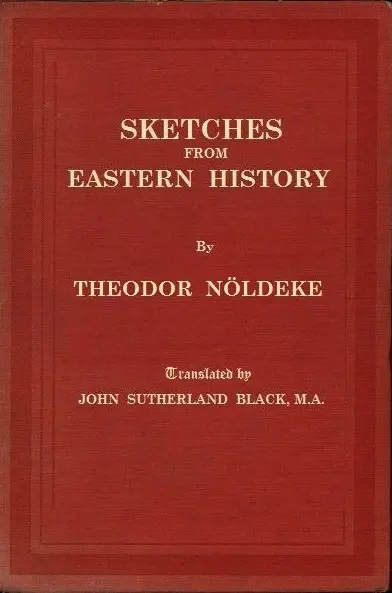
"Sketches from Eastern History" by Theodor Nöldeke is a historical account written in the late 19th century. This work provides a series of essays that explore key aspects of Eastern history, particularly focused on the Semitic races and the rise of Islam. The author, a noted orientalist, aims to provide insights into the culture, religion, and political dynamics of the region, enhancing the understanding of historical figures such as the Islamic prophet Mohammed and his works. At the start of the text, Nöldeke presents the complex task of depicting the moral and psychological characteristics of the Semitic races, acknowledging the challenges and contradictions involved. He critiques previous scholars who have portrayed these traits and outlines his intent to contribute meaningfully to the discourse. The opening engages the reader by elaborating on how geography, religion, and history have shaped the characteristics and civilizations of the Semitic peoples, and it sets the stage for a deeper examination that will unfold in subsequent chapters. Through his rigorous analysis, Nöldeke's work promises to be a valuable resource for both specialists and general readers interested in the history and influence of the Eastern world.
Introduction adapted from the source catalogue; source summaries may be automatically generated.
Free to read · English · 93,547 words · No account needed
MAKE TIME FOR A GOOD BOOK
On by default. Untick to stop anonymous reading totals. Each page counts after 10 seconds in view. How this works.
Anonymous counting is on unless you have switched it off.
The Zenj leader utilised to the utmost the truce that had been thus forced upon his assailants, to place his defensive works in as complete repair as possible, or even to strengthen them still further. It is certain, too, that he was adequately informed by his spies and scouts as to the seriousness of Mowaffak’s then position, both personally and politically, and he may well have cherished new hopes; but in February 883 he was again sorely pressed: his own palace was plundered and burnt, and he himself exposed to great danger. In March and April the illness of Mowaffak rendered necessary another cessation of the attack, but from the end of April onwards the struggle was seldom intermitted for any time. The rebel chief transferred the centre of his defence from the west to the east side of the main canal, though without wholly abandoning the former.
The desertions of his officers went on increasing. It is alleged that even his own son opened negotiations with Mowaffak; these, however, we may conjecture to have been quite hollow. But, among others, Shibl, a former slave, one of his most prominent lieutenants, went over to Mowaffak, and allowed himself forthwith to be sent directly against his old comrades. To another of these people, Sharání, whose wicked deeds had been many, there was at first an inclination to refuse pardon; but, in order not to scare his accomplices, he too was at last accepted, and received a rich reward for his treachery. The official account gives us a touching scene, in which Mowaffak, shortly before the last decisive struggle, solemnly admonishes the deserters to make good their evil deeds by bravery and fidelity; and this, deeply moved, they promised to do.
In the actual encounters the Zenj still continued to show great courage. The imperialists were not now, it is true, invariably forced to give up again in the evening the ground they had gained during the day; yet even in the great battle of Tuesday, 21st May 883, in which the harem of the negro chief, with more than a hundred women and children, had been sacked, and Prince Abul-Abbás, in his advance, had burned great stores of grain, the assailants found themselves at last so hard pressed by the blacks that Mowaffak judged it advisable to withdraw them to his ships. He did not yet feel himself strong enough to deliver the mortal blow. But now new reinforcements were continually coming in, though indeed, for the most part, these did nothing more than repair the continual losses through battle and sickness. Among the new-comers were numerous volunteers, who, from religious motives, entered upon the holy war against the heretics. An event of very special importance was the separation from his master of Lúlú, the commander in Northern Syria of the forces of Ibn Túlún, the ruler of Egypt mentioned above; he entered into negotiations with Mowaffak, of which the result was that with a considerable army behind him he joined the latter on Thursday, 11th July 883. The preparations for a decisive assault were now complete; transport ships for large masses of troops were in immediate readiness, and the great waterways of the hostile territory were by this time so entirely free of all obstacles as to be passable at all states of the tide. Mowaffak is said to have brought more than 50,000 men into the great battle of Monday, 5th August, while yet leaving a large number behind in Mowaffakíya. After a severe struggle the whole city was taken. The negro chief fled; but as the imperialists, instead of pursuing him keenly, occupied themselves with plunder, and, by becoming scattered, exposed themselves to the danger of surprise, a withdrawal was again in the end found necessary, and Alí returned once more to the city. The respite, however, was but short. The final assault was delivered on Saturday, 11th August 883. From the first the advanced troops broke up the Zenj. Their leader was separated from his companions; Sulaimán, son of Jámi, along with others, was made prisoner. A section of the Zenj, indeed, drove back the enemy once more, but this was of no avail; in a little news was brought that the rebel chief was dead, and one of Lúlú’s people almost immediately confirmed this intelligence by bringing in his head. It is not certain how he met his death. Perhaps we may venture to believe a statement[59] that he poisoned himself. According to another story, he perished in flight. That he did not fall in battle is further indicated by the circumstance that none of our authorities, with all their fulness, speak of any combatant as having sought to obtain the royal reward for slaying the arch-rebel. Death by his own hand seems the most appropriate to the nature of the man; at the same time, I am free to confess that we can form a tolerably vivid picture of him only if we bring a good deal of fancy into play.
Your reading position is saved on this browser. Take it to another device with a library code. Reading pages adapt to text, rather than matching a printed edition.
BEHIND THE BOOK
This eBook is for the use of anyone anywhere in the United States and most other parts of the world at no cost and with almost no restrictions whatsoever. You may copy it, give it away or re-use it under the terms of the Project Gutenberg License included with this eBook or online at www.gutenberg.org. If you are not located in the United States, you will have to check the laws of the country where you are located before using this eBook. Read the source licence.
The original source file, including credits and licence, is retained by this library. Request an original-format copy at no charge. Please include the book title and Project Gutenberg identifier #54782.
KEEP YOUR CURIOSITY GOING
Cécile Tormay

Moritz Busch
John L. Ransom
Frances Wright
Cécile Tormay

Mabel Potter Daggett