
Last letters from the living dead man
David Patterson (Spirit) Hatch
THE CLASSIC COLLECTION · 1826
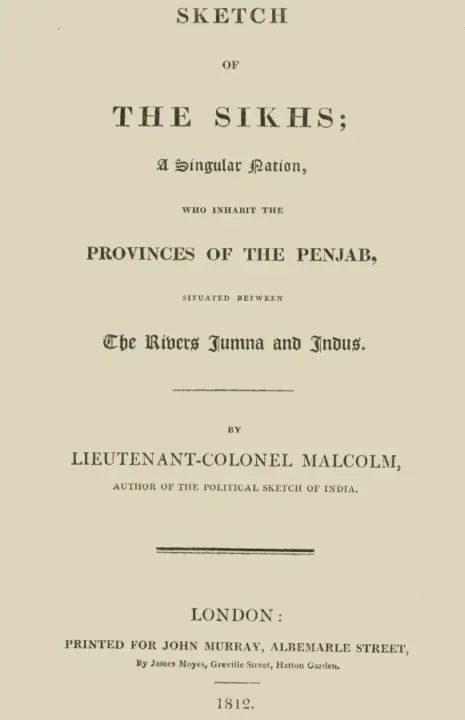
"Sketch of the Sikhs" by John Malcolm is a historical account written in the early 19th century. The work provides a concise narrative about the Sikhs, focusing on their unique religion, customs, and significant historical events as they relate to the British colonial context. Malcolm aims to shed light on this "singular nation," offering insights into a culture that was largely unfamiliar to European readers of his time. The opening of the book introduces Malcolm's motivations for writing, detailing his experiences and observations while stationed with the British army in Punjab. He discusses the challenges faced in gathering accurate information about the Sikh community, emphasizing the reliance on original Sikh sources to counteract misconceptions presented by both admirers and detractors. Notably, he begins the exploration of Sikh history with an account of Nánac, the founder of Sikhism, recounting his early life, spiritual inclinations, and establishing the basis for the Sikh faith while detailing his attempts to unify differing religious beliefs among the Hindus and Muslims. The beginning sets a foundation for a deeper understanding of the evolution of Sikhism and its significant figures.
Introduction adapted from the source catalogue; source summaries may be automatically generated.
Free to read · English · 34,654 words · No account needed
MAKE TIME FOR A GOOD BOOK
On by default. Untick to stop anonymous reading totals. Each page counts after 10 seconds in view. How this works.
Anonymous counting is on unless you have switched it off.
While Nánac remained in the pool, abstracted from all worldly considerations, holding converse with a prophet, poor Jayrám was put in prison by Daulet Khán Lódí, on the charge of having dissipated his property. Nánac, however, returned, and told Daulet Khán that Jayrám was faultless; that he was the object of punishment; and that, as such, he held himself ready to render the strictest account of all he had lost. The Khán accepted his proposal: Jayrám's accounts were settled; and, to the surprise of all, a balance was found in his favour; on which he was not only released, but reinstated in the employment and favour of his master. We are told, by the Sikh authors, that these wonderful actions increased the fame of Nánac in a very great degree; and that he began, from this period, to practise all the austerities of a holy man; and, by his frequent abstraction in the contemplation of the divine Being, and his abstinence and virtue, he soon acquired great celebrity through all the countries into which he travelled.
There are many extravagant accounts regarding the travels of Nánac. One author[10], who treats of the great reform which he made in the worship of the true God, which he found degraded by the idolatry of the Hindús, and the ignorance of the Muhammedans, relates his journey to all the different Hindú places of pilgrimage, and to Mecca, the holy temple of the Muhammedans.
It would be tedious, and foreign to the purpose of this sketch, to accompany Nánac in his travels, of which the above-mentioned author, as well as others, has given the most circumstantial accounts. He was accompanied (agreeable to them) by a celebrated musician, of the name of Merdaná, and a person named Bála Sand'hú; and it is on the tradition of the latter of these disciples, that most of the miracles[11] and wonders of his journies are related. In Bengal, the travellers had to encounter all kinds of sorcerers and magicians. Poor Merdaná, who had some of the propensities of Sancho, and preferred warm houses and good meals to deserts and starvation, was constantly in trouble, and more than once had his form changed into that of a sheep, and of several other animals. Nánac, however, always restored his humble friend to the human shape, and as constantly read him lectures on his imprudence. It is stated, in one of those accounts, that a Rájá of Sivanáb'hu endeavoured to tempt Nánac, by offering him all the luxuries of the world, to depart from his austere habits, but in vain. His presents of rich meats, splendid clothes, and fair ladies, only afforded the Sikh teacher so many opportunities of decrying the vanities of this world, and preaching to the Rájá the blessings of eternal life; and he at last succeeded in making him a convert, and resided at Sivanáb'hu two years and five months; during which period he composed the Prán Sancali[12], for the instruction of his followers. After Nánac had visited all the cities of India, and explained to all ranks the great doctrines of the unity and omnipresence of God, he went to Mecca and Medina, where his actions, his miracles, and his long disputations with the most celebrated Muhammedan saints and doctors, are most circumstantially recorded by his biographers. He is stated, on this occasion, to have maintained his own principles, without offending those of others; always professing himself the enemy of discord, and as having no object but to reconcile the two faiths of the Muhammedans and Hindús in one religion; which he endeavoured to do by recalling them to that great and original tenet, in which they both believed, the unity of God, and by reclaiming them from the numerous errors into which they had fallen. During his travels, Nánac was introduced to the emperor Báber[13], before whom he is said to have defended his doctrine with great firmness and eloquence. Báber was pleased with him, and ordered an ample maintenance to be bestowed upon him; which the Sikh priest refused; observing, that he trusted in him who provided for all men, and from whom alone a man of virtue and religion would consent to receive favour or reward. When Nánac returned from his travels, he cast off the garments of a Fakír, and wore plain clothes, but continued to give instructions to his numerous disciples; and he appears, at this period, to have experienced the most violent opposition from the Hindú zealots, who reproached him with having laid aside the habits of a Fakír, and with the impiety of the doctrines which he taught. These accusations he treated with great contempt; and an author, before cited, Bhai Gúrú Dás Vali, states, that when he visited Vatála, he enraged the Yógíswaras[14] so much, that they tried all their powers of enchantment to terrify him. "Some," says this writer, "assumed the shape of lions and tigers, others hissed like snakes, one fell in a shower of fire, and another tore the stars from the firmament;" but Nánac remained tranquil: and when required to exhibit some proof of his powers that would astonish them, he replied: "I have nothing to exhibit worthy of you to behold. A holy teacher has no defence but the purity of his doctrine: the world may change, but the Creator is unchangeable." These words, adds the author, caused the miracles and enchantments of the Yógíswaras to cease, and they all fell at the feet of the humble Nánac, who was protected by the all perfect God.
Your reading position is saved on this browser. Take it to another device with a library code. Reading pages adapt to text, rather than matching a printed edition.
BEHIND THE BOOK
This eBook is for the use of anyone anywhere in the United States and most other parts of the world at no cost and with almost no restrictions whatsoever. You may copy it, give it away or re-use it under the terms of the Project Gutenberg License included with this eBook or online at www.gutenberg.org. If you are not located in the United States, you will have to check the laws of the country where you are located before using this eBook. Read the source licence.
The original source file, including credits and licence, is retained by this library. Request an original-format copy at no charge. Please include the book title and Project Gutenberg identifier #53510.
KEEP YOUR CURIOSITY GOING
David Patterson (Spirit) Hatch

David Patterson (Spirit) Hatch

David Patterson (Spirit) Hatch
Cécile Tormay

Moritz Busch
John L. Ransom