
Last letters from the living dead man
David Patterson (Spirit) Hatch
THE CLASSIC COLLECTION · 1826
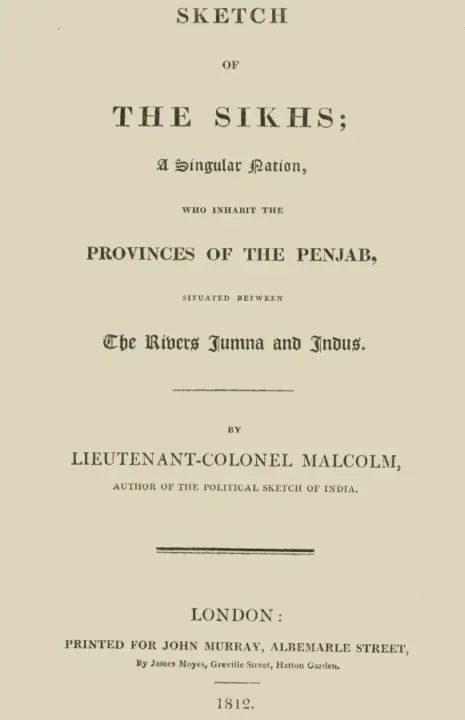
"Sketch of the Sikhs" by John Malcolm is a historical account written in the early 19th century. The work provides a concise narrative about the Sikhs, focusing on their unique religion, customs, and significant historical events as they relate to the British colonial context. Malcolm aims to shed light on this "singular nation," offering insights into a culture that was largely unfamiliar to European readers of his time. The opening of the book introduces Malcolm's motivations for writing, detailing his experiences and observations while stationed with the British army in Punjab. He discusses the challenges faced in gathering accurate information about the Sikh community, emphasizing the reliance on original Sikh sources to counteract misconceptions presented by both admirers and detractors. Notably, he begins the exploration of Sikh history with an account of Nánac, the founder of Sikhism, recounting his early life, spiritual inclinations, and establishing the basis for the Sikh faith while detailing his attempts to unify differing religious beliefs among the Hindus and Muslims. The beginning sets a foundation for a deeper understanding of the evolution of Sikhism and its significant figures.
Introduction adapted from the source catalogue; source summaries may be automatically generated.
Free to read · English · 34,654 words · No account needed
MAKE TIME FOR A GOOD BOOK
On by default. Untick to stop anonymous reading totals. Each page counts after 10 seconds in view. How this works.
Anonymous counting is on unless you have switched it off.
SKETCH OF THE HISTORY AND PRESENT STATE OF THE SIKHS; WITH
OBSERVATIONS ON THEIR RELIGIOUS INSTITUTIONS, USAGES, MANNERS, AND
CHARACTER.
Nánac Sháh, the founder of the sect, since distinguished by the name of Sikhs[2], was born in the year of Christ 1469, at a small village called Talwandi[3], in the district of Bhatti, in the province of Lahore. His father, whose name was Cálú[4], was of the Cshatríya cast, and Védí tribe of Hindús, and had no family except Nánac, and his sister Nánaci, who married a Hindú of the name of Jayarám, that was employed as a grain-factor by Daulet Khán Lódí, a relation of the reigning emperor of Delhi. Nánac was, agreeably to the usage of the tribe in which he was born, married to a woman of respectable family, at an early age[5], by whom he had two sons, named Sríchand and Lacshmí Dás. The former, who abandoned the vanities of the world, had a son called Dherm Chand, who founded the sect of Udásí; and his descendants are yet known by the name of Nánac Putráh, or the children of Nánac. Lacshmí Dás addicted himself to the pleasures of this world, and left neither heirs nor reputation.
Nánac is stated, by all Sikh writers, to have been, from his childhood, inclined to devotion; and the indifference which this feeling created towards all worldly concerns, appears to have been a source of continual uneasiness to his father; who endeavoured, by every effort, to divert his mind from the religious turn which it had taken. With a view to effect this object, he one day gave Nánac a sum of money, to purchase salt at one village, in order to sell it at another; in the hope of enticing him to business, by allowing him to taste the sweets of commercial profit. Nánac was pleased with the scheme, took the money, and proceeded, accompanied by a servant of the name of Bála, of the tribe of Sand'hú, towards the village where he was to make his purchase. He happened, however, on the road, to fall in with some Fakírs, (holy mendicants,) with whom he wished to commence a conversation; but they were so weak, from want of victuals, which they had not tasted for three days, that they could only reply to the observations of Nánac by bending their heads, and other civil signs of acquiescence. Nánac, affected by their situation, said to his companion, with emotion: "My father has sent me to deal in salt, with a view to profit; but the gain of this world is unstable, and profitless; my wish is to relieve these poor men, and to obtain that gain which is permanent and eternal." His companion[6] replied: "Thy resolution is good: do not delay its execution." Nánac immediately distributed his money among the hungry Fakírs; who, after they had gained strength from the refreshment which it obtained them, entered into a long discourse with him on the unity of God, with which he was much delighted. He returned next day to his father, who demanded what profit he had made? "I have fed the poor," said Nánac, "and have obtained that gain for you which will endure for ever." As the father happened to have little value for the species of wealth which the son had acquired, he was enraged at having his money so fruitlessly wasted, abused poor Nánac, and even struck him; nor could the mild representations of Nánací save her brother from the violence of parental resentment. Fortune, however, according to the Sikh narrators of this anecdote of their teacher's early life, had raised him a powerful protector, who not only rescued him from punishment, but established his fame and respectability upon grounds that at once put him above all fear of future bad usage from his low-minded and sordid father. When Nánac was quite a youth, and employed to tend cattle in the fields, he happened to repose himself one day under the shade of a tree; and, as the sun declined towards the west, its rays fell on his face, when a large black snake[7], advancing to the spot where he lay, raised itself from the ground, and interposed its spread hood between Nánac and the sun's rays. Ráy Bolar[8], the ruler of the district, was passing the road, near the place where Nánac slept, and marked, in silence, though not without reflection, this unequivocal sign of his future greatness. This chief overheard Cálú punishing his son for his kindness to the Fakírs. He immediately entered, and demanded the cause of the uproar; and, when informed of the circumstances, he severely chid Cálú for his conduct, and interdicted him from ever again lifting his hand to Nánac, before whom, to the astonishment of all present, he humbled himself with every mark of the most profound veneration. Though Cálú, from this event, was obliged to treat his son with more respect than formerly, he remained as solicitous as ever to detach him from his religious habits, and to fix him in some worldly occupation; and he prevailed upon Jayrám, his son-in-law, to admit him into partnership in his business. Nánac, obliged to acquiesce in these schemes, attended at the granary of Daulet Khán Lódí, which was in charge of Jayrám; but though his hands were employed in this work, and his kindness of manner made all the inhabitants of Sultánpúr, where the granary was established, his friends, yet his heart never strayed for one moment from its object. It was incessantly fixed on the Divinity; and one morning, as he sat in a contemplative posture, a holy Muhammedan Fakír approached, and exclaimed: "Oh Nánac! upon what are thy thoughts now employed? Quit such occupations, that thou mayest obtain the inheritance of eternal wealth." Nánac is said to have started up at this exclamation, and after looking for a moment in the face of the Fakír, he fell into a trance; from which he had no sooner recovered, than he immediately distributed every thing in the granary among the poor[9]: and, after this act, proceeded with loud shouts out of the gates of the city, and running into a pool of water, remained there three days; during which some writers assert he had an interview with the prophet Elias, termed by the Muhammedans, Khizzer, from whom he learnt all earthly sciences.
Your reading position is saved on this browser. Take it to another device with a library code. Reading pages adapt to text, rather than matching a printed edition.
BEHIND THE BOOK
This eBook is for the use of anyone anywhere in the United States and most other parts of the world at no cost and with almost no restrictions whatsoever. You may copy it, give it away or re-use it under the terms of the Project Gutenberg License included with this eBook or online at www.gutenberg.org. If you are not located in the United States, you will have to check the laws of the country where you are located before using this eBook. Read the source licence.
The original source file, including credits and licence, is retained by this library. Request an original-format copy at no charge. Please include the book title and Project Gutenberg identifier #53510.
KEEP YOUR CURIOSITY GOING
David Patterson (Spirit) Hatch

David Patterson (Spirit) Hatch

David Patterson (Spirit) Hatch
Cécile Tormay

Moritz Busch
John L. Ransom