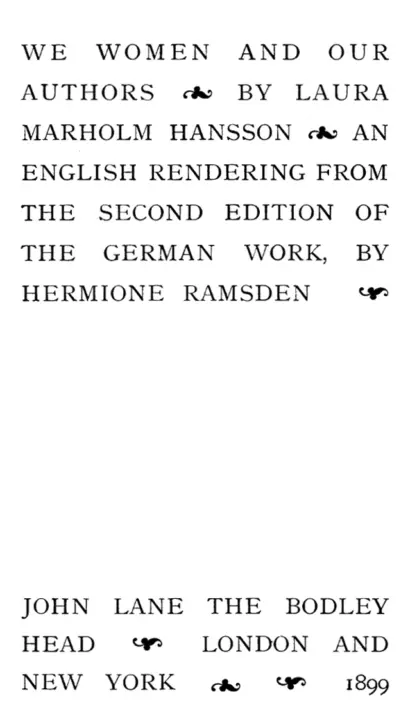
We Women and Our Authors
Laura Marholm
THE CLASSIC COLLECTION · 1896
"Six Modern Women: Psychological Sketches" by Laura Marholm is a collection of biographical sketches written in the late 19th century. The work explores the lives and experiences of six influential women, focusing on their emotional struggles and the inherent conflicts between their intellect and womanly instincts. Notable figures include Sonia Kovalevsky, Marie Bashkirtseff, and Eleonora Duse, among others, highlighting their journeys through societal expectations and personal aspirations. The opening of the work establishes Marholm's intent to delve into the emotional lives of these modern women rather than just their accomplishments. She reflects on how their successes often came at the expense of their inner fulfillment, emphasizing the tension between societal roles and individual desires. The text introduces Sonia Kovalevsky's life and reveals her profound loneliness and dissatisfaction despite her intellectual achievements, setting the stage for a deeper exploration of the psychological struggles faced by women in her time. Throughout the introduction, Marholm's analysis suggests a combination of admiration and pity for these pioneering women as they navigate a world that frequently undermines their true selves.
Introduction adapted from the source catalogue; source summaries may be automatically generated.
Free to read · English · 54,705 words · No account needed
MAKE TIME FOR A GOOD BOOK
On by default. Untick to stop anonymous reading totals. Each page counts after 10 seconds in view. How this works.
Anonymous counting is on unless you have switched it off.
The subjects of these six psychological sketches are well known to English readers, with the exception of Amalie Skram, the Norwegian novelist, and Fru Leffler, who is known only as the biographer of Sonia Kovalevsky.
Laura Marholm, the writer of this book, is a German authoress of Norwegian extraction, who is celebrated for her literary criticisms and the beauty of her style. In September, 1889, she married Ola Hansson, the Swedish author of “Sensitiva Amorosa,” “Young Scandinavia,” and a novel called “Fru Esther Bruce,” in which the heroine is said to bear a strong resemblance to Eleonora Duse. He has also published a volume of prose poems, called “Ofeg’s Ditties,” which has been translated by George Egerton, whose vivid style and powerful descriptions have gained a place for her among the foremost women writers of the day.
Laura Marholm was the first to introduce her husband to the German public by means of two articles in the Neue Freie Presse. The first, called “A Swedish Love Poet,” appeared May 24th, 1888, before they had met, and was written in praise of his early work, “Sensitiva Amorosa.” The second article was a criticism on “Pariahs,” and it is an interesting fact that in it she compares him to Gottfried Keller.
In all her writings, Laura Marholm looks at life through the spectacles of a happy marriage; she believes that matured thought and widened views can--in a woman’s case--be only the direct result of marriage; and consequently she considers marriage to be absolutely indispensable to every woman, and that without it she is both mentally and morally undeveloped. She has little sympathy with the Woman’s Rights movement, judged either from the social, political, or educational point of view; with regard to the latter, she has not had a university education herself, and she is not at all impressed by those who have. She considers that a woman’s individuality is of greater importance than her actions; she upholds woman’s influence as woman, and has no sympathy with the advanced thinkers, who, with Stuart Mill at their head, would fain have women exert their influence as thinking, reasoning human beings, believing all other influence to be unworthy the dignity of the modern woman. Laura Marholm has the intuitive faculty, and this enables her to gauge the feelings of those women who spend a long youth in waiting--who are taught to believe, and who do believe, that their youth is nothing more than a transition period between childhood and marriage,--women who grow old in waiting, and awake to reality to find behind them nothing but a wasted youth, and in the future--an empty old age. But these are not modern women, they are the women of the ancien régime, who have missed their vocation, and failed to attain their sole object in life,--viz., marriage. On the one hand we are confronted with the old-fashioned girl, on the other by the new woman. Of the two, we prefer the new woman; and while recognizing her mistakes, and lamenting her exaggerated views, Laura Marholm acknowledges that she is formed of the best material of the age, and prophesies for her a brighter future. But her views differ greatly from those of Ibsen and Björnson. According to Ibsen, a woman is first of all a human being, and then a woman; she places the woman first, the human being last. Björnson believes that an intellectually developed woman with a life-work can get on very well by herself; Laura Marholm maintains that, apart from man, a woman is nothing. According to her, woman is a creature of instinct, and this instinct is her most precious possession, and of far greater value than the intellect. Of all the studies in this book, Fru Leffler is probably the one with whom she is least in sympathy. Fru Leffler was essentially intellectual, possessed of a somewhat cold and critical temperament, and in writing the biography of Sonia Kovalevsky she was often unable to appreciate the latter’s very complicated character. Sonia was a rare combination of the mystic and the scientist; she was not only a mathematician, but also, in every important crisis of her life, a dreamer of prophetic dreams. The biography was intended to be the continuation of Sonia’s own story of her childhood, and the two should be read together. As a child, Sonia suffered from a painful conviction that in her family she was not the favorite, and it is probable that her unaccountable shyness, her want of self-confidence, and her inability to attract love in after life, were due to the fact of her having passed an unhappy and unloved childhood.
Your reading position is saved on this browser. Take it to another device with a library code. Reading pages adapt to text, rather than matching a printed edition.
Laura Marholm
BEHIND THE BOOK
This eBook is for the use of anyone anywhere in the United States and most other parts of the world at no cost and with almost no restrictions whatsoever. You may copy it, give it away or re-use it under the terms of the Project Gutenberg License included with this eBook or online at www.gutenberg.org. If you are not located in the United States, you will have to check the laws of the country where you are located before using this eBook. Read the source licence.
The original source file, including credits and licence, is retained by this library. Request an original-format copy at no charge. Please include the book title and Project Gutenberg identifier #68655.
KEEP YOUR CURIOSITY GOING
John L. Ransom

Herman W. Mudgett

Harriet Monroe
Daniel Dulany Addison
Charles Lanman

Harold Rosher