
The Story of a Governess
Mrs. (Margaret) Oliphant
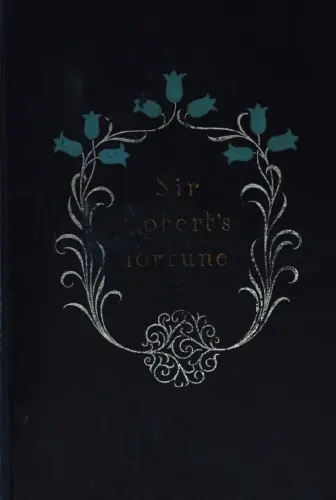
THE CLASSIC COLLECTION · 1894
"Sir Robert's Fortune: A Novel" by Mrs. Oliphant is a fiction work written in the late 19th century. The story revolves around Lily Ramsay, a young woman caught in the constraints of her uncle's strict control over her inheritance, and her budding romance with Ronald Lumsden, who is also ensnared in the turmoil caused by financial dependence on Sir Robert. As Lily grapples with her feelings of confinement and longing for independence, the narrative explores themes of love, class disparities, and the struggles against societal expectations. The opening of the novel sets the stage for Lily's predicament, revealing her desperate situation as she learns from Ronald that her uncle plans to send her away to a remote location called Dalrugas, isolating her from the world and her love. Amid lively festivities, Lily finds herself at the mercy of her uncle's whims, which dictate her future and relationship choices. The dialogue between Lily and Ronald highlights their contrasting views on money and independence, setting in motion the central conflict of the story. As the chapters progress, Lily's frustrations and aspirations are laid bare, painting a picture of a young woman on the cusp of significant life decisions amidst external constraints.
Introduction adapted from the source catalogue; source summaries may be automatically generated.
Free to read · English · 174,376 words · No account needed
MAKE TIME FOR A GOOD BOOK
On by default. Untick to stop anonymous reading totals. Each page counts after 10 seconds in view. How this works.
Anonymous counting is on unless you have switched it off.
Lily threw herself down in the big chair, which rose above her head with its high back and brought out all her whiteness against its sober cover. She was silenced--obviously by the thought thus suggested of Sir Robert as a poor man, which was an absurdity, and perhaps secretly, in that innermost seclusion of the heart, which even its possessor does not always realize, by a faint chill of wonder whether she would indeed and really like to be poor, as she protested she should. It was quite true that a drink of milk and a piece of oatcake appeared to her as much nourishment as any person of refinement need care for. In the novels of her day, which always affect the young mind, all the heroines lived upon such fare, and were much superior to beef and mutton. But there were undoubtedly other things--Robina, for instance; although no thought of parting from Robina had ever crossed Lily’s mind as a necessary part of poverty. But she was silenced by these thoughts. She had not, indeed, ever confessed in so many words even to Robina, scarcely to herself, that it was Ronald who cared for the money, and that it was the want of any impulse on his part to do without it that carried so keen a pang to her heart. Had he cried, “A fig for the money!” then it might have been her part to temporize and be prudent. The impetuosity, the recklessness, should not, she felt, be on her side.
It was on the very next day that her decision was to be made, and it had not been till all other means had failed that Sir Robert had thus put the matter to the touch. He had opposed her in many gentler ways before it came to that. Sir Robert was not a brute or a tyrant--very far from it. He was an old gentleman of fine manners, pluming himself on his successes with “the other sex,” and treating all women with a superfine courtesy which only one here and there divined to conceal contempt. Few men--one may say with confidence, no elderly man without wife or daughters--has much respect for women in general. It is curious, it is to some degree reciprocal, it is of course always subject to personal exceptions; yet it is the rule between the two sections of humanity which nevertheless have to live in such intimate intercourse with each other. In an old bachelor like Sir Robert, and one, too, who was conscious of having imposed upon many women, this prepossession was more strong than among men of more natural relationships. And Lily, who was only his niece, and had not lived with him until very lately, had not overcome all prejudices in his mind, as it is sometimes given to a daughter to do. He had thought first that he could easily separate her from the young man who did not please him, and bestow her, as he had a right to bestow his probable heiress, on whom he pleased. When this proved ineffectual, he cursed her obstinacy, but reflected that it was a feature in women, and therefore nothing to be surprised at. They were always taken in by fictitious qualities--who could know it better than he?--and considered it a glory to stick to a suitor unpalatable to their belongings. And then he had threatened her with the loss of the fortune which she had been brought up to expect. “See if this fine fellow you think so much of will have you without your money,” he said. Lily had never in so many words put Lumsden to the trial, never proposed to him to defy Sir Robert; but she had made many an attempt to discover his thoughts, and even to push him to this rash solution, and, with an ache at her heart, had felt that there was at least a doubt whether the fine fellow would think so much of her if she were penniless. She had never put it to the test, partly because she dared not, though she had not been able to refrain from an occasional burst of defiance and hot entreaty to Sir Robert to keep his money to himself. And now she was to decide for herself--to give Ronald over forever, or to give over Edinburgh and the society in which she might meet him, and keep her love at the cost of martyrdom in her uncle’s lonely shooting-box on the moors. There was, of course, a second alternative--that which she had so often thought of: to refuse, to leave Sir Robert’s house, to seek refuge in some cottage, to live on milk and oatcake, and provide for herself. If the alternative had been to run away with her lover, to be married to him in humility and poverty, to keep his house and cook his dinners and iron his linen, Lily would not have hesitated for a moment. But he had not asked her to do this--had not dreamed of it, it seemed; and to run away alone and work for herself would be, Lily felt, to expose him to much animadversion as well as herself; and, most of all, it would betray fully to herself and to her uncle, with that sneer on his face, the certainty that Ronald would not risk having her without her money, that discovery which she held at arm’s-length and would not consent to make herself sure of. All these thoughts were tumultuous in her mind as she opened her eyes to the light of a new day. This was the final moment, the turning-point of her life. She thought at first when she woke that it was still the same misty moonlight on which she had shut her eyes, and that there must still be some hours between her and the day. But it was only an easterly haar with which the air was full--a state of atmosphere not unknown in Edinburgh, and which wraps the landscape in a blinding shroud as of white wool, obliterating every feature in a place which has so many. Arthur’s Seat and Salisbury Craigs and the Castle Rock had all disappeared in it from those who were in a position to see them; and here, in George Square, even the brown houses opposite had gone out of sight, and the trees in the garden loomed dimly like ghosts, a branch thrust out here and there. Lily asked herself, was it still night? And then her mind awoke to a state of the atmosphere not at all unusual, and a sense that the moment of her fate had arrived, and that every thing must be settled for her for good or for evil this day.
Your reading position is saved on this browser. Take it to another device with a library code. Reading pages adapt to text, rather than matching a printed edition.
Mrs. (Margaret) Oliphant

Mrs. (Margaret) Oliphant

Mrs. (Margaret) Oliphant

Mrs. (Margaret) Oliphant
BEHIND THE BOOK
This eBook is for the use of anyone anywhere in the United States and most other parts of the world at no cost and with almost no restrictions whatsoever. You may copy it, give it away or re-use it under the terms of the Project Gutenberg License included with this eBook or online at www.gutenberg.org. If you are not located in the United States, you will have to check the laws of the country where you are located before using this eBook. Read the source licence.
The original source file, including credits and licence, is retained by this library. Request an original-format copy at no charge. Please include the book title and Project Gutenberg identifier #53744.
KEEP YOUR CURIOSITY GOING
Coulson Kernahan

Maurice Baring
Frances Wright
Cécile Tormay

Frederic Jesup Stimson

W. H. P. (William Henry Pope) Jarvis