
Life of Edwin Forrest, the American Tragedian. Volume 2 (of 2)
William Rounseville Alger & Horatio, Jr. Alger

THE CLASSIC COLLECTION · 1870
"Sink or Swim; or, Harry Raymond's Resolve" by Horatio Alger Jr. is a novel written in the late 19th century. The story revolves around Harry Raymond, a determined and resilient boy who faces various challenges in his life as he grows up in a modest household. The narrative explores themes of perseverance, integrity, and the pursuit of success through hard work and moral character. The opening portion introduces Harry as a spirited student at Vernon High School, where he captivates his classmates with an enthusiastic declamation. Despite his humble background, Harry wins admiration from his peers and a prize for his speaking abilities, which incites jealousy in a wealthy classmate, James Turner. As Harry navigates the complexities of school rivalries and the social dynamics of wealth versus character, he is also confronted with the harsh realities of life when tragedy strikes his family. The foundation is laid for Harry's resolve to succeed despite the odds, reflecting the overarching message of the novel about striving to overcome adversity.
Introduction adapted from the source catalogue; source summaries may be automatically generated.
Free to read · English · 64,952 words · No account needed
MAKE TIME FOR A GOOD BOOK
On by default. Untick to stop anonymous reading totals. Each page counts after 10 seconds in view. How this works.
Anonymous counting is on unless you have switched it off.
“I am not your cabin-boy,” said Harry, indignantly.
“That’s your mistake. You’ve got to work your passage. I shan’t allow any skulkers aboard this ship.”
This speech, as well as most of the captain’s, was garnished with oaths, which I choose to omit, though at the risk of conveying an inadequate idea of his brutality and coarseness. Our hero was greatly exasperated at the mean plot which had been concocted against him, and being of a fearless temperament would have given full and free expression to his indignation, and a scene of violence would no doubt have resulted, but for the opportune entrance of Mr. Weldon, the supercargo.
Mr. Weldon was a young man, not over twenty-five, a nephew of the owner of the vessel, and had been sent out as supercargo, with the intention of remaining in China for two or three years in a branch establishment of his uncle’s house. On account of his connection with the firm by whom he was employed, Captain Brandon found it prudent to treat him with more respect than in ordinary circumstances he would have paid to the supercargo.
“Good-morning, Captain Brandon,” said the young man.
“Good-morning, Mr. Weldon,” said Brandon, smoothing his face, and lowering his arm, which had been raised to strike Harry. “How do you feel this morning?”
“Not sea-sick as yet; but I don’t know how soon it may be on. I am in no hurry for it, I can assure you. But who is this young gentleman?”
“You are joking, Mr. Weldon,” said the captain. “We don’t usually address cabin-boys as young gentlemen on board ship.”
“Is he your cabin-boy?” asked Weldon, in surprise; for Harry was not, it will be remembered, dressed in sailor rig.
“No, I am not,” said Harry, boldly.
“Shut up!” said the captain, sharply, with a threatening look. “He’s a headstrong young rascal, whom his friends have placed in my charge, with intentions to make a sailor of him.”
“That is not true. I was trapped on board this vessel,” said our hero.
“I used a little stratagem, knowing that I would have trouble otherwise,” said the captain, who would not have deigned any explanation to any other than the nephew of his employer, in whose estimation he wished to stand well. “But now he’s on board, I shall carry out the wishes of his friends, and he will find it for his interest not to make any trouble,” he added, with a significant look directed towards our hero.
At this moment the captain was summoned to the deck, and Harry found himself alone with the supercargo.
Your reading position is saved on this browser. Take it to another device with a library code. Reading pages adapt to text, rather than matching a printed edition.
William Rounseville Alger & Horatio, Jr. Alger

William Rounseville Alger & Horatio, Jr. Alger

Horatio, Jr. Alger
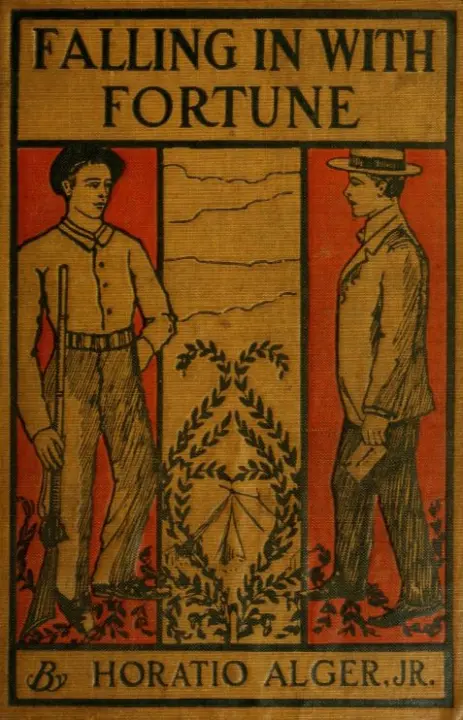
Horatio, Jr. Alger & Edward Stratemeyer
BEHIND THE BOOK
This eBook is for the use of anyone anywhere in the United States and most other parts of the world at no cost and with almost no restrictions whatsoever. You may copy it, give it away or re-use it under the terms of the Project Gutenberg License included with this eBook or online at www.gutenberg.org. If you are not located in the United States, you will have to check the laws of the country where you are located before using this eBook. Read the source licence.
The original source file, including credits and licence, is retained by this library. Request an original-format copy at no charge. Please include the book title and Project Gutenberg identifier #59517.
KEEP YOUR CURIOSITY GOING
Coulson Kernahan

Maurice Baring
Frances Wright
Cécile Tormay

Frederic Jesup Stimson

W. H. P. (William Henry Pope) Jarvis