
Life of Edwin Forrest, the American Tragedian. Volume 2 (of 2)
William Rounseville Alger & Horatio, Jr. Alger

THE CLASSIC COLLECTION · 1870
"Sink or Swim; or, Harry Raymond's Resolve" by Horatio Alger Jr. is a novel written in the late 19th century. The story revolves around Harry Raymond, a determined and resilient boy who faces various challenges in his life as he grows up in a modest household. The narrative explores themes of perseverance, integrity, and the pursuit of success through hard work and moral character. The opening portion introduces Harry as a spirited student at Vernon High School, where he captivates his classmates with an enthusiastic declamation. Despite his humble background, Harry wins admiration from his peers and a prize for his speaking abilities, which incites jealousy in a wealthy classmate, James Turner. As Harry navigates the complexities of school rivalries and the social dynamics of wealth versus character, he is also confronted with the harsh realities of life when tragedy strikes his family. The foundation is laid for Harry's resolve to succeed despite the odds, reflecting the overarching message of the novel about striving to overcome adversity.
Introduction adapted from the source catalogue; source summaries may be automatically generated.
Free to read · English · 64,952 words · No account needed
MAKE TIME FOR A GOOD BOOK
On by default. Untick to stop anonymous reading totals. Each page counts after 10 seconds in view. How this works.
Anonymous counting is on unless you have switched it off.
“Is your mother at home, Katy?” asked Squire Turner, as the child opened
the outer door.
“Yes, sir,” said Katy. “She’s upstairs.”
“Will you tell her I wish to see her?”
“Yes, sir.”
Squire Turner walked in, and took a seat without ceremony, as was natural, considering that it was the house of his future wife. Katy went upstairs, and presently Mrs. Raymond, who had changed her dress, came down.
“I thought you were out of town,” she said, trying to speak in her usual manner, but succeeding with difficulty, for she could not help thinking of the squire’s agency in driving Harry from home.
“I returned sooner than I anticipated. By the way, I think I have found a tenant for this cottage.”
“I don’t think that will be necessary, Squire Turner. I shall probably continue to occupy it myself.”
“How can that be?” demanded the squire, surprised. “As my wife, you will, of course, live in my house.”
“I shall not become your wife. I have changed my mind.”
“What does this mean?” he demanded, angrily. “Why do you trifle with me
thus?”
“I am afraid, Squire Turner, you have not been so much my friend as I
supposed.”
“In what respect have I failed to act as your friend?”
“O Squire Turner!” exclaimed the widow, impulsively, “how could you contrive such a wicked plot against my poor boy? How could you send him to sea, and not tell me, when you saw I was breaking my heart at his absence?”
The squire flushed at this unexpected accusation. How in the world, he thought, could Mrs. Raymond have heard of his agency in the abduction of Harry?
“I don’t know what you mean,” he said; but his face belied his words.
“It was wicked,” said Mrs. Raymond, “to endanger his life and rob me of
happiness!”
“Who makes this absurd charge against me?” demanded the squire.
The door opened, and Harry entered.
“Squire Turner,” he said, “I don’t suppose you are very glad to see me. Probably you did not expect me home so soon; perhaps not at all.”
“Where did you come from?” stammered the squire.
“From Australia.”
“From Australia—I thought—”
“Yes, you thought I was bound to China,” said Harry, coolly. “But I left the Sea Eagle, not liking Captain Hartley Brandon very much, and went to Australia instead.”
This was a surprise to the squire, who answered, doggedly, however, “You seem to be laboring under a strange mistake, Harry. What possible motive could I have for sending you away?”
“I can think of one,” said Harry, significantly; “but perhaps you would not like to have me mention it.”
Your reading position is saved on this browser. Take it to another device with a library code. Reading pages adapt to text, rather than matching a printed edition.
William Rounseville Alger & Horatio, Jr. Alger

William Rounseville Alger & Horatio, Jr. Alger

Horatio, Jr. Alger
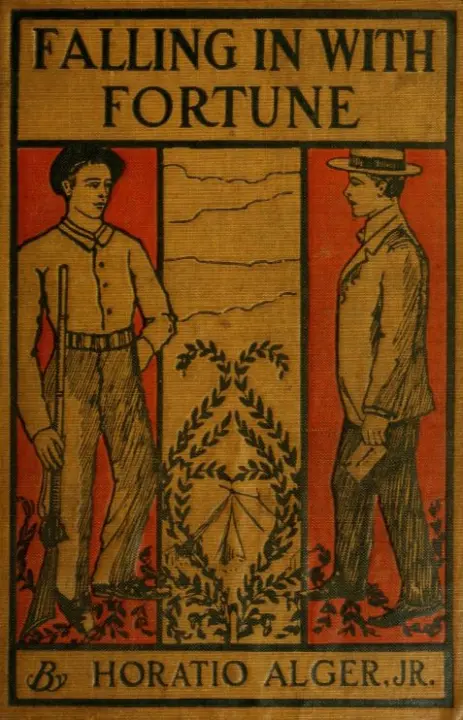
Horatio, Jr. Alger & Edward Stratemeyer
BEHIND THE BOOK
This eBook is for the use of anyone anywhere in the United States and most other parts of the world at no cost and with almost no restrictions whatsoever. You may copy it, give it away or re-use it under the terms of the Project Gutenberg License included with this eBook or online at www.gutenberg.org. If you are not located in the United States, you will have to check the laws of the country where you are located before using this eBook. Read the source licence.
The original source file, including credits and licence, is retained by this library. Request an original-format copy at no charge. Please include the book title and Project Gutenberg identifier #59517.
KEEP YOUR CURIOSITY GOING
Coulson Kernahan

Maurice Baring
Frances Wright
Cécile Tormay

Frederic Jesup Stimson

W. H. P. (William Henry Pope) Jarvis