
Life of Edwin Forrest, the American Tragedian. Volume 2 (of 2)
William Rounseville Alger & Horatio, Jr. Alger

THE CLASSIC COLLECTION · 1870
"Sink or Swim; or, Harry Raymond's Resolve" by Horatio Alger Jr. is a novel written in the late 19th century. The story revolves around Harry Raymond, a determined and resilient boy who faces various challenges in his life as he grows up in a modest household. The narrative explores themes of perseverance, integrity, and the pursuit of success through hard work and moral character. The opening portion introduces Harry as a spirited student at Vernon High School, where he captivates his classmates with an enthusiastic declamation. Despite his humble background, Harry wins admiration from his peers and a prize for his speaking abilities, which incites jealousy in a wealthy classmate, James Turner. As Harry navigates the complexities of school rivalries and the social dynamics of wealth versus character, he is also confronted with the harsh realities of life when tragedy strikes his family. The foundation is laid for Harry's resolve to succeed despite the odds, reflecting the overarching message of the novel about striving to overcome adversity.
Introduction adapted from the source catalogue; source summaries may be automatically generated.
Free to read · English · 64,952 words · No account needed
MAKE TIME FOR A GOOD BOOK
On by default. Untick to stop anonymous reading totals. Each page counts after 10 seconds in view. How this works.
Anonymous counting is on unless you have switched it off.
When night came, and the office closed, Mr. Fairchild took Harry to Lovejoy’s once more to take supper.
“I must get a boarding-place for you to-morrow,” he said. “To-night, I will secure a room for you here.”
“Where do you live, Mr. Fairchild?” asked Harry, with natural curiosity.
“Why, the fact is, I am boarding at the hotel myself just at present. I have a fine house up town, but it is being painted and refurnished, and, until that is finished, I board at a hotel.”
“Are you married?” continued Harry, who was something of a Yankee, as he showed by his questions.
“My wife and children are travelling in Europe,” said Mr. Fairchild, telling, of course, an unblushing falsehood. “I would join them if I could get away from my business. I must wait till I have a partner to leave in charge.” And he looked at Harry in a significant way, which caused our young hero’s heart to beat with proud anticipations.
They made a very good supper, and then sat down for a while in the public room, Fairchild smoking a couple of cigars with evident enjoyment. He offered one to Harry, which the latter declined, having fortunately never acquired a habit that to boys, at least, can never be productive of good.
About eight o’clock Harry asked permission to go to bed. His long ride in the morning, with the new experiences of his first day in the city, had produced a feeling of fatigue.
“Oh, yes, you can go to bed if you like,” said Fairchild. “I’ll speak to the clerk to give us a room with two beds.”
“How early do you want me to get up in the morning, Mr. Fairchild?”
“How early do you get up in the country?”
“About half-past five.”
“We don’t rise so early in the city. We’ll breakfast at eight, and get to the office at nine. Any time before eight will do.”
Harry thought that nine was rather late to commence business; but this, as he supposed, was only another difference between the city and the country.
Harry soon fell asleep in spite of the rattling of wheels and the never-ceasing noise in the busy street beneath. He was too tired even to dream, but slept soundly until the next morning.
When he awoke it was broad daylight. He looked across the room, and saw Fairchild still sleeping. He jumped out of bed, and dressed hastily. Remembering that it was his first morning in the city, he was eager to go downstairs, and look about him.
Fairchild opened his eyes sleepily, as he completed dressing.
Your reading position is saved on this browser. Take it to another device with a library code. Reading pages adapt to text, rather than matching a printed edition.
William Rounseville Alger & Horatio, Jr. Alger

William Rounseville Alger & Horatio, Jr. Alger

Horatio, Jr. Alger
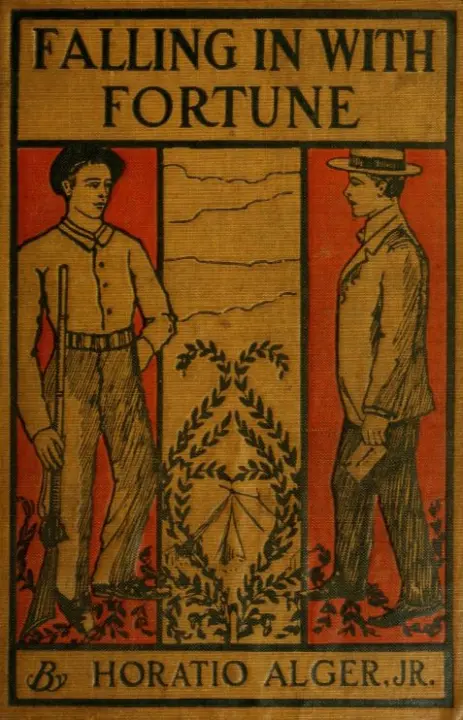
Horatio, Jr. Alger & Edward Stratemeyer
BEHIND THE BOOK
This eBook is for the use of anyone anywhere in the United States and most other parts of the world at no cost and with almost no restrictions whatsoever. You may copy it, give it away or re-use it under the terms of the Project Gutenberg License included with this eBook or online at www.gutenberg.org. If you are not located in the United States, you will have to check the laws of the country where you are located before using this eBook. Read the source licence.
The original source file, including credits and licence, is retained by this library. Request an original-format copy at no charge. Please include the book title and Project Gutenberg identifier #59517.
KEEP YOUR CURIOSITY GOING
Coulson Kernahan

Maurice Baring
Frances Wright
Cécile Tormay

Frederic Jesup Stimson

W. H. P. (William Henry Pope) Jarvis