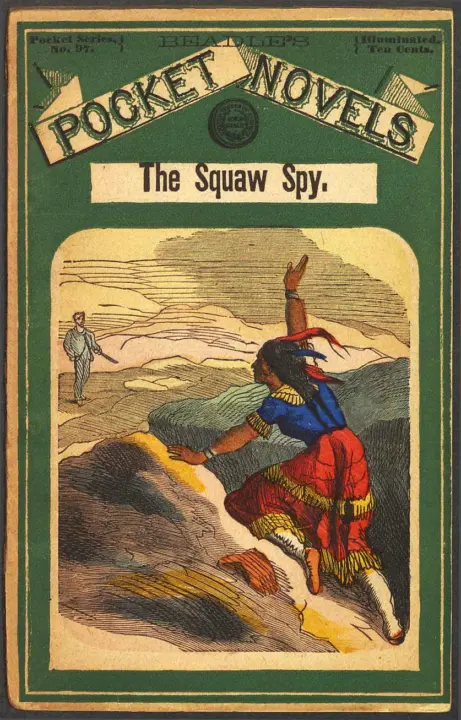
The squaw spy; or the rangers of the lava-beds
T. C. (Thomas Chalmers) Harbaugh
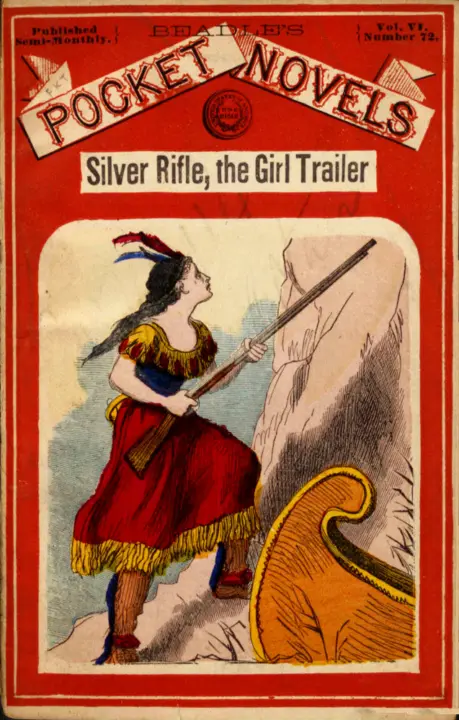
THE CLASSIC COLLECTION · 1884
"Silver Rifle, the Girl Trailer; Or, The White Tigers of Lake Superior" by Captain Charles Howard is a novel written in the late 19th century. The story centers around two main characters: Ahdeek, a half-breed youth, and Nahma, known as the White Tiger; both are caught in a world of rivalry and conflict involving Native American tribes and their struggles against encroaching European settlers. The narrative unfolds in a richly described wilderness setting near Lake Superior, hinting at themes of survival, kinship, and identity amidst cultural upheaval. At the start of the book, readers are introduced to Ahdeek as he prepares to meet Nahma, whose nickname suggests a lineage tied to a ferocious legacy. Their world dramatically shifts when Ahdeek finds himself pursued by a group of Chippewa warriors, unveiling a fierce confrontation as he fights for his life. The opening is action-packed, characterized by the theme of combat, as well as the struggles of individuals navigating their identities in times of conflict. As tensions escalate with the arrival of both allies and foes, the scene is set for further intrigues and the quest for a significant ring that holds mysterious importance, signaling deeper connections between characters as events unfold.
Introduction adapted from the source catalogue; source summaries may be automatically generated.
Free to read · English · 32,812 words · No account needed
MAKE TIME FOR A GOOD BOOK
On by default. Untick to stop anonymous reading totals. Each page counts after 10 seconds in view. How this works.
Anonymous counting is on unless you have switched it off.
The death of Oagla was accomplished before the youth’s eyes, and while Mossuit faced the mad braves, and dared them to advance upon Silver Rifle, he heard the clicking of a rifle-lock.
It emanated from a spot not far away, where a footstep, which he had thought belonged to some animal, had died; but now he knew that the prowler was a man.
“Surely the Indian does not know aught of my presence,” he muttered, “for I was here before he came to yon tree. However, we will soon see for whose heart he cocked his rifle.”
He tried to see the body of the foe, and once or twice, believing that the savage saw him, he drew up to shoot, trusting to luck but lowered the weapon, undetermined how to act.
All at once a sharp report rent the air, and the youth saw Silver Rifle fall, as witnessed in the last chapter.
He could scarcely repress a cry of horror, for the unseen Indian was the
slayer.
“Curse me for not shooting!” he hissed. “I might have dropped the fiend,
and then—”
The savage, flying from his crime, was bounding toward him!
White Tiger’s heart took a great leap for exultation, and a moment later, with the butt of his rifle, he scattered the young brave’s brains far and wide!
“Oh, heaven, does Silver Rifle live?” he cried, starting impulsively toward the group about the fire. “That I have learned to love her, must she be snatched from me now?”
He saw Mossuit face the menacing braves, with Silver Rifle hanging heavily on his arm, and then he heard the sub-chief’s voice.
“Warriors, I will be obeyed now,” cried the young Chippewa. “Hondurah is dead, and Oagla, who should have stepped into his shoes, lies before us. The Chippewas are chiefless. In the council-house we must say who shall be chief in Hondurah’s stead. Now turn upon your heels. Back to the council-house; and when we have a chief, the captives shall die.”
Without a word the rebellious warriors turned abruptly on their heels, and the march through the forest was resumed.
Mossuit walked erect, with the stricken girl in his arms.
He gloated over the thought that he had conquered Oagla’s braves, and was planning his elevation by chicanery to the chief sachemship of the Chippewa nation.
The mind of each was absorbed in dark plots, which smacked of the rifle, knife, tomahawk and stake, nor did they bear the footsteps of the White Tiger, who trailed them through the dim aisles of the forest.
The wood drama was drawing to a close; the curtain was rising on the
last acts.
Your reading position is saved on this browser. Take it to another device with a library code. Reading pages adapt to text, rather than matching a printed edition.
T. C. (Thomas Chalmers) Harbaugh
T. C. (Thomas Chalmers) Harbaugh
T. C. (Thomas Chalmers) Harbaugh
BEHIND THE BOOK
This eBook is for the use of anyone anywhere in the United States and most other parts of the world at no cost and with almost no restrictions whatsoever. You may copy it, give it away or re-use it under the terms of the Project Gutenberg License included with this eBook or online at www.gutenberg.org. If you are not located in the United States, you will have to check the laws of the country where you are located before using this eBook. Read the source licence.
The original source file, including credits and licence, is retained by this library. Request an original-format copy at no charge. Please include the book title and Project Gutenberg identifier #66310.
KEEP YOUR CURIOSITY GOING
Coulson Kernahan

Maurice Baring
Frances Wright
Cécile Tormay

Frederic Jesup Stimson

W. H. P. (William Henry Pope) Jarvis