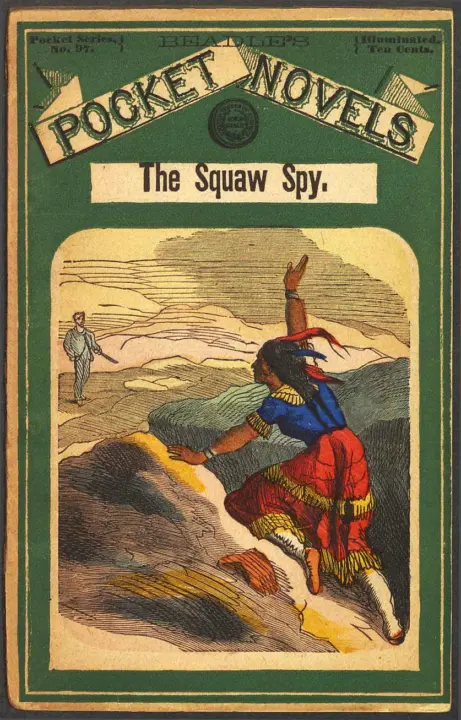
The squaw spy; or the rangers of the lava-beds
T. C. (Thomas Chalmers) Harbaugh
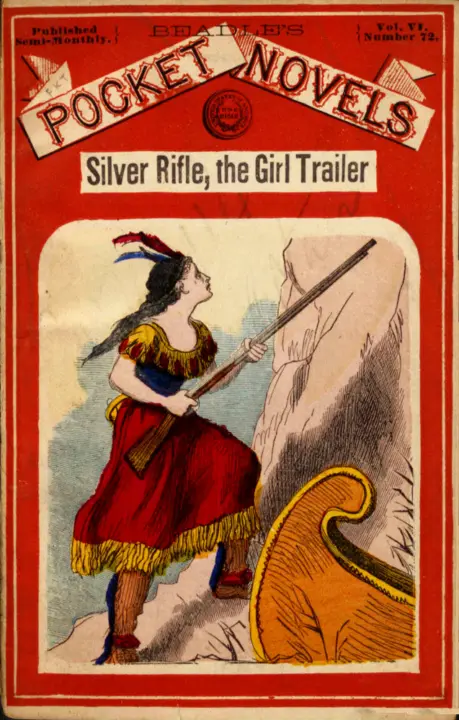
THE CLASSIC COLLECTION · 1884
"Silver Rifle, the Girl Trailer; Or, The White Tigers of Lake Superior" by Captain Charles Howard is a novel written in the late 19th century. The story centers around two main characters: Ahdeek, a half-breed youth, and Nahma, known as the White Tiger; both are caught in a world of rivalry and conflict involving Native American tribes and their struggles against encroaching European settlers. The narrative unfolds in a richly described wilderness setting near Lake Superior, hinting at themes of survival, kinship, and identity amidst cultural upheaval. At the start of the book, readers are introduced to Ahdeek as he prepares to meet Nahma, whose nickname suggests a lineage tied to a ferocious legacy. Their world dramatically shifts when Ahdeek finds himself pursued by a group of Chippewa warriors, unveiling a fierce confrontation as he fights for his life. The opening is action-packed, characterized by the theme of combat, as well as the struggles of individuals navigating their identities in times of conflict. As tensions escalate with the arrival of both allies and foes, the scene is set for further intrigues and the quest for a significant ring that holds mysterious importance, signaling deeper connections between characters as events unfold.
Introduction adapted from the source catalogue; source summaries may be automatically generated.
Free to read · English · 32,812 words · No account needed
MAKE TIME FOR A GOOD BOOK
On by default. Untick to stop anonymous reading totals. Each page counts after 10 seconds in view. How this works.
Anonymous counting is on unless you have switched it off.
The first shots which the red grave-diggers fired at the escaping party roused the Indian village.
The braves who guarded Hondurah’s empty lodge sprung to their feet and
listened intently.
Suddenly the sound of hasty feet greeted their ears, and a moment the sachem halted before them. He did not speak, but darted to the lodge, and throwing wide the curtains, leaped across the threshold.
Then a cry of rage and disappointment cleft the darkness of the lodge. The guards turned as Hondurah reappeared.
“Where Yucata?” he demanded.
“Gone to catch the owl that hooted.”
“Where Clearwater?”
“Gone to see Omaha put in the ground.”
For a moment the chief was silent.
“Hear rifles in the dark woods?” he said, half interrogatively, and while he finished the sentence, the shots were repeated.
“The pale-faces are in the forest,” he cried. “We catch ’em ’fore day,” and after issuing a few necessary orders, he and ten warriors hastened to the scene of conflict; and a moment after the denunciation which, at the close of our last chapter, rung from Chopah’s lips, they reached the scene of danger and death.
“What means this?” demanded Hondurah, striding into the midst of the baffled party. “Did Chopah allow the pale worms to crawl away? Where are they now? Where is Hondurah’s child?”
His glance fell upon the recumbent forms, and a moment later he sprung to the motionless body of the tomahawked trader.
“Ha!” he cried; “the trader never trade by Gitche Gumee any more. He kill last Chippewa: there, take that, white dog!”
With the last word, he bestowed a brutal kick on the body and turned to
his braves again.
“Chopah, tell Hondurah all,” he commanded; and turning from the young braves whom he had called liars, Chopah, with folded arms, faced his sachem.
Intently Hondurah listened to the narrative until Chopah mentioned the
name of his child.
Then he started forward and touched the speaker’s arm.
“Clearwater help whites?”
Chopah nodded.
“No, no, Chopah, don’t tell Hondurah this;” and for a moment the chief hid his eyes in his hands. “Do not tell him that Clearwater is a traitress.”
“Chopah never hides the truth,” was the reply reluctantly given. “The young braves—the braves who have lied—will say that Chopah speaks the right words. Braves—”
He paused suddenly, for the young warriors were gone! One by one, silent and sullen, they had sneaked unperceived from the spot, unable to withstand the anger of Hondurah, when Chopah should denounce them.
Hondurah smiled faintly at the chief’s consternation.
Your reading position is saved on this browser. Take it to another device with a library code. Reading pages adapt to text, rather than matching a printed edition.
T. C. (Thomas Chalmers) Harbaugh
T. C. (Thomas Chalmers) Harbaugh
T. C. (Thomas Chalmers) Harbaugh
BEHIND THE BOOK
This eBook is for the use of anyone anywhere in the United States and most other parts of the world at no cost and with almost no restrictions whatsoever. You may copy it, give it away or re-use it under the terms of the Project Gutenberg License included with this eBook or online at www.gutenberg.org. If you are not located in the United States, you will have to check the laws of the country where you are located before using this eBook. Read the source licence.
The original source file, including credits and licence, is retained by this library. Request an original-format copy at no charge. Please include the book title and Project Gutenberg identifier #66310.
KEEP YOUR CURIOSITY GOING
Coulson Kernahan

Maurice Baring
Frances Wright
Cécile Tormay

Frederic Jesup Stimson

W. H. P. (William Henry Pope) Jarvis