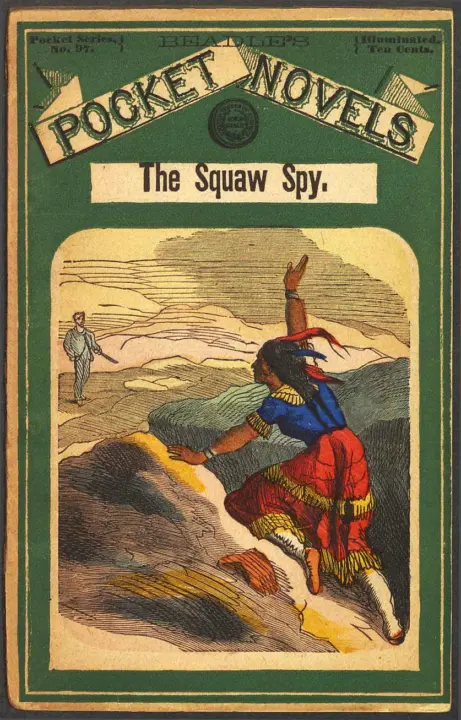
The squaw spy; or the rangers of the lava-beds
T. C. (Thomas Chalmers) Harbaugh
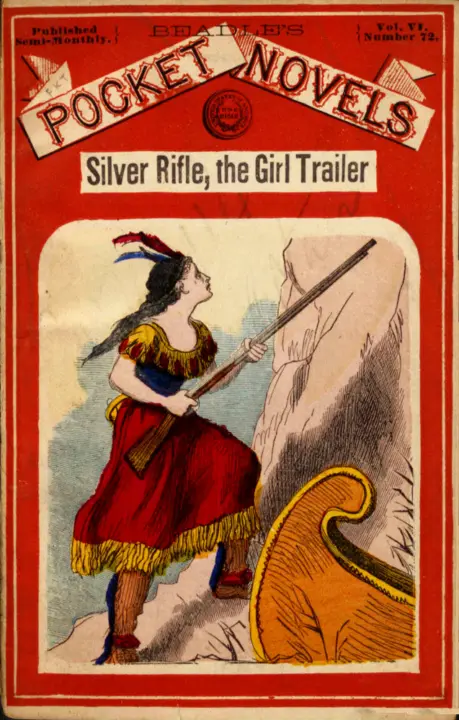
THE CLASSIC COLLECTION · 1884
"Silver Rifle, the Girl Trailer; Or, The White Tigers of Lake Superior" by Captain Charles Howard is a novel written in the late 19th century. The story centers around two main characters: Ahdeek, a half-breed youth, and Nahma, known as the White Tiger; both are caught in a world of rivalry and conflict involving Native American tribes and their struggles against encroaching European settlers. The narrative unfolds in a richly described wilderness setting near Lake Superior, hinting at themes of survival, kinship, and identity amidst cultural upheaval. At the start of the book, readers are introduced to Ahdeek as he prepares to meet Nahma, whose nickname suggests a lineage tied to a ferocious legacy. Their world dramatically shifts when Ahdeek finds himself pursued by a group of Chippewa warriors, unveiling a fierce confrontation as he fights for his life. The opening is action-packed, characterized by the theme of combat, as well as the struggles of individuals navigating their identities in times of conflict. As tensions escalate with the arrival of both allies and foes, the scene is set for further intrigues and the quest for a significant ring that holds mysterious importance, signaling deeper connections between characters as events unfold.
Introduction adapted from the source catalogue; source summaries may be automatically generated.
Free to read · English · 32,812 words · No account needed
MAKE TIME FOR A GOOD BOOK
On by default. Untick to stop anonymous reading totals. Each page counts after 10 seconds in view. How this works.
Anonymous counting is on unless you have switched it off.
As he spoke, he knelt down and began to examine the bones, which proved to be those of animals, intent upon solving a certain inquiry to his satisfaction. He had laid his rifle beside the tree, nor did he dream of danger.
Suddenly he was roused by the snapping of a twig, and whirling
instantly, he reached for his rifle, but, to his horror, found it
missing.
Then, with a cry of defiance, he leaped to his feet, as two dark figures rounded neighboring trees and threw themselves upon him.
The assaulters were young, lithe, active Indians; but their features were concealed by fox-skin masks.
Hondurah’s knife and hatchet were wrested from him, and when he saw that he was completely overpowered, he ceased to struggle, and submitted as quietly as possible.
To his question, “Who binds Hondurah?” a low, sarcastic reply was given, and the chief saw he was in the hands of those who would not scruple to take his life.
They stripped his owl-feathers from his head, tore every insignia of chieftainship from his person, hastily bedaubed him, after the manner of a Green River Indian, with whom the Chippewas were at war, and secured his eyes with a blindfold.
Then through the wood they urged the chief, and, after two hours’ tramp, descended to the stormy lake shore, and filed into a cave whose mouth, so densely packed with young shrubbery, indigenous to the climate, was not visible at a distance of ten feet.
Hondurah could not get a word from his captors, who he felt were the young chiefs whom he had dishonored; but he held his peace, and did not venture to accuse one.
They conducted him a long distance underground, and at last halted in a place which seemed to be quite large.
Presently a torch was introduced, and when the light penetrated the apartment, several savages simultaneously shrunk back, and stared at the figure of a young Indian girl, asleep on the couch.
Hondurah knew that the warriors were excited, and his impatience to learn the cause of that excitement continually increased.
All at once a hand was laid on his arm.
“Hondurah stands over his grave,” said one of the masked Indians, in a disguised tone. “Who would he see before he dies?”
The answer came quickly:
“Clearwater.”
“And what would he do, then?”
“Kill her! She is a traitress!”
A moment later the skinny bandage fell from the chieftain’s eyes, and he beheld one of the masks pointing to the couch.
His eye followed the scarlet finger, and there, peacefully sleeping, unconscious of danger, lay his hunted daughter—Clearwater.
Your reading position is saved on this browser. Take it to another device with a library code. Reading pages adapt to text, rather than matching a printed edition.
T. C. (Thomas Chalmers) Harbaugh
T. C. (Thomas Chalmers) Harbaugh
T. C. (Thomas Chalmers) Harbaugh
BEHIND THE BOOK
This eBook is for the use of anyone anywhere in the United States and most other parts of the world at no cost and with almost no restrictions whatsoever. You may copy it, give it away or re-use it under the terms of the Project Gutenberg License included with this eBook or online at www.gutenberg.org. If you are not located in the United States, you will have to check the laws of the country where you are located before using this eBook. Read the source licence.
The original source file, including credits and licence, is retained by this library. Request an original-format copy at no charge. Please include the book title and Project Gutenberg identifier #66310.
KEEP YOUR CURIOSITY GOING
Coulson Kernahan

Maurice Baring
Frances Wright
Cécile Tormay

Frederic Jesup Stimson

W. H. P. (William Henry Pope) Jarvis