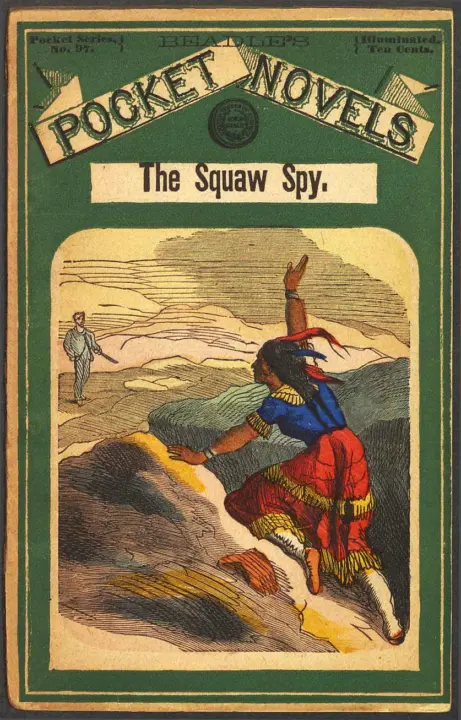
The squaw spy; or the rangers of the lava-beds
T. C. (Thomas Chalmers) Harbaugh
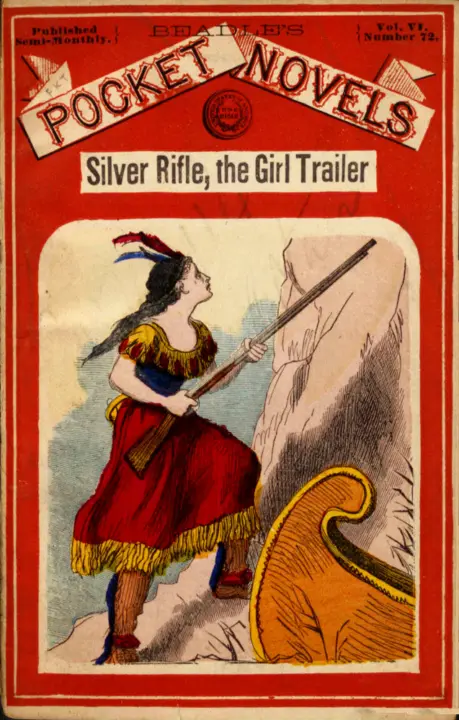
THE CLASSIC COLLECTION · 1884
"Silver Rifle, the Girl Trailer; Or, The White Tigers of Lake Superior" by Captain Charles Howard is a novel written in the late 19th century. The story centers around two main characters: Ahdeek, a half-breed youth, and Nahma, known as the White Tiger; both are caught in a world of rivalry and conflict involving Native American tribes and their struggles against encroaching European settlers. The narrative unfolds in a richly described wilderness setting near Lake Superior, hinting at themes of survival, kinship, and identity amidst cultural upheaval. At the start of the book, readers are introduced to Ahdeek as he prepares to meet Nahma, whose nickname suggests a lineage tied to a ferocious legacy. Their world dramatically shifts when Ahdeek finds himself pursued by a group of Chippewa warriors, unveiling a fierce confrontation as he fights for his life. The opening is action-packed, characterized by the theme of combat, as well as the struggles of individuals navigating their identities in times of conflict. As tensions escalate with the arrival of both allies and foes, the scene is set for further intrigues and the quest for a significant ring that holds mysterious importance, signaling deeper connections between characters as events unfold.
Introduction adapted from the source catalogue; source summaries may be automatically generated.
Free to read · English · 32,812 words · No account needed
MAKE TIME FOR A GOOD BOOK
On by default. Untick to stop anonymous reading totals. Each page counts after 10 seconds in view. How this works.
Anonymous counting is on unless you have switched it off.
A sorrowful sigh escaped the lips of the figure that walked beside the speaker, and she paused and touched his arm.
“Look up, White Tiger.”
He obeyed.
A single star glittered overhead, the others were obscured by clouds.
“That star, Ahdeek,” said a whispered voice. “He tells Clearwater not to spare young braves. She spare ’em not.”
Four figures flitted through the darkness that enwrapped the Indian village; they were Clearwater, Silver Rifle, the White Tiger, and Doc Cromer, the trader.
Clearwater had led the trio to comparative freedom. Her cunning had outwitted her own father, and, like Yucata’s braves, he guarded an empty lodge. The hunters were not unprepared for rescue, for, during the day, Clearwater, while talking to a dandyfied brave who guarded the lodge, had managed to smuggle a piece of bark to the captives, upon which were traced Indian characters which, from their acquaintance with savage life, they easily deciphered.
By a stratagem Hondurah and his warriors were thrown off their guard, for the old chief did not dream that his daughter would attempt treachery before his very eyes, and presently the whites found themselves free.
Noiselessly they left the hoodwinked Indians, and soon joined a single figure, dressed like Clearwater. It was Silver Rifle.
Then the owl-hoot which drove Yucata away pealed from Clearwater’s throat, and the quartette moved on.
One or two Indian dogs which came smelling about them were noiselessly dispatched, and, as the party reached the summit of a knoll, and were beginning to breathe freer, they came upon the burial of Omaha.
The best trail to the lake led by the Chippewa burying-ground, and the night interment of the slain savage was unknown to the chief’s daughter. Several torches threw their ghostly light upon the scene, and the escaping party dropped to the earth which they hugged closely, and watched the burial.
They were within thirty feet of the group, and held their breath while the Indians lowered Omaha into his grave, incumbered, as he was, by his rifles, hatchets, knives, and well-stocked medicine bag.
“We must go,” whispered Doc Cromer; “they will smoke over him, and pow-wow an hour. Let us try the right. Tell the gal.”
The Destroyer spoke to Clearwater.
“We must crawl like the cat,” she said. “Clearwater would sooner wait till the Indians go. But she will lead the pale faces to the right, on a little trail covered with leaves.”
Slowly and painfully, then, the four vacated their position, and with eyes fixed on the Indians, crawled down to the right. Fortune favored them, however, and they were congratulating themselves, when the most terrible adventure of the night occurred.
Your reading position is saved on this browser. Take it to another device with a library code. Reading pages adapt to text, rather than matching a printed edition.
T. C. (Thomas Chalmers) Harbaugh
T. C. (Thomas Chalmers) Harbaugh
T. C. (Thomas Chalmers) Harbaugh
BEHIND THE BOOK
This eBook is for the use of anyone anywhere in the United States and most other parts of the world at no cost and with almost no restrictions whatsoever. You may copy it, give it away or re-use it under the terms of the Project Gutenberg License included with this eBook or online at www.gutenberg.org. If you are not located in the United States, you will have to check the laws of the country where you are located before using this eBook. Read the source licence.
The original source file, including credits and licence, is retained by this library. Request an original-format copy at no charge. Please include the book title and Project Gutenberg identifier #66310.
KEEP YOUR CURIOSITY GOING
Coulson Kernahan

Maurice Baring
Frances Wright
Cécile Tormay

Frederic Jesup Stimson

W. H. P. (William Henry Pope) Jarvis