THE CLASSIC COLLECTION✦An outlaw’s diary: the CommuneCLASSIC FREE BOOKS
An outlaw’s diary: the Commune
Cécile Tormay
THE CLASSIC COLLECTION · 1919
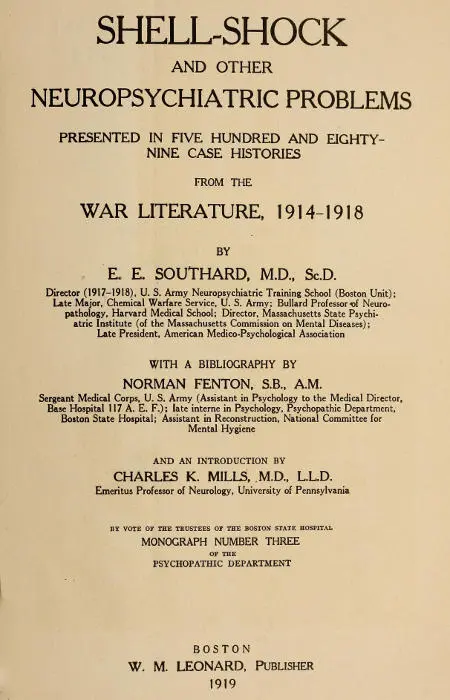
"SHELL-SHOCK AND OTHER NEUROPSYCHIATRIC PROBLEMS" by E. E. Southard is a scientific publication written in the early 20th century. The book serves as a case-history compilation focused on neuropsychiatric conditions arising from World War I, specifically highlighting cases categorized under 'Shell-shock.' Through detailed records and analyses of various cases, Southard aims to provide insights into the psychological and neurological effects of warfare on soldiers. The opening of the volume sets the stage for a comprehensive examination of neuropsychiatric issues linked to the horrors of war. It introduces the purpose of the book, which is to document and analyze case histories from both military and civilian perspectives. Southard discusses the challenges faced by the medical community in treating these conditions due to the unique stresses of combat, and he emphasizes the importance of including a wide range of cases from different countries involved in the war. The introduction also hints at the evolving understanding of war-related psychological conditions and lays the groundwork for the subsequent sections that delve deeper into specific cases and treatments.
Introduction adapted from the source catalogue; source summaries may be automatically generated.
Free to read · English · 312,106 words · No account needed
MAKE TIME FOR A GOOD BOOK
On by default. Untick to stop anonymous reading totals. Each page counts after 10 seconds in view. How this works.
Anonymous counting is on unless you have switched it off.
Re Shell-shock and its relations to epilepsy, see below, discussion under Cases 82-84 of Ballard, who has erected a theory of Shell-shock as in some sense epileptic.
Shell-shock: Epilepsia larvata.
=Case 81.= (JUQUELIER and QUELLIEN, May, 1917.)
A soldier, 29 (father alcoholic, died in hospital for the insane), a decorative painter without plumbic history, non-alcoholic, non-syphilitic, was wounded once, September, 1914, but returned to the front in 1915.
May, 1915, a shell burst near him. He lost consciousness, regained it a few days later at Brest, and was so far recovered that he could go on leave in seven days. While on leave, he had short attacks of delirium, followed by a total amnesia; there was, however, no crisis, fall, or convulsion. After the first attack, he had for 24 hours malaise and headache, but got well and went back to his dépôt. Shortly afterward more attacks of this sort recurred, and he went to hospital and thence to the neurological centre at Tours. Whence, August 9, 1915, he got a two-months’ leave for “mental disorder post-confusional, second état, probably hysterical (commotio cerebri), and organic hemiparesis.”
November, 1915, after returning to the dépôt, there were more spells and he went again to hospital. Invalided December, 1915, he passed a year at home, but the spells continued. Although the epileptic nature of these attacks was maintained by Francais at Évreux, he was placed in the auxiliaries, December, 1916, but had to go to hospital almost at once, and, February 28, 1917, entered the neurological centre of the 9th Region for the second time. Here, when called to be examined two days after admission, he was observed in an attack. He suddenly rose from the bench, made a few steps, seemed to be listening and anxious, as if he ought to be on guard. He looked up, seemed to be looking for something whose noise was approaching, lowered his head, made a slight jerking movement, and said, “Poum!” as if to express the noise of an explosion. He took a few more steps, the same movements were repeated, and the same “Poum!” was uttered. This lasted for about a quarter of an hour, during which the patient was unaware of his surroundings. He could be guided all about the hall without resistance, but did not respond to orders, commands, noises, or contact. In short, the patient was in the midst of a hallucinatory dream at his post in the trenches, undergoing a bombardment. He was placed in a chair; remained motionless for a few seconds, woke up, and answered questions. “Where am I? Oh, yes; I must have been sick because my head feels bad.” In answer to the question. “What did you see; what was there?”, he said, “I don’t remember anything. I never remember. I don’t know.” The patient was dull and weak after the spell.
Your reading position is saved on this browser. Take it to another device with a library code. Reading pages adapt to text, rather than matching a printed edition.
BEHIND THE BOOK
This eBook is for the use of anyone anywhere in the United States and most other parts of the world at no cost and with almost no restrictions whatsoever. You may copy it, give it away or re-use it under the terms of the Project Gutenberg License included with this eBook or online at www.gutenberg.org. If you are not located in the United States, you will have to check the laws of the country where you are located before using this eBook. Read the source licence.
The original source file, including credits and licence, is retained by this library. Request an original-format copy at no charge. Please include the book title and Project Gutenberg identifier #52105.
KEEP YOUR CURIOSITY GOING
Cécile Tormay

Moritz Busch
John L. Ransom
Frances Wright
Cécile Tormay

Mabel Potter Daggett