THE CLASSIC COLLECTION✦An outlaw’s diary: the CommuneCLASSIC FREE BOOKS
An outlaw’s diary: the Commune
Cécile Tormay
THE CLASSIC COLLECTION · 1919
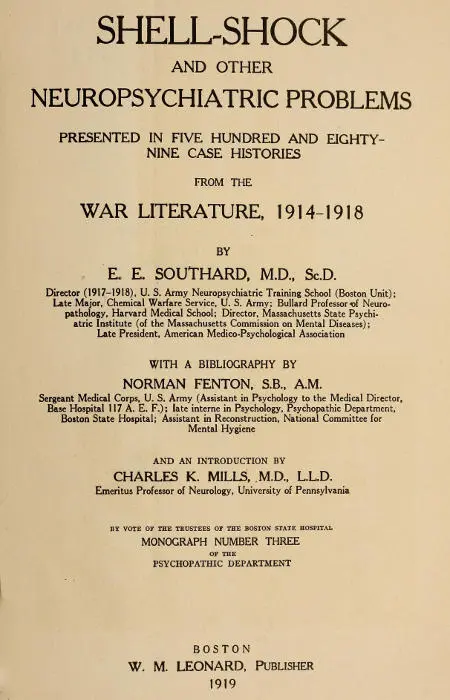
"SHELL-SHOCK AND OTHER NEUROPSYCHIATRIC PROBLEMS" by E. E. Southard is a scientific publication written in the early 20th century. The book serves as a case-history compilation focused on neuropsychiatric conditions arising from World War I, specifically highlighting cases categorized under 'Shell-shock.' Through detailed records and analyses of various cases, Southard aims to provide insights into the psychological and neurological effects of warfare on soldiers. The opening of the volume sets the stage for a comprehensive examination of neuropsychiatric issues linked to the horrors of war. It introduces the purpose of the book, which is to document and analyze case histories from both military and civilian perspectives. Southard discusses the challenges faced by the medical community in treating these conditions due to the unique stresses of combat, and he emphasizes the importance of including a wide range of cases from different countries involved in the war. The introduction also hints at the evolving understanding of war-related psychological conditions and lays the groundwork for the subsequent sections that delve deeper into specific cases and treatments.
Introduction adapted from the source catalogue; source summaries may be automatically generated.
Free to read · English · 312,106 words · No account needed
MAKE TIME FOR A GOOD BOOK
On by default. Untick to stop anonymous reading totals. Each page counts after 10 seconds in view. How this works.
Anonymous counting is on unless you have switched it off.
A case of Pathological Lying occurring in a soldier.
=Case 183.= (HENDERSON, July, 1917.)
No. 27369, a private, attached to the 15th Battalion Durham Light
Infantry, was admitted Oct. 14, 1916, to Lord Derby War Hospital from
Netley.
September 11, 1916, he had been admitted to Number 3 General Hospital, France, in a noisy, excited, insolent state: said he saw spirits of the dead; heard his sister urging him to lead a better life. Admitted to Netley early in October, 1916: now said he was a spiritualist, a Frenchman, had a quarrel with parents and enlisted in British Army, in army service; went to France August 12, 1914, was wounded at Loos, September, 1915, returned to front in February, 1916, “shell-shocked” June 1, 1916; lost consciousness after this--did not know where he was until July 22, 1916, when he had been arrested as deserter.
Admitted to Lord Derby Hospital October 14, 1916,--quiet, orderly, coöperative: desired to return to his regiment. He now gave a history: Enlisted British Army 1908, went to France, August, 1914, wounded February, 1915, at Neuve Chapelle; recovered; then attached to 45th Durham Light Infantry; blown up July 22, 1916, came to August 5, 1916, in hospital in Boulogne; then back to his regiment--but month later left without leave to pay off old score on a former comrade who had insulted his sister--arrested later by military police; put under observation in 65th Field Ambulance. No deterioration noted, school knowledge fairly well retained; no hallucinations or delusions (maintained he was a spiritualist, also that following shell-shock had suffered from insomnia and seemed to hear sister’s voice). Physically--small, well nourished, effeminate looking.
Oct. 23, 1916, he broke parole, but a month later returned to hospital under arrest. The police reported he had been masquerading as wounded French soldier attached to British army as interpreter; imposed on people; had two leaden types in his possession: “Interpreter R. le Auldere, attached to 1st Division.”
Story in hospital on return:--Born in France, did well in school, entered military academy at Paris. Quarreled with father--ran away to sea. Adopted by a French lady at Pembroke Dock. On account of drunken habits, quarreled again; joined army at Bristol, 1908. Went to France in August, 1914; January, 1915, invalided home because of “trench feet”--discharged as unfit. Reënlisted June, 1915, in Durham Light Infantry. January, 1916, again ordered to France. Blown up on Somme, July, 1916, by shell--remembered nothing until brought to No. 3 General Hospital. He remembers being accused of desertion but sentence was not passed, as he was held by the medical officer to have been irresponsible (as a matter of fact he was, at that time, considered to be a case of dementia praecox.)
Your reading position is saved on this browser. Take it to another device with a library code. Reading pages adapt to text, rather than matching a printed edition.
BEHIND THE BOOK
This eBook is for the use of anyone anywhere in the United States and most other parts of the world at no cost and with almost no restrictions whatsoever. You may copy it, give it away or re-use it under the terms of the Project Gutenberg License included with this eBook or online at www.gutenberg.org. If you are not located in the United States, you will have to check the laws of the country where you are located before using this eBook. Read the source licence.
The original source file, including credits and licence, is retained by this library. Request an original-format copy at no charge. Please include the book title and Project Gutenberg identifier #52105.
KEEP YOUR CURIOSITY GOING
Cécile Tormay

Moritz Busch
John L. Ransom
Frances Wright
Cécile Tormay

Mabel Potter Daggett