THE CLASSIC COLLECTION✦An outlaw’s diary: the CommuneCLASSIC FREE BOOKS
An outlaw’s diary: the Commune
Cécile Tormay
THE CLASSIC COLLECTION · 1919
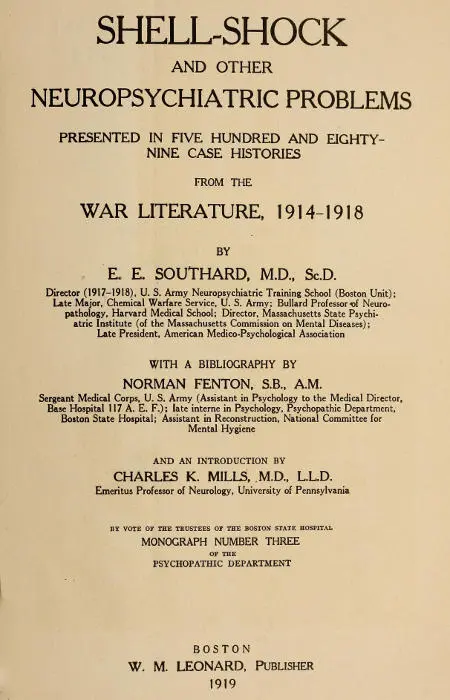
"SHELL-SHOCK AND OTHER NEUROPSYCHIATRIC PROBLEMS" by E. E. Southard is a scientific publication written in the early 20th century. The book serves as a case-history compilation focused on neuropsychiatric conditions arising from World War I, specifically highlighting cases categorized under 'Shell-shock.' Through detailed records and analyses of various cases, Southard aims to provide insights into the psychological and neurological effects of warfare on soldiers. The opening of the volume sets the stage for a comprehensive examination of neuropsychiatric issues linked to the horrors of war. It introduces the purpose of the book, which is to document and analyze case histories from both military and civilian perspectives. Southard discusses the challenges faced by the medical community in treating these conditions due to the unique stresses of combat, and he emphasizes the importance of including a wide range of cases from different countries involved in the war. The introduction also hints at the evolving understanding of war-related psychological conditions and lays the groundwork for the subsequent sections that delve deeper into specific cases and treatments.
Introduction adapted from the source catalogue; source summaries may be automatically generated.
Free to read · English · 312,106 words · No account needed
MAKE TIME FOR A GOOD BOOK
On by default. Untick to stop anonymous reading totals. Each page counts after 10 seconds in view. How this works.
Anonymous counting is on unless you have switched it off.
=Régis, E.= Les troubles psychiques et neuro-psychiques de la guerre. Presse méd., Par., 1915, v. 23, pp. 177-179.
=Régis, E.= Psychic and neuro-psychic affections in war. Boston M. and S. J., 1916, v. 174, pp. 784-792.
=Régis, E.= Les aliénés militaires internés du centre psychiatrique de Bordeaux. Statistique et commentaires. Caducée, Par., 1916, v. 16, pp. 55-59.
=Régis et Hesnard.= Un cas d’aphonie hystérique d’origine émotive. Le rôle pathogéne des émotions oniriques. Journal de Psychologie, mai-juin 1913.
=Regnier, P.= Organisation scientifique de la rééducation
professionnelle des mutilés. Rev. scient., Par., 1916, v. 2,
pp. 458-460.
=Regnier, P.= De la rééducation fonctionnelle des blessés. Rev. de chir., Par., 1916, 4. 35, pp. 668-696.
=Renaux, Jules.= États confusionnels consécutifs aux commotions des batailles. (Thèse, Paris, 1915), Presse méd., Par., 1916, v. 24, p. 184.
=Renon, Louis.= L’angoisse de guerre et son traitement. Bull. gén. de thérap., Par., 1915-16, v. 168^1, pp. 785-791; also pp. 821-827.
=Renon, Louis.= L’angoisse de guerre et son traitement. Rev. gén. de clin. et de thérap., Par., 1916, v. 30, pp. 41-43.
=Repkewitz.= Ueber die Simulation und Uebertreibung. Neurol.
Centralbl., 37, Nr. 12, 1918.
=Report of Dr. Henry Carre.= Glasgow District Mental Hospital, Brit. M. J., Lond., 1916, i, p. 148.
=Report.= War Disablement Committee. Use of Remedial Baths in connection with other physical methods in the treatment of disabled soldiers. Proc. Roy. Soc. Med., Lond., 1917-18, v. 10 (sec. Balneol.), pp. 78-80.
=Resch, H.= Geisteskrankheiten und Krieg. Allg. Ztschr. f. Psychiat., Berl., 1915, v. 72, No. 2 and No. 3, pp. 121-133.
=Responsabilité des oeuvres de rééeducation des mutilés= de guerre au point de vue des accidents. Ann. d’Hyg., Par., 1917, v. 25, pp. 190-192.
=Revault d’Allones, G.= Le signe achilléen sensitif des
affections du nerf sciatique. Press méd., Par., 1917, v. 25,
pp. 351-352.
=Richet, Ch.= “Anesthésie” en dictionnaire de physiologie. Lyon méd., 1915, v. 124, p. 347.
=Richet, Ch.= Le courage. Rev. sc., Par., 1916, ii, pp.
385-391.
=Richet, Ch.= Les évènements psychiques de la guerre. Un appel de M. Charles Richet aux soldats; avez-vous des pressentiments? Ann. d. sc. psych., Par., 1916, xxvi, 185-192.
=Riddoch, George.= Dissociation of visual perceptions due to occipital injuries with especial reference to appreciation of movement. Brain, Lond., 1917, v. 40, pp. 15-57.
=Riddoch, George.= On the relative perceptions of movement and a stationary object in certain visual disturbances due to occipital injuries. Proc. Roy. Soc. Med., Lond., 1917, v. 10, No. 3 (Sect. Neurol.), p. 13.
=Riebeth.= Ueber Neurasthenie bei Kriegsteilnehmern. Psychiat.-neurol. Wchnschr., Halle a. S., 1915-16, v. 17, p. 71.
=Rietschel, H.= Die Kriegsenuresis. Münch. med. Wchnschr., Nr.
26, 1918.
=Riggall, Robert M.= The treatment of neurasthenia by
hypnotism. J. Roy. Nav. M. Serv., Lond., 1917, v. 3, pp.
190-194.
Your reading position is saved on this browser. Take it to another device with a library code. Reading pages adapt to text, rather than matching a printed edition.
BEHIND THE BOOK
This eBook is for the use of anyone anywhere in the United States and most other parts of the world at no cost and with almost no restrictions whatsoever. You may copy it, give it away or re-use it under the terms of the Project Gutenberg License included with this eBook or online at www.gutenberg.org. If you are not located in the United States, you will have to check the laws of the country where you are located before using this eBook. Read the source licence.
The original source file, including credits and licence, is retained by this library. Request an original-format copy at no charge. Please include the book title and Project Gutenberg identifier #52105.
KEEP YOUR CURIOSITY GOING
Cécile Tormay

Moritz Busch
John L. Ransom
Frances Wright
Cécile Tormay

Mabel Potter Daggett