THE CLASSIC COLLECTION✦An outlaw’s diary: the CommuneCLASSIC FREE BOOKS
An outlaw’s diary: the Commune
Cécile Tormay
THE CLASSIC COLLECTION · 1919
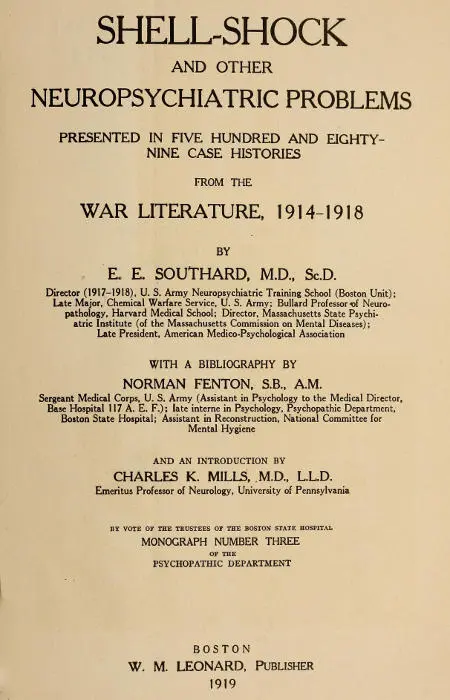
"SHELL-SHOCK AND OTHER NEUROPSYCHIATRIC PROBLEMS" by E. E. Southard is a scientific publication written in the early 20th century. The book serves as a case-history compilation focused on neuropsychiatric conditions arising from World War I, specifically highlighting cases categorized under 'Shell-shock.' Through detailed records and analyses of various cases, Southard aims to provide insights into the psychological and neurological effects of warfare on soldiers. The opening of the volume sets the stage for a comprehensive examination of neuropsychiatric issues linked to the horrors of war. It introduces the purpose of the book, which is to document and analyze case histories from both military and civilian perspectives. Southard discusses the challenges faced by the medical community in treating these conditions due to the unique stresses of combat, and he emphasizes the importance of including a wide range of cases from different countries involved in the war. The introduction also hints at the evolving understanding of war-related psychological conditions and lays the groundwork for the subsequent sections that delve deeper into specific cases and treatments.
Introduction adapted from the source catalogue; source summaries may be automatically generated.
Free to read · English · 312,106 words · No account needed
MAKE TIME FOR A GOOD BOOK
On by default. Untick to stop anonymous reading totals. Each page counts after 10 seconds in view. How this works.
Anonymous counting is on unless you have switched it off.
=Lortat, Jacob et Oppenheim, R. et Tournay, A.= Topographie des modifications de la sensibilité au cours des troubles physiopathiques; constitution d’un syndrôme radiculo-sympathique réflexe. Progrès méd., Par., 1917, No. 10, pp. 77-81.
=Love, K.= Hearing in the Army. J. Roy. Army Med. Corps, Lond.,
1915, v. 27, pp. 652-654.
=Löwenfeld.= Über den französischen Nationalcharakter und seine Auswüchse im gegenwärtigen Kriege (Psychopathia gallica). Allgem. Zeitschr. f. Psychiat., Wiesbaden, 1914.
=Löwenstein, Kurt.= Zerebellare Symptomenkomplexe nach
Kriegsverletzungen. Neurol. Centralbl., Leipz., 1915, v. 34,
pp. 626-637.
=Löwenstein, Sally.= Zur traumatischen Entstehung chronischer Rückenmarksleiden. Neurol. Centralbl., 37, Nr. 16, 1918.
=Löwy, Max.= Neurologische und psychiatrische Mitteilungen aus dem Kriege. Monatschr. f. Psychiat. und Neurol., Berl., 1915, v. 37, pp. 380-388.
=Löwy, Julius.= Über die Beeinflussung von Erkrankungen des Nervensystem durch den Apparat von Bergonié. Ztschr. f. Phys. u. Diätet. Therap., Leipz., 1915, No. 9, pp. 272-276.
=Lumière, Auguste et Astier.= Cerebral troubles in tetanus. Monde Méd., Par., 1917, v. 27, pp. 101-105.
=Lumsden, T.= The psychology of malingering and functional neuroses in peace and war. Lancet, Lond., 1916, ii, pp. 860-862. Rev. Boston M. and S. J., 1916, ii, p. 8.
=Lumsden, T.= Treatment of war neuroses. Lancet, Lond., 1917,
ii, p. 804.
=Lumsden, T.= Shell Shock. (A letter.) Lancet, Lond., 1917, i,
p. 34.
=Lumsden’s scheme for treatment of nerve-shattered soldiers.= Hospital, Lond., 1917, v. 61, pp. 487-488.
=Lust, F.= Kriegsneurosen und Kriegsgefangene. Münch, med.
Wchnschr., 1916, v. 63, p. 1829.
=Lyonnet.= Un cas de paraplégie d’origine cérébrale. Lyon méd., 1915, v. 124, pp. 362-363.
=Lyle, H. H. M.= Physiological treatment of bullet and shell
wounds of the peripheral nerve trunks. S. G. O., 1916, xxii,
127.
=Lyristritski, V. V.= (Psychical symptoms, difficult to simulate). Psikhiat. Gaz., Petrogr., 1915, v. 2, pp. 121-124.
=MacAuliffe, Léon.= Evolution de l’état commotionnel chez
les blessés du crâne trépanés. Paris méd., 1917, No. 47, pp.
421-424.
=MacCurdy, John T.= The Psychology of War. Wm. Heinemann, 1917.
=MacCurdy, John T.= War Neuroses. Cambridge Univ. Press, 1918.
=MacCurdy, John T.= War neuroses. Psychiat. Bull., Utica, 1917,
v. 2, No. 3, pp. 243-254.
=Macdonald, W. M.= Contractions of the hand after wounds of the upper limb. Brit. M. J., Lond., 1916, ii, pp. 209-212.
=MacDonald, W. M.= Tinel’s sign in peripheral nerve lesions. Brit. Med. Jour., 1918, ii, 6.
=Mackenzie, W. C.= Military orthopaedic hospitals. Brit. M. J., Lond., 1917, v. 1, pp. 669-678.
=MacKenzie, Kenneth A. J.= Repair of large gaps in peripheral
nerves by neuroplasty. Surg. Gynecol. and Obstet., 1918, xxvii,
355.
=MacLeod, Kenneth.= Dreaming. Med. Press and Circ., Lond.,
1916, v. 102, pp. 98-100.
=MacMahon, Cortlandt.= Shell shock, stammering and other affections of voice and speech. J. Roy. Army Med. Corps, Lond., 1917, v. 39, pp. 192-201.
=Madelung.= Kriegsärztliche Erfahrungen im England und Frankreich. Münch. med. Wchnschr., v. 62^1, pp. 283-284.
Your reading position is saved on this browser. Take it to another device with a library code. Reading pages adapt to text, rather than matching a printed edition.
BEHIND THE BOOK
This eBook is for the use of anyone anywhere in the United States and most other parts of the world at no cost and with almost no restrictions whatsoever. You may copy it, give it away or re-use it under the terms of the Project Gutenberg License included with this eBook or online at www.gutenberg.org. If you are not located in the United States, you will have to check the laws of the country where you are located before using this eBook. Read the source licence.
The original source file, including credits and licence, is retained by this library. Request an original-format copy at no charge. Please include the book title and Project Gutenberg identifier #52105.
KEEP YOUR CURIOSITY GOING
Cécile Tormay

Moritz Busch
John L. Ransom
Frances Wright
Cécile Tormay

Mabel Potter Daggett