THE CLASSIC COLLECTION✦An outlaw’s diary: the CommuneCLASSIC FREE BOOKS
An outlaw’s diary: the Commune
Cécile Tormay
THE CLASSIC COLLECTION · 1919
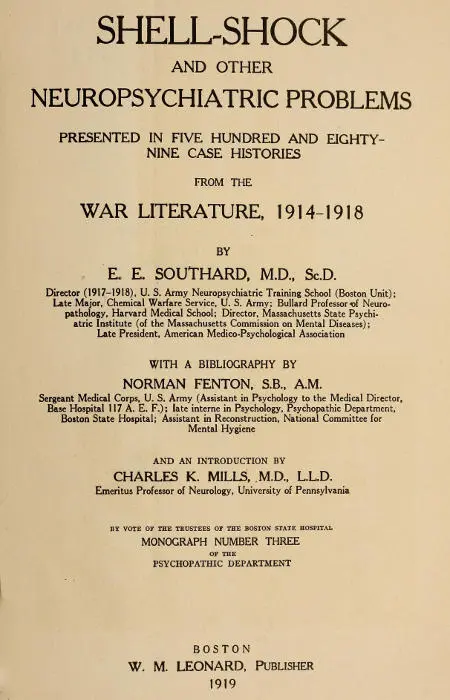
"SHELL-SHOCK AND OTHER NEUROPSYCHIATRIC PROBLEMS" by E. E. Southard is a scientific publication written in the early 20th century. The book serves as a case-history compilation focused on neuropsychiatric conditions arising from World War I, specifically highlighting cases categorized under 'Shell-shock.' Through detailed records and analyses of various cases, Southard aims to provide insights into the psychological and neurological effects of warfare on soldiers. The opening of the volume sets the stage for a comprehensive examination of neuropsychiatric issues linked to the horrors of war. It introduces the purpose of the book, which is to document and analyze case histories from both military and civilian perspectives. Southard discusses the challenges faced by the medical community in treating these conditions due to the unique stresses of combat, and he emphasizes the importance of including a wide range of cases from different countries involved in the war. The introduction also hints at the evolving understanding of war-related psychological conditions and lays the groundwork for the subsequent sections that delve deeper into specific cases and treatments.
Introduction adapted from the source catalogue; source summaries may be automatically generated.
Free to read · English · 312,106 words · No account needed
MAKE TIME FOR A GOOD BOOK
On by default. Untick to stop anonymous reading totals. Each page counts after 10 seconds in view. How this works.
Anonymous counting is on unless you have switched it off.
=Bailey, Pearce.= War and mental diseases. Am. Jour. Pub.
Health, 1918, viii, 1.
=Baldi, Felice.= Le subconscient dans la génèse des phénomènes traumato-névrosiques. Contribution à la connaissance de la névrose traumatique. Annali di Neurologia, an XXXII, fasc. 4, pp. 147-178, 1914.
=Ballard, E. Fryer.= An epitome of mental disorders. 1917,
Blakiston, pp. 145-165.
=Ballet, Gilbert.= Oedème blanc associé aux contractures
d’origine psychique. Rev. neurol., Par., 1914-15, v. 22^2, pp.
705-707.
=Ballet, G.= Bourdonnements et sifflements d’oreille dus à un trouble du représentation mentale. Rev. neurol., Par., 1914-15, v. 22^2, pp. 707-708.
=Ballet, G.= Syndrome de Brown-Séquard par suite de commotion par éclatement d’obus, sans plaie extérieure (hématomyélie vraisemblable). Rev. neurol., Par., 1914-15, v. 22^2, pp. 768-769.
=Ballet, G.= Note sur la relation des tremblements et des états émotionnels. Rev. neurol., Par. 1914-15, v. 22^1, pp. 934-936.
=Ballet, G.= L’insomnie à crises intermittentes. Presse méd. Par., 1916, v. 24, pp. 73-74.
=Ballet, G.= Persistance des contractures d’origine psychique pendant le sommeil. Société de Neurol. 29 juillet 1915.
=Ballet, G. et Rogues de Fursac, J.= Les psychoses “commotionnelles.” Paris méd., 1916, v. 19, pp. 2-8.
=Ballet, Sicard, Dejerine, etc.= Examens où l’on peut suspecter simulation chez les “blessés nerveux.” Rev. neurol., Par., 1914-15, v. 22, pp. 1245-1247.
=Bannard, W.= The mechanics of convalescence: methods of hastening the cure of German wounded soldiers. Scient. Am., N. Y., 1915, v. 112, p. 404.
=Barat, L.= Une fugue confusionnelle en temps de guerre. J. de psychol., norm. et path., Par., 1914, v. 2, pp. 455-463.
=Barker, L. F.= War and the nervous system. J. Nerv. and Ment. Dis., N. Y., 1916, v. 44, pp. 1-10.
=Barr, J., Sir.= The “Soldier’s Heart” and its relation to thyroidism. Brit. Med. Jour., 1916, i, 544.
=Barron, Netterville.= Physical training with especial reference to the training of convalescents. J. Roy. Army Med. Corps, Lond., 1916, v. 27, pp. 460-476.
=Barth, E.= Ueber organische und funktionelle Kehlkopfstörungen
bei Kriegsverletzungen. Berl. klin. Wchschr., 1916, No. 5, pp.
120-121.
=Basset, A.= Plaies des nerfs des membres par projectiles de guerre. Rev. de Chir., 1916, li, 609.
=Batten, F. E.= Some functional nervous affections produced by the war. Quart. J. Med., Oxford, 1915-1916, ii, pp. 13-38.
=Batten, F. E.= Two cases of post-central injury of cortex shown for the purpose of eliciting evidence on--(i) the appreciation of vibration, (ii) Recovery, (iii) Segmental Representation of the Cortex. Proc. Roy. Soc. Med., Lond., 1915-16, v. 9 (neurol. sect.), pp. 67-68.
=Baudisson and Marie (A.).= Sur la spondylothérapie des troubles asthéniques et vasomoteurs post-traumatiques ou commotionnels. Comp. rend. Acad. d. sc., Par., 1917, clxv, 479.
=Bauer, J.= Kombinationen organischer mit funktionellen
Nervenstörungen. Neurol. Centralbl., Leipz., 1915, v. 34, pp.
175-176.
=Bauer, J.= Einige Bemerkungen über die Beurteilung und
Behandlung der Kriegsneurosen. Wien. klin. Wchschr., 1916, v.
29, pp. 951-953.
Your reading position is saved on this browser. Take it to another device with a library code. Reading pages adapt to text, rather than matching a printed edition.
BEHIND THE BOOK
This eBook is for the use of anyone anywhere in the United States and most other parts of the world at no cost and with almost no restrictions whatsoever. You may copy it, give it away or re-use it under the terms of the Project Gutenberg License included with this eBook or online at www.gutenberg.org. If you are not located in the United States, you will have to check the laws of the country where you are located before using this eBook. Read the source licence.
The original source file, including credits and licence, is retained by this library. Request an original-format copy at no charge. Please include the book title and Project Gutenberg identifier #52105.
KEEP YOUR CURIOSITY GOING
Cécile Tormay

Moritz Busch
John L. Ransom
Frances Wright
Cécile Tormay

Mabel Potter Daggett