THE CLASSIC COLLECTION✦An outlaw’s diary: the CommuneCLASSIC FREE BOOKS
An outlaw’s diary: the Commune
Cécile Tormay
THE CLASSIC COLLECTION · 1919
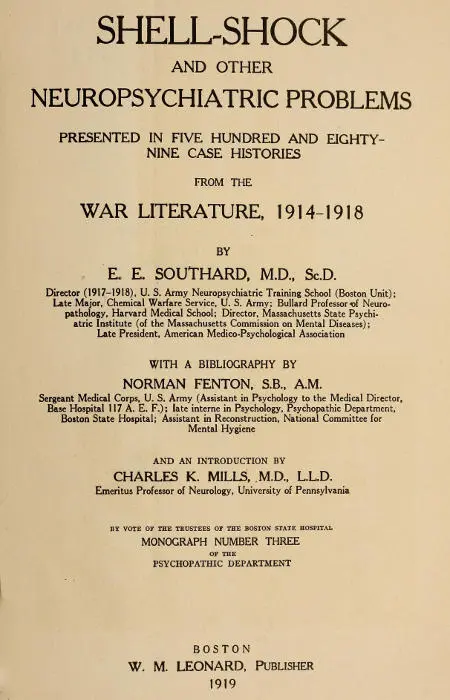
"SHELL-SHOCK AND OTHER NEUROPSYCHIATRIC PROBLEMS" by E. E. Southard is a scientific publication written in the early 20th century. The book serves as a case-history compilation focused on neuropsychiatric conditions arising from World War I, specifically highlighting cases categorized under 'Shell-shock.' Through detailed records and analyses of various cases, Southard aims to provide insights into the psychological and neurological effects of warfare on soldiers. The opening of the volume sets the stage for a comprehensive examination of neuropsychiatric issues linked to the horrors of war. It introduces the purpose of the book, which is to document and analyze case histories from both military and civilian perspectives. Southard discusses the challenges faced by the medical community in treating these conditions due to the unique stresses of combat, and he emphasizes the importance of including a wide range of cases from different countries involved in the war. The introduction also hints at the evolving understanding of war-related psychological conditions and lays the groundwork for the subsequent sections that delve deeper into specific cases and treatments.
Introduction adapted from the source catalogue; source summaries may be automatically generated.
Free to read · English · 312,106 words · No account needed
MAKE TIME FOR A GOOD BOOK
On by default. Untick to stop anonymous reading totals. Each page counts after 10 seconds in view. How this works.
Anonymous counting is on unless you have switched it off.
Neurologically, there was a partial spastic paralysis of the right thigh which could be abducted, could be flexed to 120°, and showed some power in the quadriceps. There was also a spastic paralysis of the right arm, but the shoulder girdle movements were not impaired. There was a slight weakness on the right side of the face. There was no anesthesia anywhere.
The deep reflexes were increased on the right side, Babinski on right, flexor contractures of right hand, extensor contractures of right leg, abdominal and epigastric reflexes absent, pupils active, tongue protruded in straight line.
Fluid: slight increase in protein. W. R. + + +
The Board of Pension Commissioners ruled that the condition had been aggravated by service (not “on service”).
Re general paresis, Fearnsides suggested at the Section of Neurology in the Royal Society of Medicine early in 1916, that in all cases of suspected Shell-shock the Wassermann reaction of the serum should be determined, and went on to say that cases of so-called Shell-shock with positive W. R. often improve rapidly with antisyphilitic remedies.
Duration of neurosyphilitic process important re compensation.
=Case 8.= (FARRAR, personal communication, 1917.)
A Canadian of 36 enlisted in 1915, served in England, and was returned to Canada in February, 1917, clearly suffering from some form of neurosyphilis (W. R. positive in serum and fluid, globulin, pleocytosis 108).
There is no record of any disability or symptom of nervous or mental disease at enlistment. The first symptoms were noted by the patient in May, 1916, six months or more after enlistment. The case was reviewed at a Canadian Special Hospital, October 11, 1916, by a board which reported:
“The condition could only come from syphilitic infection of three years’ standing” (a decision bearing on compensation); but the general diagnosis remained:
“Cerebrospinal lues, =aggravated by service=.”
The picture which the medical board regarded as of at least three years’ standing was as follows:
History of incontinence, shooting pains, attacks of syncope, general weakness, facial tremor, exaggerated knee-jerks, pupils react with small excursion. Speech and writing disorder, perception dull, lapses of attention, memory defect, defective insight into nature of disorder, emotional apathy.
1. Was the conclusion “aggravated by service” sound? On humanitarian grounds the victim is naturally conceded the benefit of the doubt. But it is questionable how scientifically sound the conclusion really was.
2. Could the condition come only from syphilitic infection of at least three years’ standing? Hardly any single symptom in this case need be of so long a standing; yet the combination of symptoms seems by very weight of numbers to justify the conclusion of the medical board.
Your reading position is saved on this browser. Take it to another device with a library code. Reading pages adapt to text, rather than matching a printed edition.
BEHIND THE BOOK
This eBook is for the use of anyone anywhere in the United States and most other parts of the world at no cost and with almost no restrictions whatsoever. You may copy it, give it away or re-use it under the terms of the Project Gutenberg License included with this eBook or online at www.gutenberg.org. If you are not located in the United States, you will have to check the laws of the country where you are located before using this eBook. Read the source licence.
The original source file, including credits and licence, is retained by this library. Request an original-format copy at no charge. Please include the book title and Project Gutenberg identifier #52105.
KEEP YOUR CURIOSITY GOING
Cécile Tormay

Moritz Busch
John L. Ransom
Frances Wright
Cécile Tormay

Mabel Potter Daggett