THE CLASSIC COLLECTION✦An outlaw’s diary: the CommuneCLASSIC FREE BOOKS
An outlaw’s diary: the Commune
Cécile Tormay
THE CLASSIC COLLECTION · 1919
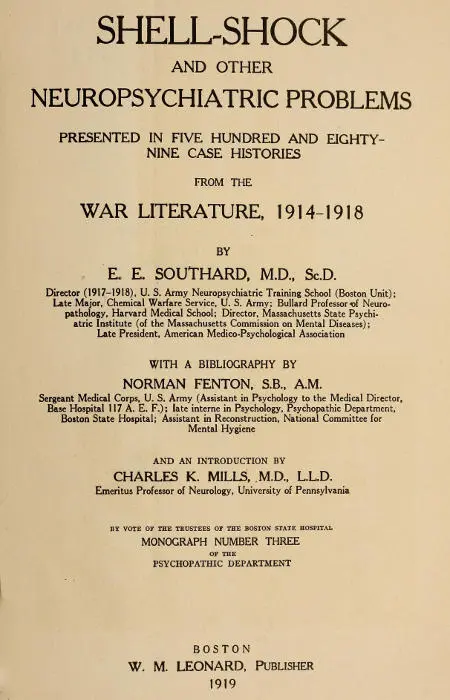
"SHELL-SHOCK AND OTHER NEUROPSYCHIATRIC PROBLEMS" by E. E. Southard is a scientific publication written in the early 20th century. The book serves as a case-history compilation focused on neuropsychiatric conditions arising from World War I, specifically highlighting cases categorized under 'Shell-shock.' Through detailed records and analyses of various cases, Southard aims to provide insights into the psychological and neurological effects of warfare on soldiers. The opening of the volume sets the stage for a comprehensive examination of neuropsychiatric issues linked to the horrors of war. It introduces the purpose of the book, which is to document and analyze case histories from both military and civilian perspectives. Southard discusses the challenges faced by the medical community in treating these conditions due to the unique stresses of combat, and he emphasizes the importance of including a wide range of cases from different countries involved in the war. The introduction also hints at the evolving understanding of war-related psychological conditions and lays the groundwork for the subsequent sections that delve deeper into specific cases and treatments.
Introduction adapted from the source catalogue; source summaries may be automatically generated.
Free to read · English · 312,106 words · No account needed
MAKE TIME FOR A GOOD BOOK
On by default. Untick to stop anonymous reading totals. Each page counts after 10 seconds in view. How this works.
Anonymous counting is on unless you have switched it off.
Here he was found sometimes sad, immobile; at other times laughing and singing. He was very irritable on small occasion. Once on leave he had a fugue with complete amnesia, though alcohol may account for the latter. His memory was vague, especially for his crimes and for recent events. He was emotional, indifferent even in the presence of his wife or aunt. Sexual indifference. He often complained of his head, saying that he felt it blocked and that he could not think. The headache was frontal and would last several hours. The man would, however, not complain spontaneously. He was physically, in general, negative.
This case might possibly be due to a post-typhoidal encephalitis, but Nordman believes rather that it is a case of dementia praecox. Perhaps the convulsions at eight produced a slight brain lesion, brought to an issue by the typhoid fever.
Paratyphoid fever: Psychosis outlasting fever.
=Case 125.= (MERKLEN, December, 1915.)
A Breton farmer, 34, had paratyphoid alpha. Admitted to hospital September 3, 1915, he had headache, anorexia, asthenia, coated tongue and tense abdomen, algosuria; later, abdominal swelling, borborygmi in the right iliac fossa, rose spots, dicrotism, albuminuria, bronchitic rales. The disease was severe, and was complicated by sacral decubitus and ran a month.
At first somnolent, September 8th the patient went into a state of mental excitement with agitation and delirium. He got out of bed, cried out, sang, talked to his neighbors, complained that his papers (colis) had been stolen, as well as his watch and tobacco; that his horses’ hoofs had been injured, and the like.
He grew calmer in a few days, and now no longer tried to get up, remaining inert in his bed. The occupation delirium persisted--he was not being paid what he owed, and the like. He had hallucinations; looked for scissors, and one day said, “Here they are!” At intervals he appeared lucid and responded appropriately to questions.
The fever dropped and the paratyphoid disease appeared past, but the mental state remained for three weeks without change, having the same periods of lucidity when he would be regarded as cured, but falling again forthwith into his post oniric ideas. He was soon sent to a convalescent hospital and was not wholly well for another month.
Psychopathic taint brought out by paratyphoid fever.
=Case 126.= (MERKLEN, December, 1915.)
A soldier, 31, was a victim of paratyphoid alpha, entering hospital October 21, 1915, with the usual symptomatology: fever, asthenia, headache, abdominal swelling, tongue coated and red along its edges, diarrhoea. After admission he passed into a deep toxic state.
Your reading position is saved on this browser. Take it to another device with a library code. Reading pages adapt to text, rather than matching a printed edition.
BEHIND THE BOOK
This eBook is for the use of anyone anywhere in the United States and most other parts of the world at no cost and with almost no restrictions whatsoever. You may copy it, give it away or re-use it under the terms of the Project Gutenberg License included with this eBook or online at www.gutenberg.org. If you are not located in the United States, you will have to check the laws of the country where you are located before using this eBook. Read the source licence.
The original source file, including credits and licence, is retained by this library. Request an original-format copy at no charge. Please include the book title and Project Gutenberg identifier #52105.
KEEP YOUR CURIOSITY GOING
Cécile Tormay

Moritz Busch
John L. Ransom
Frances Wright
Cécile Tormay

Mabel Potter Daggett