THE CLASSIC COLLECTION✦An outlaw’s diary: the CommuneCLASSIC FREE BOOKS
An outlaw’s diary: the Commune
Cécile Tormay
THE CLASSIC COLLECTION · 1919
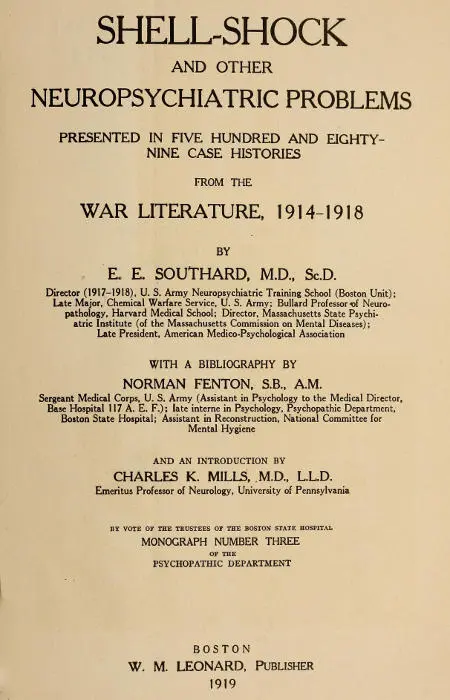
"SHELL-SHOCK AND OTHER NEUROPSYCHIATRIC PROBLEMS" by E. E. Southard is a scientific publication written in the early 20th century. The book serves as a case-history compilation focused on neuropsychiatric conditions arising from World War I, specifically highlighting cases categorized under 'Shell-shock.' Through detailed records and analyses of various cases, Southard aims to provide insights into the psychological and neurological effects of warfare on soldiers. The opening of the volume sets the stage for a comprehensive examination of neuropsychiatric issues linked to the horrors of war. It introduces the purpose of the book, which is to document and analyze case histories from both military and civilian perspectives. Southard discusses the challenges faced by the medical community in treating these conditions due to the unique stresses of combat, and he emphasizes the importance of including a wide range of cases from different countries involved in the war. The introduction also hints at the evolving understanding of war-related psychological conditions and lays the groundwork for the subsequent sections that delve deeper into specific cases and treatments.
Introduction adapted from the source catalogue; source summaries may be automatically generated.
Free to read · English · 312,106 words · No account needed
MAKE TIME FOR A GOOD BOOK
On by default. Untick to stop anonymous reading totals. Each page counts after 10 seconds in view. How this works.
Anonymous counting is on unless you have switched it off.
December 31, at the Hôtel-Dieu, he showed myosis, slight photophobia, meningitic tâche, temperature 39.6, pulse 84, heart sounds dull. Lumbar puncture: hemorrhagic fluid.
January 1, the headache was intense, neck stiffness increased, Kernig’s sign less marked; morning and afternoon temperature 39.2. Lumbar puncture yielded hypertensive cloudy fluid and 30 cubic centimeters of serum were administered.
This dose was repeated January 2 and January 3, on which date there was
no headache.
January 4, Kernig’s sign and neck stiffness were diminished; fine râles at the bases without dulness. 30 cubic centimeters of electragol were injected intravenously.
January 5, Kernig and neck stiffness slight. Meningitic tâche; exaggerated knee-jerks; unequal pupils; temp. 36.6 morning, 39.4 afternoon; respiration 36; pulse 120; no râles; splenic enlargement.
6, no headache or photophobia; constipation; fine râles, right base; spartein; meningococci found in hypertensive spinal fluid. 30 cc. serum.
7, more râles; exaggerated heart sounds; intestinal worms in stools.
8, temperature fell to 37; pulse to 90.
9, patient worse; involuntary stools; Kernig’s sign; stiff neck; fever.
30 cc. serum injected.
10, 20 cc. injected.
11, delirious all night; tetaniform stiffness of neck; more râles.
12, delirious, incoherent words, Cheyne-Stokes breathing.
13, less stiffness, Kernig almost absent; pupils normal; Romberg sign slightly developed; pulse 120.
14, a few râles at right base.
15, pains in elbows, knees and hands with joint swelling; moist râles; temp. 38.4; pulse 140. Digitalon.
16 and 17, serum erythema of thorax; edema of left knee; pulse 150;
spartein 16.
17, ice pack over heart.
18, edema of knee diminished; no headache, delirium or pupillary sign.
19, improvement. Temperature normal thereafter.
20 and 21, fine râles. Then all symptoms disappeared.
Recovery was predicted, but on January 28 it was observed that the patient was untidy, made mistakes in dressing, such as trying to put his legs into the armholes of his shirt, and denied the most evident facts: His képi on his head, he said it was not. Face drawn; skin yellow. Appearance of asthenia. Deep depression and hebetude. At this time the knee-jerks were exaggerated, pupils unequal, vermicular tremor of tongue; the patient walked on a broad base with tremulous legs suggesting contracture and weakness.
February 8, in a similar state the patient wandered about his room, moving his bed and chairs about, answering questions with an absent air. He had now been taught to be less untidy.
March 5, stiff neck and Kernig’s sign were distinct. He made believe he was on his farm. Ecchymosis of right upper eyelid: he had fallen (his sheep had pushed him over!). The improbability of this idea did not persuade him to think it had not happened. He walked after the manner of a tabetic.
Your reading position is saved on this browser. Take it to another device with a library code. Reading pages adapt to text, rather than matching a printed edition.
BEHIND THE BOOK
This eBook is for the use of anyone anywhere in the United States and most other parts of the world at no cost and with almost no restrictions whatsoever. You may copy it, give it away or re-use it under the terms of the Project Gutenberg License included with this eBook or online at www.gutenberg.org. If you are not located in the United States, you will have to check the laws of the country where you are located before using this eBook. Read the source licence.
The original source file, including credits and licence, is retained by this library. Request an original-format copy at no charge. Please include the book title and Project Gutenberg identifier #52105.
KEEP YOUR CURIOSITY GOING
Cécile Tormay

Moritz Busch
John L. Ransom
Frances Wright
Cécile Tormay

Mabel Potter Daggett