The Devil
Leo, graf Tolstoy
THE CLASSIC COLLECTION · 1888
"Sevastopol" by graf Leo Tolstoy is a collection of three short stories published in 1855. Based on Tolstoy's firsthand experiences during the Siege of Sevastopol in Crimea, these sketches offer an unflinching look at war's realities. Through intimate tours of battlefield hospitals, examinations of military psychology and vanity, and the intertwined fates of two brothers, Tolstoy captures both the human cost of conflict and the senselessness of war. These stories later formed the foundation for episodes in his masterwork, "War and Peace."
Introduction adapted from the source catalogue; source summaries may be automatically generated.
Free to read · English · 47,351 words · No account needed
MAKE TIME FOR A GOOD BOOK
On by default. Untick to stop anonymous reading totals. Each page counts after 10 seconds in view. How this works.
Anonymous counting is on unless you have switched it off.
“Well, Captain,” said Kalugin, “when are we to go to the bastion again? Do you remember how we met each other on the Schvartz redoubt—it was hot there, hey?”
“Yes, it was hot,” said Mikhaïloff, recalling how he had, that night, as he was making his way along the trenches to the bastion, encountered Kalugin, who was walking along like a hero, valiantly clanking his sword. “I ought to have gone there to-morrow, according to present arrangements; but we have a sick man,” pursued Mikhaïloff, “one officer, as....”
He was about to relate how it was not his turn, but, as the commander of the eighth company was ill, and the company had only a cornet left, he had regarded it as his duty to offer himself in the place of Lieutenant Nepshisetzky, and was, therefore, going to the bastion to-day. But Kalugin did not hear him out.
“I have a feeling that something is going to happen within a few days,” he said to Prince Galtsin.
“And won't there be something to-day?” asked Mikhaïloff, glancing first at Kalugin, then at Galtsin.
No one made him any reply. Prince Galtsin merely frowned a little, sent his eyes past the other's cap, and, after maintaining silence for a moment, said:—
“That's a magnificent girl in the red kerchief. You don't know her, do
you, captain?”
“She lives near my quarters; she is the daughter of a sailor,” replied
the staff-captain.
“Come on; let's have a good look at her.”
And Prince Galtsin linked one arm in that of Kalugin, the other in that of the staff-captain, being convinced in advance that he could afford the latter no greater gratification, which was, in fact, quite true.
The staff-captain was superstitious, and considered it a great sin to occupy himself with women before a battle; but on this occasion he feigned to be a vicious man, which Prince Galtsin and Kalugin evidently did not believe, and which greatly amazed the girl in the red kerchief, who had more than once observed how the staff-captain blushed as he passed her little window. Praskukhin walked behind, and kept touching Prince Galtsin with his hand, and making various remarks in the French tongue; but as a fourth person could not walk on the small path, he was obliged to walk alone, and it was only on the second round that he took the arm of the brave and well known naval officer Servyagin, who had stepped up and spoken to him, and who was also desirous of joining the circle of aristocrats. And the gallant and famous beau joyfully thrust his honest and muscular hand through the elbow of a man who was known to all, and even well known to Servyagin, as not too nice. When Praskukhin, explaining to the prince his acquaintance with that sailor, whispered to him that the latter was well known for his bravery, Prince Galtsin, having been on the fourth bastion on the previous evening, having seen a bomb burst twenty paces from him, considering himself no less a hero than this gentleman, and thinking that many a reputation is acquired undeservedly, paid no particular attention to Servyagin.
Your reading position is saved on this browser. Take it to another device with a library code. Reading pages adapt to text, rather than matching a printed edition.
Leo, graf Tolstoy
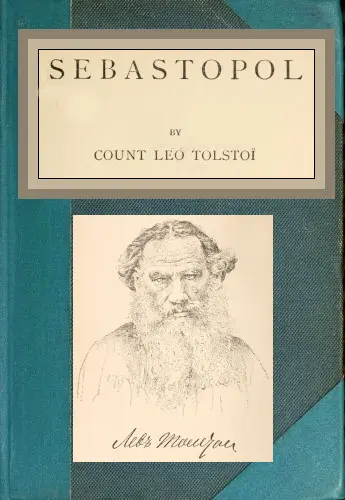
Leo, graf Tolstoy
Leo, graf Tolstoy
Leo, graf Tolstoy
BEHIND THE BOOK
This eBook is for the use of anyone anywhere in the United States and most other parts of the world at no cost and with almost no restrictions whatsoever. You may copy it, give it away or re-use it under the terms of the Project Gutenberg License included with this eBook or online at www.gutenberg.org. If you are not located in the United States, you will have to check the laws of the country where you are located before using this eBook. Read the source licence.
The original source file, including credits and licence, is retained by this library. Request an original-format copy at no charge. Please include the book title and Project Gutenberg identifier #47197.
KEEP YOUR CURIOSITY GOING
Cécile Tormay

Moritz Busch
Coulson Kernahan
John L. Ransom

Maurice Baring
Frances Wright