THE CLASSIC COLLECTION✦DisciplineCLASSIC FREE BOOKS
Discipline
Mary Brunton
THE CLASSIC COLLECTION · 1811
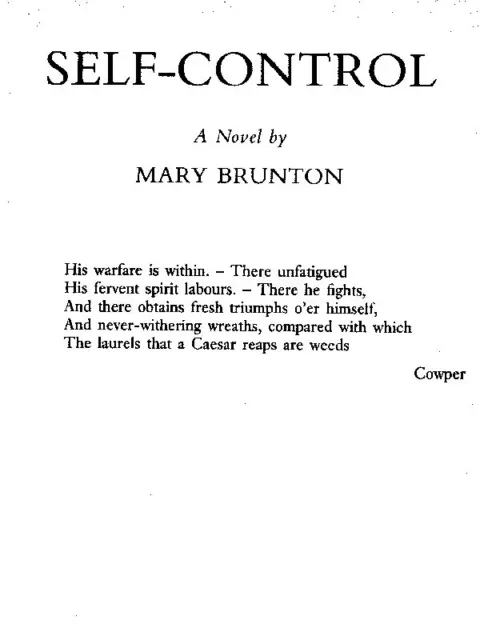
"Self-control: A Novel" by Mary Brunton is a novel published in 1811. The devout Laura Montreville faces relentless pursuit from the rake Colonel Hargrave, refusing his proposal despite his wealth and title. When circumstances force her to support her ailing father in London, Hargrave's obsession intensifies dangerously. His increasingly desperate measures culminate in a shocking kidnapping to the American wilderness. This morally-driven tale explores the power of religious principle and self-command, while challenging the romantic notion that reformed rakes make ideal husbands.
Introduction adapted from the source catalogue; source summaries may be automatically generated.
Free to read · English · 187,342 words · No account needed
MAKE TIME FOR A GOOD BOOK
On by default. Untick to stop anonymous reading totals. Each page counts after 10 seconds in view. How this works.
Anonymous counting is on unless you have switched it off.
'This kind of energy,' said Laura, with a smile, 'has at least the merit of being very generally attainable.' This remark was not in Miss Julia's line. She had, therefore, recourse to her book, and with great variety of grimace, read aloud one of Casimir's impassioned, or, as Laura thought, frantic speeches. The curious contrast of the reader's manner, with her appearance, of the affected sentimentality of her air, with the robust vulgarity of her figure, struck Laura as so irresistibly ludicrous, that, though of all young ladies, she was the least addicted to tittering, her politeness would have been fairly defeated in the struggle, had it not been reinforced by the entrance of Mr and Mrs Jones. The former was a little man, in a snuff-coloured coat, and a brown wig, who seemed to be about fifty,--the latter was a good-humoured commonplace looking woman, of about half that age. Laura was pleased with the cordiality with which Mr Jones shook his mother-in-law by the hand, saying, 'Well, Mother, I's brought you Kate pure and hearty again, and the little fellow is fine and well, tho'f he be too young to come a wisiting.'
As soon as the commotion occasioned by their entrance was over, and Laura formally made acquainted with the lady, Mrs Dawkins began, 'I hopes, Kate, you ha'nt forgot how to tell about your jaunt to Scotland; for this here young lady staid tea just o'purpose to hear it.' 'Oh, that I ha'nt,' said Mrs Jones, 'I'm sure I shall remember it the longest day I have to live.' 'Pray Miss,' added she, turning to Laura, 'was you ever in Glasgow?' 'Never,' said Laura; 'but I have heard that it is a fine city.' 'Ay, but I've been there first and last eleven days; and I can say for it, it is really a handsome town, and a mort of good white-stone houses in it. For you see, when Mr Jones married me, he had not been altogether satisfied with his rider, and he thoft as he'd go down to Glasgow himself and do business; and that he'd make it do for his wedding jaunt, and that would be killing two dogs with one stone.' 'That was certainly an excellent plan,' said Laura. 'Well,' continued Mrs Jones, 'when we'd been about a week in Glasgow, we were had to dine one day with Mr Mactavish, as supplies Mr Jones with ginghams; and he talked about some grand house of one of your Scotch dukes, and said as how we must'nt go home without seeing it. So we thought since we had come so far, we might as well see what was to be seen.' 'Certainly,' said Laura, at the pause which was made to take breath, and receive approbation. 'Well, we went down along the river, which, to say truth, is very pretty, tho'f it be not turfed, nor kept neat round the edges, to a place they call Dumbarton; where there is a rock, for all the world, like an ill-made sugar loaf, with a slice out o' the middle on't; and they told us there was a castle on it, but such a castle!' 'Pray, sister,' said Miss Julia, 'have you an accurate idea of what constitutes a castle? of the keeps, the turrets, the winding staircases, and the portcullis?' 'Bless you, my dear,' returned the traveller, 'ha'nt I seen Windsor Castle, and t'other's no more like it--no more than nothing at all. Howsoever, we slept that night at a very decent sort of an inn; and Mr Jones thought as we were so comfortable, we had best come back to sleep. So as the duke's house was but thirty miles off, we thought if we set off soon in the morning, we might get back at night. So off we set, and went two stages to breakfast, at a place with one of their outlandish names; and to be sartain, when we got there, we were as hungry as hounds. Well, we called for hot rolls; and, do but think, there was'nt no such thing to be had for love or money.'
Your reading position is saved on this browser. Take it to another device with a library code. Reading pages adapt to text, rather than matching a printed edition.
BEHIND THE BOOK
This eBook is for the use of anyone anywhere in the United States and most other parts of the world at no cost and with almost no restrictions whatsoever. You may copy it, give it away or re-use it under the terms of the Project Gutenberg License included with this eBook or online at www.gutenberg.org. If you are not located in the United States, you will have to check the laws of the country where you are located before using this eBook. Read the source licence.
The original source file, including credits and licence, is retained by this library. Request an original-format copy at no charge. Please include the book title and Project Gutenberg identifier #41196.
KEEP YOUR CURIOSITY GOING
Coulson Kernahan

Maurice Baring
Frances Wright
Cécile Tormay

Frederic Jesup Stimson

W. H. P. (William Henry Pope) Jarvis