THE CLASSIC COLLECTION✦DisciplineCLASSIC FREE BOOKS
Discipline
Mary Brunton
THE CLASSIC COLLECTION · 1811
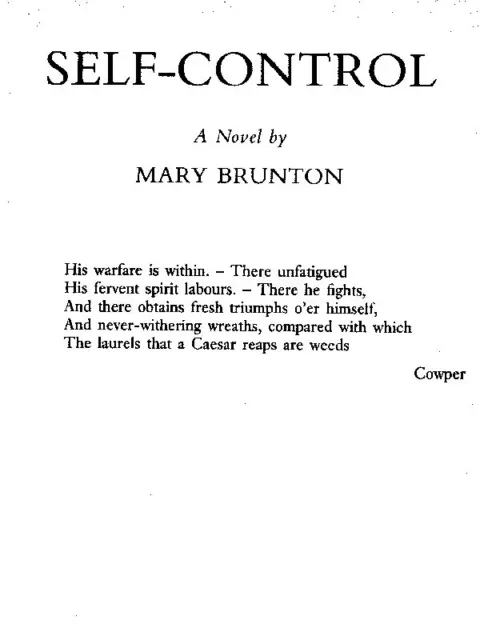
"Self-control: A Novel" by Mary Brunton is a novel published in 1811. The devout Laura Montreville faces relentless pursuit from the rake Colonel Hargrave, refusing his proposal despite his wealth and title. When circumstances force her to support her ailing father in London, Hargrave's obsession intensifies dangerously. His increasingly desperate measures culminate in a shocking kidnapping to the American wilderness. This morally-driven tale explores the power of religious principle and self-command, while challenging the romantic notion that reformed rakes make ideal husbands.
Introduction adapted from the source catalogue; source summaries may be automatically generated.
Free to read · English · 187,342 words · No account needed
MAKE TIME FOR A GOOD BOOK
On by default. Untick to stop anonymous reading totals. Each page counts after 10 seconds in view. How this works.
Anonymous counting is on unless you have switched it off.
Laura had proceeded but a short way towards Norwood when she was met by De Courcy, who, with a manner the most opposite to his coldness on the preceding day, sprang forward to meet her, his countenance radiant with pleasure. Laura, delighted with the change, playfully reproached him with his caprice. Montague coloured, but defended himself with spirit; and a dialogue, more resembling flirtation than any in which Laura had ever engaged, occupied them till, as they loitered along the dark avenue of Norwood, a shade of the sentimental began to mingle with their conversation. De Courcy had that morning resolved, firmly resolved, that while Laura was his guest at Norwood, he would avoid a declaration of his sentiments. Convinced, as he now was, that he no longer had any thing to fear from the perseverance of Hargrave, he was yet far from being confident of his own success. On the contrary, he was persuaded that he had hitherto awakened in Laura no sentiment beyond friendship, and that she must become accustomed to him as a lover, before he could hope for any farther grace. He considered how embarrassing would be her situation in a house of which the master was a repulsed, perhaps a rejected, admirer; and he had determined not to hazard embittering to her a residence from which she had at present no retreat. Yet the confiding manner, the bewitching loveliness of Laura, the stillness, shade, and solitude of their path had half-beguiled him of his prudence, when, fortunately for his resolution, he saw Harriet advancing to meet her friend. Harriet's liveliness soon restored gaiety to the conversation; and the party proceeded less leisurely than before to Norwood, where Laura was received with affectionate cordiality by Mrs De Courcy.
Never had the time appeared to Laura to fly so swiftly as now. Every hour was sacred to improvement, to elegance, or to benevolence. Laura had a mind capable of intense application; and therefore could exalt relaxation into positive enjoyment. But the pleasure which a vigorous understanding takes in the exercise of its powers, was now heightened in her hours of study, by the assistance, the approbation of De Courcy; and the hours of relaxation he enlivened by a manner which, at once frank and respectful, spirited and kind, seemed peculiarly fitted to adorn the domestic circle. A part of each day was employed by Mrs De Courcy in various works of charity; and, joining in these, Laura returned with satisfaction to a habit which she had unwillingly laid aside during her residence in London, and but imperfectly resumed at Walbourne. Amiable, rational, and pious, the family at Norwood realized all Laura's day-dreams of social happiness; and the only painful feeling that assailed her mind arose from the recollection that the time of her visit was fast stealing away. Her visit was, however, prolonged by a fortunate cold which detained Lady Pelham at Derham Green; and Laura could not regret an accident which delayed her separation from her friends. Indeed she began to dread Lady Pelham's return, both as the signal of her departure from Norwood, and as a prelude to the renewal of her persecutions on account of Hargrave. Far from having, as Lady Pelham had insinuated, renounced his pursuit, he returned in a few days from Mrs Bathurst's; again established himself with Lambert; and, though he could not uninvited intrude himself into Norwood, contrived to beset Laura as often as she passed its bounds. In the few visits which she paid, she generally encountered him; and he regularly waylaid her at church. But he had lost an able coadjutor in Lady Pelham; and now, when no one present was concerned to assist his designs, and when Laura was protected by kind and considerate friends, she generally found means to escape his officious attentions; though, remembering his former jealousy of Montague, and the irritability of his temper, she was scrupulously cautious of marking her preference of De Courcy, or of appearing to take sanctuary with him from the assiduities of Hargrave. Indeed, notwithstanding the mildness of De Courcy's disposition, she was not without fear that he might be involved in a quarrel by the unreasonable suspicions of Hargrave, who had often taxed her with receiving his addresses, ascribing his own failure to their success. She had in vain condescended to assure him that the charge was groundless. He never met De Courcy without shewing evident marks of dislike. If he accosted him, it was in a tone and manner approaching to insult. The most trivial sentence which De Courcy addressed to Laura, drew from Hargrave looks of enmity and defiance; while Montague, on his part, returned these aggressions by a cool disdain, the most opposite to the conciliating frankness of his general manners. Laura's alarm lest Hargrave's ill-concealed aversion should burst into open outrage, completed the dread with which he inspired her; and she felt like one subjected to the thraldom of an evil genius, when he one day announced to her that he had procured leave to remove his regiment to --; in order, as he said, 'that he might be at hand to assert his rights over her.'
Your reading position is saved on this browser. Take it to another device with a library code. Reading pages adapt to text, rather than matching a printed edition.
BEHIND THE BOOK
This eBook is for the use of anyone anywhere in the United States and most other parts of the world at no cost and with almost no restrictions whatsoever. You may copy it, give it away or re-use it under the terms of the Project Gutenberg License included with this eBook or online at www.gutenberg.org. If you are not located in the United States, you will have to check the laws of the country where you are located before using this eBook. Read the source licence.
The original source file, including credits and licence, is retained by this library. Request an original-format copy at no charge. Please include the book title and Project Gutenberg identifier #41196.
KEEP YOUR CURIOSITY GOING
Coulson Kernahan

Maurice Baring
Frances Wright
Cécile Tormay

Frederic Jesup Stimson

W. H. P. (William Henry Pope) Jarvis