THE CLASSIC COLLECTION✦DisciplineCLASSIC FREE BOOKS
Discipline
Mary Brunton
THE CLASSIC COLLECTION · 1811
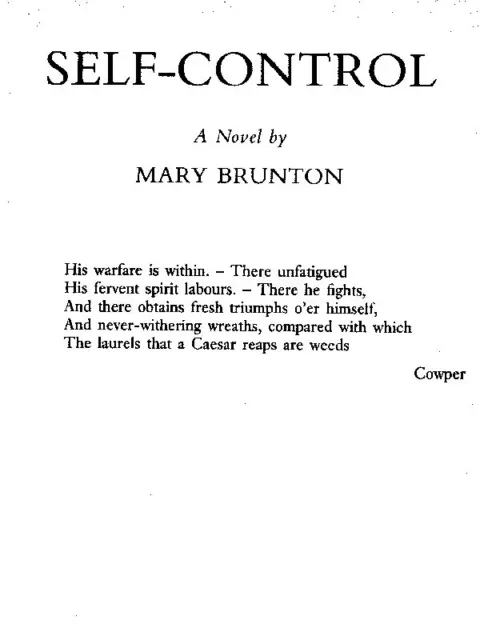
"Self-control: A Novel" by Mary Brunton is a novel published in 1811. The devout Laura Montreville faces relentless pursuit from the rake Colonel Hargrave, refusing his proposal despite his wealth and title. When circumstances force her to support her ailing father in London, Hargrave's obsession intensifies dangerously. His increasingly desperate measures culminate in a shocking kidnapping to the American wilderness. This morally-driven tale explores the power of religious principle and self-command, while challenging the romantic notion that reformed rakes make ideal husbands.
Introduction adapted from the source catalogue; source summaries may be automatically generated.
Free to read · English · 187,342 words · No account needed
MAKE TIME FOR A GOOD BOOK
On by default. Untick to stop anonymous reading totals. Each page counts after 10 seconds in view. How this works.
Anonymous counting is on unless you have switched it off.
She was busily searching every corner for the hidden handkerchief, the little rogue who had concealed it in his shoe laughing the while and clapping his hands in delight, when she started at the voice of a stranger in the lobby; who was announcing that he had a letter for Mrs Douglas, which he could deliver to no person but herself. The next moment the stranger was shewn in to the room, and Laura with amazement beheld her American attendant. The amazement on his part was still greater. He started, he trembled, he at first shrunk from Laura, then eagerly advancing towards her, 'Bless my soul, Madam!' he exclaimed, 'are you alive? Then Mary's words are true, and the angels watch over you.'
It was some time before the man's astonishment would permit him to declare his errand. At last when his curiosity had been partially satisfied, he was prevailed upon to enter his narrative. 'You may remember, Madam,' said he, addressing himself to Laura, 'it was the morning we expected my master, (though I told Mary, for a make-believe, that he would not come till evening,) that morning Mary took you out and left you; for which I was mortal angry with her, for my mind misgave me that some mischief would come of it. So she ran down to the place where she left you sitting, but you were not there. Then she looked all about, but she could see you nowhere. She was afraid to go among the canes, for fear of the rattlesnakes, so she ran home and told me. So I went with her, scolding her to be sure all the way. Well we sought and sought, till at last, half in the water, and half on the shore, we found your hat and then to be sure none of us never doubted that you had drowned yourself; and Mary cried and wrung her hands like a distracted creature, saying that my master was a wicked wretch that had broken your heart, and often and often she wished that we could find you to give you Christian burial, for she said she was sure your ghost would never let her rest in her bed. But we had no drags, nor anything to take you up with out of the water. Well, we were just in the midst of all our troubles when my master came. "Well, Robert," says he, in his hearty way, "Where is my angel?" I had not the heart to say a word; so with that Mary ran forward sobbing like a baby, and says she, just off hand, "Miss Montreville is in a watery grave, and I am sure, Sir, some heavy judgment will light on him that drove her to it." So my master stood for a moment thunderstruck, as it were, and then he flew upon us both like a tiger, and shook us till he scarce left breath in us, and swore that it was all a trick, and that he would make us produce you or he would have our lives. So I tried to pacify him the best I could; but Mary answered him, that it was all his own doing, and that he might seek you in the river where he would find your corpse. This put my master quite beside himself; and he catched her up, and flung her from him, just as if she had been a kitten; and then he flew down to the river side, and I followed him, and shewed him where we had found your hat; and explained to him how it was not our fault, for we had both been very civil and given you no disturbance at all, which you know Madam was true. So, close to the place where we found your hat we saw the print of your little shoe in the bank; and when my master saw it he grew quite distracted, crying out that he had murdered you, and that he would revenge you upon a wretch not fit to live (meaning himself, Madam), and so he would have leaped into the river; but by this time one of the servants he brought with him came up, and we forced him back to the house. Then he grew more quiet; and called for Mary, and gave her his purse with all his money, and bid her tell every thing about you, Madam; how you had behaved, and what you had said. So she told him, crying all the while, for she repented from her heart that ever she consented to have any hand in the business. And sometimes he would start away and gnash his teeth, and dash his head against the wall; and sometimes he would bid her go on, that he might run distracted at once and forget all. So she told him that you had written to one Mrs Douglas, in hopes that when you were dead he would take pity on you, (repeating your very words, Madam). Then he asked to see the letter, and he carried it into your room. And there we heard him groaning and speaking to himself, and throwing himself against the walls; and we thought it best to let him come to himself a little and not disturb him. So by and by he called for pen and ink, and I carried them to him, thinking if he wanted to write it was a sign he was growing more calm. Then he continued writing for some time, though now and again we heard him restless as before. At last he opened the door, and called me, "Robert," says he, quite calm and composed like, "if you deliver this packet as directed, you will earn three hundred pounds. But be sure to deliver it with your own hand." I was going to ask him something more about it, for I did not just know what he meant about the £300; but he pushed me out, and shut himself into the room. Then I bethought myself that there was something strange like in his look, and that he was pale, and somehow not like himself. So I went to the kitchen to consult with the rest what we had best do. So I had scarcely got there when I heard a pistol go off, and we all ran and burst open the door, and there we saw my master, Madam, laid out upon Miss Montreville's bed, and the pistol still in his hand; though he was stone dead, Madam, for I suppose the ball had gone right through his heart.'
Your reading position is saved on this browser. Take it to another device with a library code. Reading pages adapt to text, rather than matching a printed edition.
BEHIND THE BOOK
This eBook is for the use of anyone anywhere in the United States and most other parts of the world at no cost and with almost no restrictions whatsoever. You may copy it, give it away or re-use it under the terms of the Project Gutenberg License included with this eBook or online at www.gutenberg.org. If you are not located in the United States, you will have to check the laws of the country where you are located before using this eBook. Read the source licence.
The original source file, including credits and licence, is retained by this library. Request an original-format copy at no charge. Please include the book title and Project Gutenberg identifier #41196.
KEEP YOUR CURIOSITY GOING
Coulson Kernahan

Maurice Baring
Frances Wright
Cécile Tormay

Frederic Jesup Stimson

W. H. P. (William Henry Pope) Jarvis