THE CLASSIC COLLECTION✦DisciplineCLASSIC FREE BOOKS
Discipline
Mary Brunton
THE CLASSIC COLLECTION · 1811
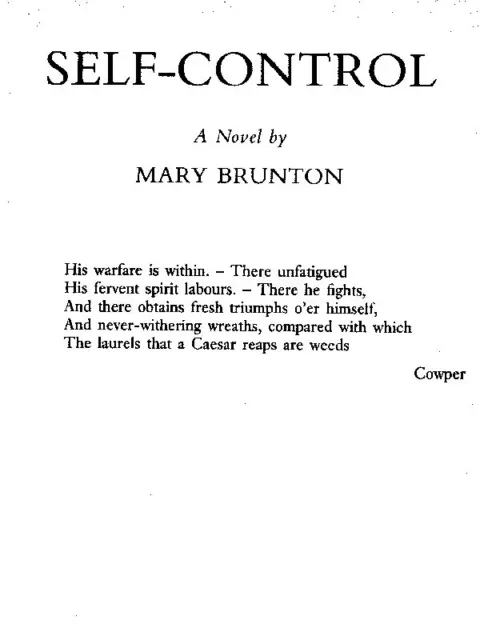
"Self-control: A Novel" by Mary Brunton is a novel published in 1811. The devout Laura Montreville faces relentless pursuit from the rake Colonel Hargrave, refusing his proposal despite his wealth and title. When circumstances force her to support her ailing father in London, Hargrave's obsession intensifies dangerously. His increasingly desperate measures culminate in a shocking kidnapping to the American wilderness. This morally-driven tale explores the power of religious principle and self-command, while challenging the romantic notion that reformed rakes make ideal husbands.
Introduction adapted from the source catalogue; source summaries may be automatically generated.
Free to read · English · 187,342 words · No account needed
MAKE TIME FOR A GOOD BOOK
On by default. Untick to stop anonymous reading totals. Each page counts after 10 seconds in view. How this works.
Anonymous counting is on unless you have switched it off.
On comparing the suppressed melancholy of Laura, her embarrassment at the mention of Hargrave, and her inadvertent disclosure, with her father's detail of her rejection of the insinuating young soldier, a suspicion not very remote from truth, had entered the mind of Mrs Douglas. She imagined that Captain Montreville had in some way been deceived as to the kind of proposals made to his daughter; and that Laura had rejected no offers but such as it would have been infamy to accept. Under this conviction, it is not surprising that her reception of the Colonel was far from being cordial; nor that, guessing his correspondence to be rather intended for the young lady than for the old gentleman, she chose to afford no facility to an intercourse which she considered as both dangerous and degrading. To Hargrave's questions, therefore, she answered, that until she should hear from London, she was ignorant of Captain Montreville's address; and that the time of his return was utterly unknown to her. When the Colonel, with the same intention, soon after repeated his visit, she quietly, but steadily, evaded all his inquiries, equally unmoved by his entreaties, and the paroxysms of impatience with which he endured his disappointment.
Hargrave was the only child of a widow--an easy, indolent, good sort of woman, who would gladly have seen him become every thing that man ought to be, provided she could have accomplished this laudable desire without recourse to such harsh instruments as contradiction and restraint. But of these she disliked the use, as much as her son did the endurance: and thus the young gentleman was educated, or rather grew up, without the slightest acquaintance of either. Of consequence, his naturally warm temper became violent, and his constitutionally strong passions ungovernable.
Hargrave was the undoubted heir of a title, and of a fine estate. Of money he had never felt the want, and did not know the value; he was, therefore, so far as money was concerned, generous even to profusion. His abilities were naturally of the highest order. To force him to the improvement of them, was an effort above the power of Mrs Hargrave; but, fortunately for him, ere his habits of mental inaction were irremediable, a tedious illness confined him to recreations in which mind had some share, however small. During the interdiction of bats and balls, he, by accident, stumbled on a volume of Peregrine Pickle, which he devoured with great eagerness; and his mother, delighted with what she was pleased to call a turn for reading, took care that this new appetite should not, any more than the old ones, pine for want of gratification. To direct it to food wholesome and invigorating, would have required unremitting though gentle labour: and to labour of all kinds Mrs Hargrave had a practical antipathy. But it was very easy to supply the young man with romances, poetry, and plays; and it was pleasing to mistake their intoxicating effect for the bursts of mental vigour. A taste for works of fiction, once firmly established, never after yielded to the attractions of sober truth; and, though his knowledge of history was neither accurate nor extensive, Hargrave could boast of an intimate acquaintance with all the plays, with almost all the poetry, and as far as it is attainable by human diligence, with all the myriads of romances in his mother tongue. He had chosen, of his own free-will, to study the art of playing on the flute; the violin requiring more patience than he had to bestow; and emulation, which failed to incite him to more useful pursuits, induced him to try whether he could not draw as well as his play-fellow, De Courcy. At the age of seventeen he had entered the army. As he was of good family, of an elegant figure, and furnished by nature with one of the finest countenances she ever formed, his company was courted in the highest circles, and to the ladies he was particularly acceptable. Among such associates, his manners acquired a high polish; and he improved in what is called knowledge of the world; that is, a facility of discovering, and a dexterity in managing the weaknesses of others. One year--one tedious year, his regiment had been quartered in the neighbourhood of the retirement where the afore-said De Courcy was improving his 'few paternal acres;' and, partly by his persuasion and example, partly from having little else to do, partly because it was the fashionable science of the day, Hargrave had prosecuted the study of chemistry. Thus have we detailed, and in some measure accounted for, the whole of Colonel Hargrave's accomplishments, excepting only, perhaps, the one in which he most excelled--he danced inimitably. For the rest, he had what is called a good heart; that is, he disliked to witness or inflict pain, except from some incitement stronger than advantage to the sufferer. His fine eyes had been seen to fill with tears at a tale of elegant distress; he could even compassionate the more vulgar sorrows of cold and hunger to the extent of relieving them, provided always that the relief cost nothing but money. Some casual instances of his feeling, and of his charity, had fallen under the observation of Laura; and upon these, upon the fascination of his manners, and the expression of his countenance, her fervid imagination had grafted every virtue that can exalt or adorn humanity. Gentle reader, excuse the delusion. Laura was only seventeen--Hargrave was the first handsome man of fashion she had ever known, the first who had ever poured into her ear the soothing voice of love.
Your reading position is saved on this browser. Take it to another device with a library code. Reading pages adapt to text, rather than matching a printed edition.
BEHIND THE BOOK
This eBook is for the use of anyone anywhere in the United States and most other parts of the world at no cost and with almost no restrictions whatsoever. You may copy it, give it away or re-use it under the terms of the Project Gutenberg License included with this eBook or online at www.gutenberg.org. If you are not located in the United States, you will have to check the laws of the country where you are located before using this eBook. Read the source licence.
The original source file, including credits and licence, is retained by this library. Request an original-format copy at no charge. Please include the book title and Project Gutenberg identifier #41196.
KEEP YOUR CURIOSITY GOING
Coulson Kernahan

Maurice Baring
Frances Wright
Cécile Tormay

Frederic Jesup Stimson

W. H. P. (William Henry Pope) Jarvis