THE CLASSIC COLLECTION✦DisciplineCLASSIC FREE BOOKS
Discipline
Mary Brunton
THE CLASSIC COLLECTION · 1811
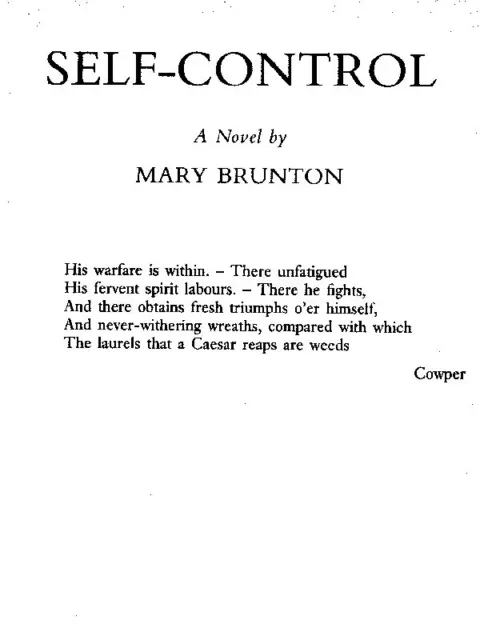
"Self-control: A Novel" by Mary Brunton is a novel published in 1811. The devout Laura Montreville faces relentless pursuit from the rake Colonel Hargrave, refusing his proposal despite his wealth and title. When circumstances force her to support her ailing father in London, Hargrave's obsession intensifies dangerously. His increasingly desperate measures culminate in a shocking kidnapping to the American wilderness. This morally-driven tale explores the power of religious principle and self-command, while challenging the romantic notion that reformed rakes make ideal husbands.
Introduction adapted from the source catalogue; source summaries may be automatically generated.
Free to read · English · 187,342 words · No account needed
MAKE TIME FOR A GOOD BOOK
On by default. Untick to stop anonymous reading totals. Each page counts after 10 seconds in view. How this works.
Anonymous counting is on unless you have switched it off.
'Norwood is the Eden of the earth,' said she to Harriet, as they drew their chairs towards the fire, to enjoy a tête à tête after the family were retired for the night; 'and it is peopled with spirits fit for paradise.--Happy you, who need never think of leaving it!' 'Bless you, my dear,' cried Harriet, 'there is nothing I think of half so much.--You would not have me be an old maid to comb lapdogs and fatten cats, when I might be scolding my own maids and whipping my own children.' 'Really,' said Laura, 'I think you would purchase even these delightful recreations too dearly by the loss of your present society. Sure it were a mad venture to change such a blessing for any uncertainty!' 'And yet, Mrs Graveairs, I have a notion that a certain gallant soldier could inspire you with the needful daring.--Now, look me in the face, and deny it if you can.' Laura did as she was desired; and, with cheeks flushed to crimson, but a voice of sweet austere composure, replied, 'Indeed, Miss De Courcy, I am hurt that you should so often have taxed me, even in sport, with so discreditable a partiality. You cannot be serious in supposing that I would marry an'--adulterer, Laura would have said; but to apply such an epithet to Hargrave was too much for human firmness, and she stopped. 'I declare she is angry,' cried Harriet. 'Well, my dear, since it displeases you, I shan't tease you any more; at least not till I find a new subject. But, pray now, do you intend to practise as you preach. Have you made a vow never to marry?' 'I do not say so,' answered Laura; 'it is silly to assert resolutions which nobody credits. Besides my situation sadly differs from yours. Like the moon, that is rising yonder, I must pursue my course alone. Thousands around me might perhaps warm and enlighten me; but far distant, their influence is lost ere it reaches me. You are in the midst of a happy family, endeared to you by all that is lovely in virtue; all that is sacred in kindred.--I know not what would tempt me to resign your situation.'--'What would tempt you?' cried Harriet. 'Why a pretty fellow would. But I verily believe you have been taking your cue from Montague; these are precisely his ideas. I think he has set his heart upon making me lead apes.' 'What makes you think so?' inquired Laura. 'Because he finds out a hundred faults to every man that talks nonsense to me. One is poor; and he thinks it folly to marry a beggar. Another is old, though he's rich; and that would be downrightly selling myself. One's a fool, and t'other's cross; and in short there's no end to his freaks. Only the other day he made me dismiss a creature that I believe I should have liked well enough in time. I have not half forgiven him for it yet. Poor Wilmot--and I should have had a nice barouche too!' 'What could possibly weigh with your brother against the barouche?' said Laura, smiling. 'Why, my dear, the saucy wretch told me, as plainly as he civilly could, that Wilmot and I had not a grain of prudence between us; ergo, that we should be ridiculous and miserable. Besides, poor Wilmot once persuaded a pretty girl to play the fool; and though he afterwards did every thing he could to prevail on her to be made an honest woman, the silly thing chose rather to break her heart and die; and, ever since, poor Wilmot has been subject to fits of low spirits.' 'Is it possible, Harriet, that you can talk so lightly of a crime so black in its nature, so dreadful in its consequences: Can it seem a trifle to you to destroy the peace, the innocence of a fellow-creature? Can you smile at remorse that pursued its victim even to the grave?' Tears filled the eyes of Harriet. 'Oh no, my dearest,' she cried, throwing her arms round Laura's neck; 'do not think so hardly of me.--I am a rattle, it is true, but I am not unprincipled.'--'Pardon my injustice, dearest Harriet,' said Laura, 'in believing, even for a moment, that you were capable of such perversion; and join with me in rejoicing that your brother's influence has saved you from witnessing, from sharing, the pangs of unavailing repentance.' 'Indeed,' said Harriet, 'Montague's influence can do any thing with me; and no wonder. I should be the most ungrateful wretch on earth if I could oppose his wishes. I cannot tell you the thousandth part of the affection he has shewn me. Did you ever hear, my dear, that my father had it not in his power to make any provision for me?' Laura answered that she had never heard the circumstances of the family at all mentioned. 'Do you know,' continued Harriet, 'I am certain that Montague is averse to my marrying, because he is afraid that my poverty, and not my will, consents. But he has himself set that matter to rest; for the very morning after I gave Wilmot his congé, Montague presented me with bills for two thousand pounds. The generous fellow told me that he did not offer his gift while Wilmot's suit was pending, lest I should think he bought a right to influence my decision.' 'This is just what I should have expected from Mr De Courcy,' said Laura, the purest satisfaction beaming in her countenance. 'He is ever considerate, ever generous.' 'To tell you that he gives me money,' cried Harriet, rapturously, 'is nothing; he gives me his time, his labour, his affection. Do love him, dear Laura! He is the best of all creatures!' 'Indeed I believe it,' said Laura, 'and I have the most cordial regard for him.'--'Ah but you must'--Harriet's gratitude to her brother had very nearly been too strong for his secret, and she was on the point of petitioning Laura to return a sentiment warmer than cordial regard, when, recollecting her mother's commands, she desisted; and to fly from the temptation, wished Laura good night, and retired.
Your reading position is saved on this browser. Take it to another device with a library code. Reading pages adapt to text, rather than matching a printed edition.
BEHIND THE BOOK
This eBook is for the use of anyone anywhere in the United States and most other parts of the world at no cost and with almost no restrictions whatsoever. You may copy it, give it away or re-use it under the terms of the Project Gutenberg License included with this eBook or online at www.gutenberg.org. If you are not located in the United States, you will have to check the laws of the country where you are located before using this eBook. Read the source licence.
The original source file, including credits and licence, is retained by this library. Request an original-format copy at no charge. Please include the book title and Project Gutenberg identifier #41196.
KEEP YOUR CURIOSITY GOING
Coulson Kernahan

Maurice Baring
Frances Wright
Cécile Tormay

Frederic Jesup Stimson

W. H. P. (William Henry Pope) Jarvis