THE CLASSIC COLLECTION✦DisciplineCLASSIC FREE BOOKS
Discipline
Mary Brunton
THE CLASSIC COLLECTION · 1811
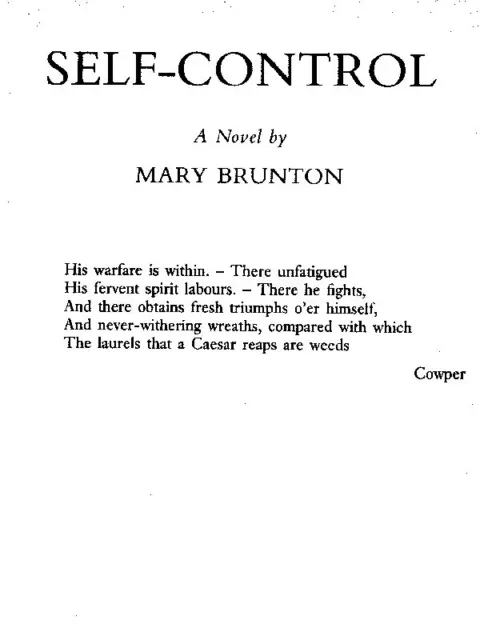
"Self-control: A Novel" by Mary Brunton is a novel published in 1811. The devout Laura Montreville faces relentless pursuit from the rake Colonel Hargrave, refusing his proposal despite his wealth and title. When circumstances force her to support her ailing father in London, Hargrave's obsession intensifies dangerously. His increasingly desperate measures culminate in a shocking kidnapping to the American wilderness. This morally-driven tale explores the power of religious principle and self-command, while challenging the romantic notion that reformed rakes make ideal husbands.
Introduction adapted from the source catalogue; source summaries may be automatically generated.
Free to read · English · 187,342 words · No account needed
MAKE TIME FOR A GOOD BOOK
On by default. Untick to stop anonymous reading totals. Each page counts after 10 seconds in view. How this works.
Anonymous counting is on unless you have switched it off.
From this reverie De Courcy was roused by the entrance of Lady Pelham, whose presence brought to his recollection the compliments and ceremonial which Laura had driven from his mind. He apologized for having delayed his visit; and excused himself for having made it alone, by saying that his sister was absent on a visit to a friend, and that his mother could not yet venture abroad; but he warmly entreated that the ladies would wave etiquette, and see Mrs De Courcy at Norwood. Lady Pelham, excusing herself for the present on the plea of her niece's indisposition, urged De Courcy to direct his walks often towards Walbourne; in charity, she said, to Laura, who being unable to take exercise, spent her forenoons alone, sighing, she supposed, for some Scotch Strephon. Laura blushed; and Montague took his leave, pondering whether the blush was deepened by any feeling of consciousness.
'She has a witchcraft in her that no language can express--no heart withstand--,' said De Courcy, suddenly breaking a long silence, as he and his mother were sitting tête à tête after dinner. 'Marriage is an excellent talisman against witchcraft,' said De Courcy, gravely; 'but Miss Montreville has charms that will delight the more the better they are known. There is such noble simplicity, such considerate benevolence, such total absence of vanity and selfishness in her character, that no woman was ever better fitted to embellish and endear domestic life.' 'Perhaps in time,' pursued De Courcy, 'I might have become not unworthy of such a companion--But now it matters not,'--and, suppressing a very bitter sigh, he took up a book which he had of late been reading to his mother. 'You know, Montague,' said Mrs De Courcy, 'I think differently from you upon this subject. I am widely mistaken in Miss Montreville, if she could bestow her preference on a libertine, knowing him to be such.' Montague took involuntary pleasure in hearing this opinion repeated; yet he had less faith in it than he usually had in the opinions of his mother. 'After the emotion which his presence excited,' returned he,--'an emotion which even these low people--I cannot think of it with patience,' cried he, tossing away the book, and walking hastily up and down the room. 'To betray her weakness, her only weakness, to such observers--to the wretch himself.' 'My dear De Courcy, do you make no allowance for the exaggeration, the rage for the romantic, so common to uneducated minds?' 'Wilkins could have no motive for inventing such a tale,' replied De Courcy; 'and if it had any foundation, there is no room for doubt.' 'Admitting the truth of all you have heard,' resumed Mrs De Courcy, 'I see no reason for despairing of success. If I know any thing of character, Miss Montreville's attachments will ever follow excellence, real or imaginary. Your worth is real, Montague; and, as such, it will in time approve itself to her.' 'Ah, Madam, had her affection been founded even on imaginary excellence, must it not now have been completely withdrawn--now, when she cannot be unacquainted with his depravity. Yet she loves him still.--I am sure she loves him. Why else this guarded silence in regard to him?--Why not mention that she permitted his daily visits--saw him even on the night when her father died?' 'Supposing,' returned Mrs De Courcy, 'that her affection had been founded on imaginary excellence, might not traces of the ruins remain perceptible, even after the foundation had been taken away? Come, come, Montague, you are only four-and-twenty, you can afford a few years patience. If you act prudently, I am convinced that your perseverance will succeed; but if it should not, I know how you can bear disappointment. I am certain that your happiness depends not on the smile of any face, however fair.' 'I am ashamed,' said De Courcy, 'to confess how much my peace depends upon Laura. You know I have no ambition--all my joys must be domestic. It is as a husband and a father that all my wishes must be fulfilled--and all that I have ever fancied of venerable and endearing, so meet in her, that no other woman can ever fill her place.' 'That you have no ambition,' replied Mrs De Courcy, 'is one of the reasons why I join in your wishes. If your happiness had any connection with splendour, I should have regretted your choice of a woman without fortune. But all that is necessary for your comfort you will find in the warmth of heart with which Laura will return your affection--the soundness of principle with which she will assist you in your duties. Still, perhaps, you might find these qualities in others, though not united in an equal degree; but I confess to you, Montague, I despair of your again meeting with a woman whose dispositions and pursuits are so congenial to your own;--a woman, whose cultivated mind and vigorous understanding, may make her the companion of your studies as well as of your lighter hours.' 'My dear mother,' cried De Courcy, affectionately grasping her hand, 'it is no wonder that I persecute you with this subject so near to my heart for you always, and you alone, support my hopes. Yet should I even at last obtain this treasure, I must ever regret that I cannot awaken the enthusiasm which belongs only to a first attachment.' 'Montague,' said Mrs De Courcy, smiling, 'from what romance have you learnt that sentiment? However I shall not attempt the labour of combating it, for I prophesy that, before the change can be necessary, you will learn to be satisfied with being loved with reason.' 'Many a weary day must pass before I can even hope for this cold preference. Indeed, if her choice is to be decided by mere rational approbation, why should I hope that it will fall upon me? Yet, if it be possible, her friendship I will gain--and I would not exchange it for the love of all her sex.' 'She already esteems you--highly esteems you,' said Mrs De Courcy; 'and I repeat that I think you need not despair of animating esteem into a warmer sentiment. But will you profit by my knowledge of my sex, Montague? You know, the less use we make of our own wisdom, the fonder we grow of bestowing it on others in the form of advice! Keep your secret carefully, Montague. Much of your hope depends on your caution. Pretensions to a pre-engaged heart are very generally repaid with dislike.' Montague promised attention to his mother's advice; but added, that he feared he should not long be able to follow it. 'I am a bad dissembler,' said he, 'and on this subject, it is alleged, that ladies are eagle-eyed.' 'Miss Montreville, of all women living, has the least vanity,' returned Mrs De Courcy; 'and you may always reinforce your caution, by recollecting that the prepossessions which will certainly be against you as a lover, may be secured in your favour as a friend.'
Your reading position is saved on this browser. Take it to another device with a library code. Reading pages adapt to text, rather than matching a printed edition.
BEHIND THE BOOK
This eBook is for the use of anyone anywhere in the United States and most other parts of the world at no cost and with almost no restrictions whatsoever. You may copy it, give it away or re-use it under the terms of the Project Gutenberg License included with this eBook or online at www.gutenberg.org. If you are not located in the United States, you will have to check the laws of the country where you are located before using this eBook. Read the source licence.
The original source file, including credits and licence, is retained by this library. Request an original-format copy at no charge. Please include the book title and Project Gutenberg identifier #41196.
KEEP YOUR CURIOSITY GOING
Coulson Kernahan

Maurice Baring
Frances Wright
Cécile Tormay

Frederic Jesup Stimson

W. H. P. (William Henry Pope) Jarvis