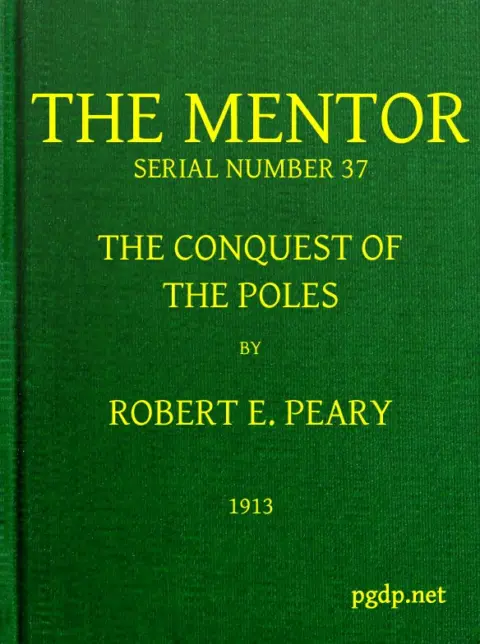
Nearest the Pole a narrative of the polar expedition of the Peary Arctic Club in the S.S. Roosevelt, 1905-1906
Robert E. (Robert Edwin) Peary
THE CLASSIC COLLECTION · 1917
"Secrets of Polar Travel" by Robert E. Peary is a practical guide to arctic exploration written in the early 20th century. The work focuses on the methods and equipment required for successful polar travel, drawing from Peary's extensive experience in the harsh conditions of the Arctic. With a detailed examination of the strategies implemented to conquer polar challenges, the book aims to equip both present and future explorers with invaluable knowledge they might need to survive and thrive in the frigid extremes of the polar regions. The opening portion of the book details Peary's introduction to polar travel and the foundations of his "Peary System" of exploration. He outlines the necessity of practical experience in developing effective equipment and methods, emphasizing the importance of thorough preparation and an understanding of the geographical and environmental conditions that polar explorers face. Peary also sets the stage for the book by contrasting the characteristics of the North and South Poles, explaining that while the North Pole is an ocean surrounded by land, the South Pole is a landmass surrounded by ocean, highlighting how these differences profoundly impact the approach to exploration.
Introduction adapted from the source catalogue; source summaries may be automatically generated.
Free to read · English · 58,574 words · No account needed
MAKE TIME FOR A GOOD BOOK
On by default. Untick to stop anonymous reading totals. Each page counts after 10 seconds in view. How this works.
Anonymous counting is on unless you have switched it off.
The detail of equipping a polar expedition is like the detail of equipping an army for foreign service, with, however, this difference. After the expedition has cast loose from civilization there is no chance to rectify mistakes or omissions. No rush wires or cables can be sent back to ship this or that article by next train or steamer. The little ship which bears the hopes of a polar expedition must contain in its restricted space everything to supply all the needs of its people for two or three years in a region where nothing can be obtained but meat, and even that only by those who possess the “know how.” Even when the needs are reduced to almost primeval simplicity, the multiplicity of essential things is great.
As an illustration of how an article, though so common that, like breathing, we are unaware of it, may be overlooked, it is said that a great polar expedition costing hundreds of thousands of dollars, and fitted out under the supervision of committees of scientists and polar experts, discovered, when it reached its winter quarters, that there was no salt on board except that in the salt pork and beef.
Supplies for a polar expedition comprise primarily equipment and provisions. The latter subdivides again into provisions for ship and headquarters and provisions for sledge-work.
The former are essentially normal, comprising standard commercial supplies, the principal thing being to have the best, and the specialness lies largely in the packing. The latter number only four items, pemmican, compressed tea, condensed milk, hard tack; but they are special in every detail of make and packing, with the exception of the condensed milk.
Here are a few of the items and figures on the list of supplies for one of my last expeditions, flour, 16,000 pounds; coffee, 1000 pounds; tea, 800 pounds; sugar, 10,000 pounds; kerosene, 3500 gallons; bacon, 7000 pounds; biscuit, 10,000 pounds; condensed milk, 100 cases; pemmican, 30,000 pounds; dried fish, 3000 pounds.
To illustrate how normal was our bill of fare on the Roosevelt in winter quarters, here is our weekly menu for the winter of 1908–09 (the north pole voyage):
Monday. Breakfast: cereal, beans and brown bread, butter, coffee. Dinner: liver and bacon, macaroni and cheese, bread and butter, tea.
Tuesday. Breakfast: oatmeal, ham and eggs, bread and butter, coffee. Dinner: corned beef and creamed peas, duff, tea.
Wednesday. Breakfast: choice of two kinds of cereal, fish, forward (that is, for the sailors), sausage, aft (for the members of the expedition), bread and butter, coffee. Dinner: steak and tomatoes, bread and butter, tea.
Thursday. Breakfast: cereal, ham and eggs, bread and butter, coffee. Dinner: corned beef and peas, duff, tea.
Your reading position is saved on this browser. Take it to another device with a library code. Reading pages adapt to text, rather than matching a printed edition.
Robert E. (Robert Edwin) Peary

Robert E. (Robert Edwin) Peary
BEHIND THE BOOK
This eBook is for the use of anyone anywhere in the United States and most other parts of the world at no cost and with almost no restrictions whatsoever. You may copy it, give it away or re-use it under the terms of the Project Gutenberg License included with this eBook or online at www.gutenberg.org. If you are not located in the United States, you will have to check the laws of the country where you are located before using this eBook. Read the source licence.
The original source file, including credits and licence, is retained by this library. Request an original-format copy at no charge. Please include the book title and Project Gutenberg identifier #67973.
KEEP YOUR CURIOSITY GOING
Wilfrid Scawen Blunt

E. W. (Edgar Watson) Howe
Francis Greenleaf Allinson & Anne C. E. (Anne Crosby Emery) Allinson
Cyrenus Cole

John Martineau

