THE CLASSIC COLLECTION✦My diaries, being a personal narrative of events 1888-1914, Part 2 (1900-1914)CLASSIC FREE BOOKS
My diaries, being a personal narrative of events 1888-1914, Part 2 (1900-1914)
Wilfrid Scawen Blunt
THE CLASSIC COLLECTION · 1922
"Secret History of the English Occupation of Egypt" by Wilfrid Scawen Blunt is a historical account written in the early 20th century. The work focuses on the political intricacies and events surrounding the English occupation of Egypt, particularly during the time of Khedive Ismaïl and the subsequent Egyptian revolution. It aims to provide an insider perspective on the occupation, revealing the motivations and consequences of Britain's involvement in Egyptian affairs. The opening of the book introduces the author’s background and motivations, as well as a historical context for his involvement in Egypt's political landscape. Blunt reflects on his early diplomatic career, his initial perception of Egypt as a traveler, and the socio-political climate of the time, detailing Ismaïl’s lavish reign and the financial mismanagement that contributed to widespread poverty. Through personal anecdotes and observations, he sets the stage for a deeper examination of the events leading up to England's intervention, framing his narrative as an effort to convey an honest account of a tumultuous period that ultimately shaped Egypt's future.
Introduction adapted from the source catalogue; source summaries may be automatically generated.
Free to read · English · 171,514 words · No account needed
MAKE TIME FOR A GOOD BOOK
On by default. Untick to stop anonymous reading totals. Each page counts after 10 seconds in view. How this works.
Anonymous counting is on unless you have switched it off.
"April 26.--Home to England, where Gladstone is the talk of the hour. He has taken office (as Prime Minister) and has surrounded himself with ineptitudes, Childers, Bright, Granville! Hartington, who is a good second-rate man, takes the India Office and Ripon goes to India. This last arrangement is a secret."
Lord Ripon's appointment to India as Viceroy was the only quite sincere attempt made in foreign policy by Gladstone to carry out in office what he had preached when in opposition. Ripon was a thoroughly honest man, of no very brilliant parts but straightforward and in earnest. He took seriously the mission with which he was entrusted by the new Government of making and keeping the peace on the Indian frontiers, and of inaugurating a new policy having for its object to carry out the Queen's proclamation of self-government among the natives. To the astonishment, and indeed scandal, of the official world, he took with him as his private secretary Gordon, whom all looked upon as mad--than which no better proof could have been given of his bona fides towards Native India. Gordon, however, was not of the stuff of which private secretaries, even with a chief like Ripon, are made, and he had hardly landed at Bombay before he resigned. I do not think that Ripon was in fault in this, but rather Gordon's restless chafing against all rules and conventions. I shall have later to describe Ripon's viceroyalty when I come to my second Indian journey in 1884. Now it will be enough to say that, if it achieved comparatively little, it was through the pusillanimity of the Ministry at home rather than his own. He valiantly went on in the course traced out for him at the start, but like boys who sometimes in a race, to make a fool of their companion who is in front of them, hang back and stop, he found out to his confusion after a while that he had been running alone and that the Ministers who had changed their minds without letting him know had long been laughing at him for his persistence. It must have been a bitter moment for him when he, too, had to give in. The other appointments made were all, as far as the highest offices went, given by Gladstone to the Whigs. Lord Granville--the matter which interested me most--got the Foreign Office, an amiable old nobleman with a good knowledge of French, but very deaf and very idle, whose diplomacy was of the old procrastinating school of never doing today what could possibly be put off till to-morrow, or, as he himself was fond of putting it, of "dawdling matters out" and leaving them to right themselves alone. Of such a Minister nothing in the way of a new policy could be expected, and none was attempted either in Turkey, or Egypt, or elsewhere. The Cyprus Convention was neither repudiated nor turned to account for any good purpose, and beyond a little sham pressure put upon the Sultan in the matter of Montenegro and the Greek frontier, things were left precisely as they were. The only change made was that Layard, the author of the Convention, was recalled from Constantinople and Goschen appointed in his place, the same Goschen who had made the leonine arrangement for the bondholders in Egypt three years before, his own family firm of Göschen and Frühling being one of them. The only act of the new Foreign Secretary which showed that he remembered Mr. Gladstone's denunciations of the Turks was that, in order to prove that Gladstone had been right and Disraeli and Salisbury wrong about them, he in defiance of the ordinary rule in such matters at the Foreign Office published a secret despatch of Layard's which contradicted everything the Ambassador had written about the situation at Constantinople in his public despatches. In this unfortunate document he had laid bare the secret vices and weaknesses of the Sultan Abdul Hamid, his personal cowardice especially being insisted on and emphasized with details then unknown to the world, but now notorious, of his system of spy-government. Its publication was a gross act of treachery to Layard, and was, moreover, an act of folly from the effects of which our diplomacy at Constantinople has not yet recovered; Layard had been, so to say, Abdul Hamid's bosom friend and had received from him favours of a kind not usually accorded to European Envoys. The Sultan had shown himself to Layard as to a comrade on whom he could rely, and the disclosure of what he considered Layard's treachery alienated for ever his goodwill from England.
Your reading position is saved on this browser. Take it to another device with a library code. Reading pages adapt to text, rather than matching a printed edition.
Wilfrid Scawen Blunt
Wilfrid Scawen Blunt
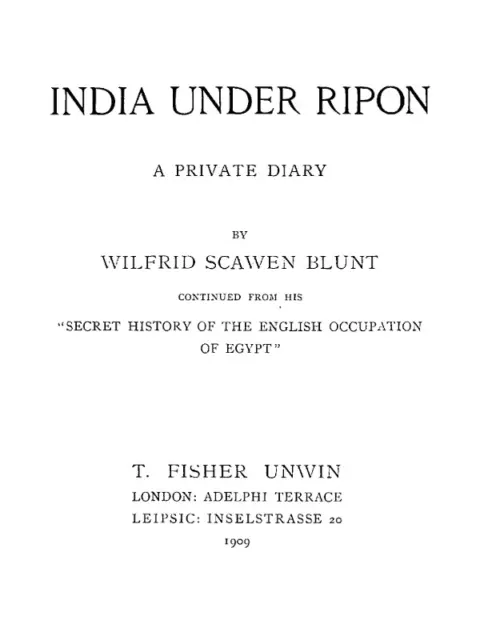
Wilfrid Scawen Blunt

Wilfrid Scawen Blunt
BEHIND THE BOOK
This eBook is for the use of anyone anywhere in the United States and most other parts of the world at no cost and with almost no restrictions whatsoever. You may copy it, give it away or re-use it under the terms of the Project Gutenberg License included with this eBook or online at www.gutenberg.org. If you are not located in the United States, you will have to check the laws of the country where you are located before using this eBook. Read the source licence.
The original source file, including credits and licence, is retained by this library. Request an original-format copy at no charge. Please include the book title and Project Gutenberg identifier #41373.
KEEP YOUR CURIOSITY GOING
Cécile Tormay

Moritz Busch
John L. Ransom
Frances Wright
Cécile Tormay

Mabel Potter Daggett