THE CLASSIC COLLECTION✦My diaries, being a personal narrative of events 1888-1914, Part 2 (1900-1914)CLASSIC FREE BOOKS
My diaries, being a personal narrative of events 1888-1914, Part 2 (1900-1914)
Wilfrid Scawen Blunt
THE CLASSIC COLLECTION · 1922
"Secret History of the English Occupation of Egypt" by Wilfrid Scawen Blunt is a historical account written in the early 20th century. The work focuses on the political intricacies and events surrounding the English occupation of Egypt, particularly during the time of Khedive Ismaïl and the subsequent Egyptian revolution. It aims to provide an insider perspective on the occupation, revealing the motivations and consequences of Britain's involvement in Egyptian affairs. The opening of the book introduces the author’s background and motivations, as well as a historical context for his involvement in Egypt's political landscape. Blunt reflects on his early diplomatic career, his initial perception of Egypt as a traveler, and the socio-political climate of the time, detailing Ismaïl’s lavish reign and the financial mismanagement that contributed to widespread poverty. Through personal anecdotes and observations, he sets the stage for a deeper examination of the events leading up to England's intervention, framing his narrative as an effort to convey an honest account of a tumultuous period that ultimately shaped Egypt's future.
Introduction adapted from the source catalogue; source summaries may be automatically generated.
Free to read · English · 171,514 words · No account needed
MAKE TIME FOR A GOOD BOOK
On by default. Untick to stop anonymous reading totals. Each page counts after 10 seconds in view. How this works.
Anonymous counting is on unless you have switched it off.
On the 6th of December Arabi, who up to this time had been in retirement at Ras-el-Wady, a military post close to Tel-el-Kebir, arrived at Cairo and on the 12th for the first time I saw him. He had hired a house close to his friend Ali Fehmi's, who was now wholly with him, and not far from the Abdin Barracks. It was in company, if I remember rightly, with Eïd Diab, and taking Sabunji with me, that I went to him, it having been arranged beforehand that I should do so by some of our mutual friends. Arabi was at that time at the height of his popularity, being talked of through the length and breadth of Egypt as "El Wahíd," the "only one," and people were flocking from all sides to Cairo to lay their grievances before him. His outer room was full of suppliants, as was indeed the entrance from the street, and this was every day the case. He had already heard of me as a sympathizer and friend of the fellah cause, and received me with all possible cordiality, especially, he told me, on account of what he had also heard, my family connection with Byron, whom, though he knew nothing of his poetry, he held in high esteem for his work for liberty in Greece. The point is worth noting, as it is very characteristic of Arabi's attitude towards humanity at large without distinction of race or creed. There was nothing in him of the fanatic, if fanaticism means religious hatred, and he was always ready to join hands in the cause of liberty with Jew, Christian, or infidel, notwithstanding his own, by no means lukewarm, piety.
I talked to him long and without reserve on all the questions of the day, and found him equally frank and plain spoken. Towards the Khedive he expressed his perfect loyalty "so long as he kept to his promises and made no attempt to baulk the Egyptians of their promised freedom." But it was clear that he did not wholly trust him, and considered it his duty to keep a strict eye over him lest he should swerve from the path. In a letter that I wrote soon after, 20th December, to Mr. Gladstone, when I had had several other conversations with him, I said of him: "The ideas he expresses are not merely a repetition of the phrases of modern Europe, but are based on a knowledge of history and on the liberal tradition of Arabian thought, inherited from the days when Mohammedanism was liberal. He understands that broader Islam which existed before Mohammed, and the bond of a common worship of the one true God which unites his own faith with that of Judaism and Christianity. He disclaims, I believe, all personal ambition, and there is no kind of doubt that the army and country are devoted to him.... Of his own position he speaks with modesty. 'I am,' he says, 'the representative of the army because circumstances have made the army trust me; but the army itself is but the representative of the people, its guardian till such time as the people shall no longer need it. At present we are the sole national force standing between Egypt and its Turkish rulers, who would renew at any moment, were they permitted, the iniquities of Ismaïl Pasha. The European Control only partially provides against this, and makes no provision whatever by national education in self-government for the day when it shall abandon its financial trust. This we have to see to. We have won for the people their right to speak in an Assembly of Notables, and we keep the ground to prevent their being cajoled or frightened out of it. In this we work not for ourselves but for our children and for those that trust us.... We soldiers are for the moment in the position of those Arabs who answered the Caliph Omar when, in old age, he asked the people whether they were satisfied with his rule, and whether he had walked straightly in the path of justice. "O son of El Khattab," said they, "thou hast indeed walked straightly and we love thee. But thou knewest that we were at hand and ready, if thou hadst walked crookedly, to straighten thee with our swords." I trust that no such violence will be needed. As Egyptians we do not love blood, and hope to shed none; and when our Parliament has learned to speak, our duty will be over. But until such time we are resolved to maintain the rights of the people at any cost and we do not fear, with God's help, to justify our guardianship if need be against all who would silence them.'"
Your reading position is saved on this browser. Take it to another device with a library code. Reading pages adapt to text, rather than matching a printed edition.
Wilfrid Scawen Blunt
Wilfrid Scawen Blunt
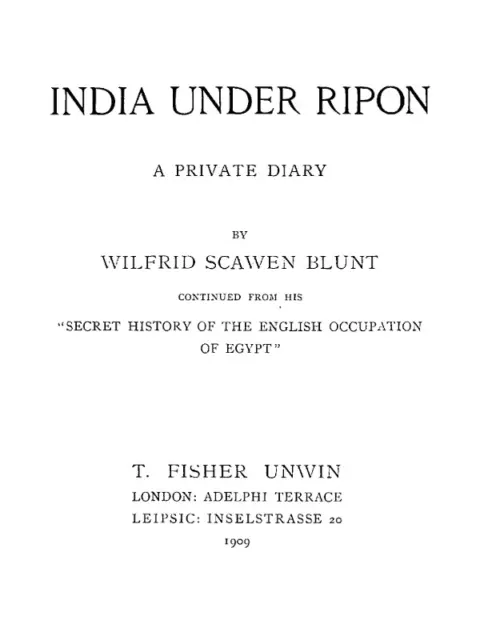
Wilfrid Scawen Blunt

Wilfrid Scawen Blunt
BEHIND THE BOOK
This eBook is for the use of anyone anywhere in the United States and most other parts of the world at no cost and with almost no restrictions whatsoever. You may copy it, give it away or re-use it under the terms of the Project Gutenberg License included with this eBook or online at www.gutenberg.org. If you are not located in the United States, you will have to check the laws of the country where you are located before using this eBook. Read the source licence.
The original source file, including credits and licence, is retained by this library. Request an original-format copy at no charge. Please include the book title and Project Gutenberg identifier #41373.
KEEP YOUR CURIOSITY GOING
Cécile Tormay

Moritz Busch
John L. Ransom
Frances Wright
Cécile Tormay

Mabel Potter Daggett