THE CLASSIC COLLECTION✦My diaries, being a personal narrative of events 1888-1914, Part 2 (1900-1914)CLASSIC FREE BOOKS
My diaries, being a personal narrative of events 1888-1914, Part 2 (1900-1914)
Wilfrid Scawen Blunt
THE CLASSIC COLLECTION · 1922
"Secret History of the English Occupation of Egypt" by Wilfrid Scawen Blunt is a historical account written in the early 20th century. The work focuses on the political intricacies and events surrounding the English occupation of Egypt, particularly during the time of Khedive Ismaïl and the subsequent Egyptian revolution. It aims to provide an insider perspective on the occupation, revealing the motivations and consequences of Britain's involvement in Egyptian affairs. The opening of the book introduces the author’s background and motivations, as well as a historical context for his involvement in Egypt's political landscape. Blunt reflects on his early diplomatic career, his initial perception of Egypt as a traveler, and the socio-political climate of the time, detailing Ismaïl’s lavish reign and the financial mismanagement that contributed to widespread poverty. Through personal anecdotes and observations, he sets the stage for a deeper examination of the events leading up to England's intervention, framing his narrative as an effort to convey an honest account of a tumultuous period that ultimately shaped Egypt's future.
Introduction adapted from the source catalogue; source summaries may be automatically generated.
Free to read · English · 171,514 words · No account needed
MAKE TIME FOR A GOOD BOOK
On by default. Untick to stop anonymous reading totals. Each page counts after 10 seconds in view. How this works.
Anonymous counting is on unless you have switched it off.
Another acquaintance at that time with whom a tragic history is connected was Colley, then Lytton's military secretary, who the year following was to die on Majuba Hill. Lytton had the highest possible opinion of his military talents, and between them they had in large measure directed the Afghan campaign from Simla. His fault was, I think, too great self-confidence and too much ambition. He occupied Majuba because he could not bear to let the campaign end without gaining some personal success. Melgund again, who is now Lord Minto, Pole-Carew, and Brabazon, Lytton's aides-de-camp, were all three, with Lord Ralph Kerr, among our friends of that time, and Plowden and Batten, the husbands of their two fair wives. We made the voyage back from Bombay in Melgund's company and that of Major Jack Napier, leaving India on the 12th of July in full monsoon and arriving at Suez on the 25th, and on the same day by train to Alexandria.
I think it was at Aden, as we passed it to the Red Sea, that we learned the great news of the day in Egypt, the deposition of the Khedive Ismaïl, a subject to us of great rejoicing, and no sooner had we arrived at Alexandria than I learned the full details of his share in the affair from that other intimate friend of my diplomatic days, Frank Lascelles, whom I found acting Consul-General at the British Agency. What he told me does not differ much from the account of it officially published, and I need not repeat it here. What, however, is not generally known is the part played in it by the Rothschilds, which Lascelles did not at that time know but which I heard later from Wilson. Wilson, indeed, was able to boast that through these he had had his full revenge. On his return, he told me, from Egypt, crestfallen and abandoned by his own Government, he had gone straight to the Rothschilds at Paris and had represented to them the danger their money was running from the turn affairs had taken at Cairo and Alexandria. The Khedive intended to repudiate his whole debt and to shelter himself in doing so by proclaiming Constitutional government in Egypt. If they did not prevent this, all would be lost. He thus succeeded in alarming the Rothschilds and in getting them to use the immense political influence they possessed in favour of active intervention. At first, however, they had pulled the strings both at Downing Street and on the Quai d'Orsay in vain. The English Government was no longer in an intervening mood, trouble having broken out for them in South Africa; and at Paris, too, there was an equal unwillingness. In despair for their millions the Rothschilds then made supplication at Berlin to Bismarck, who ever since his Frankfort days had extended a certain contemptuous protection to the great Hebrew house, and not in vain. The French and English Governments were given to understand by the then all-powerful Chancellor that if they were unable to intervene effectively in Egypt in the bond-holders' interests the German Government would make their cause its own. This settled the matter, and it was agreed that, as the least violent form of intervention, the Sultan should be applied to to depose his too recalcitrant vassal. To the last moment Ismaïl refused to believe that the Porte, on which he had lavished so many millions and was still appealing cash in hand--for he had hidden treasures--would desert him. The pressure from Europe was too great. Wilson claims to have had the question of Ismaïl's successor submitted to him as between Halim, whom the Sultan much preferred, and Tewfik, and to have decided in favor of the latter as being known to him to be of weak character and so the more convenient political instrument. But be that as it may, the fatal telegram was despatched conveying to Ismaïl the news of his fall, and that his Viceregal functions had passed away from him to his son. It had been Lascelles' disagreeable duty to convey the news to the old tyrant of eighteen irresponsible and ruinous years. True to his rapacious habit, his last act had been to deplete the treasury of its current account and to gather together all the valuables he could anywhere lay hands on, and so retire to his yacht, the "Mahroussa," with a final spoil of his Egyptian subjects amounting, it is said, to three millions sterling. Nobody had cared to hinder him or inquire, or bid him stay even for an hour.
Your reading position is saved on this browser. Take it to another device with a library code. Reading pages adapt to text, rather than matching a printed edition.
Wilfrid Scawen Blunt
Wilfrid Scawen Blunt
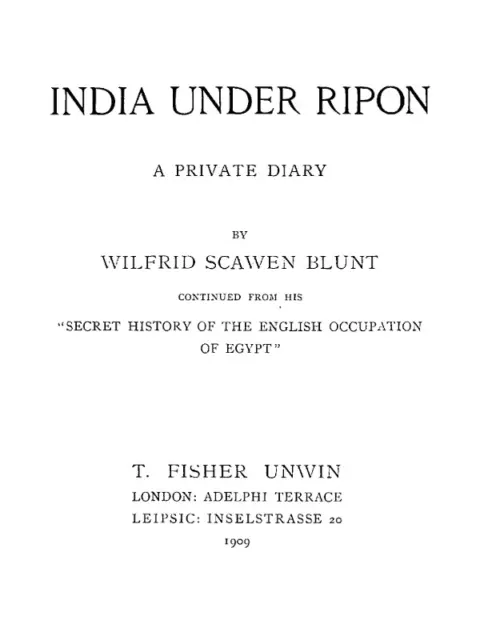
Wilfrid Scawen Blunt

Wilfrid Scawen Blunt
BEHIND THE BOOK
This eBook is for the use of anyone anywhere in the United States and most other parts of the world at no cost and with almost no restrictions whatsoever. You may copy it, give it away or re-use it under the terms of the Project Gutenberg License included with this eBook or online at www.gutenberg.org. If you are not located in the United States, you will have to check the laws of the country where you are located before using this eBook. Read the source licence.
The original source file, including credits and licence, is retained by this library. Request an original-format copy at no charge. Please include the book title and Project Gutenberg identifier #41373.
KEEP YOUR CURIOSITY GOING
Cécile Tormay

Moritz Busch
John L. Ransom
Frances Wright
Cécile Tormay

Mabel Potter Daggett