THE CLASSIC COLLECTION✦My diaries, being a personal narrative of events 1888-1914, Part 2 (1900-1914)CLASSIC FREE BOOKS
My diaries, being a personal narrative of events 1888-1914, Part 2 (1900-1914)
Wilfrid Scawen Blunt
THE CLASSIC COLLECTION · 1922
"Secret History of the English Occupation of Egypt" by Wilfrid Scawen Blunt is a historical account written in the early 20th century. The work focuses on the political intricacies and events surrounding the English occupation of Egypt, particularly during the time of Khedive Ismaïl and the subsequent Egyptian revolution. It aims to provide an insider perspective on the occupation, revealing the motivations and consequences of Britain's involvement in Egyptian affairs. The opening of the book introduces the author’s background and motivations, as well as a historical context for his involvement in Egypt's political landscape. Blunt reflects on his early diplomatic career, his initial perception of Egypt as a traveler, and the socio-political climate of the time, detailing Ismaïl’s lavish reign and the financial mismanagement that contributed to widespread poverty. Through personal anecdotes and observations, he sets the stage for a deeper examination of the events leading up to England's intervention, framing his narrative as an effort to convey an honest account of a tumultuous period that ultimately shaped Egypt's future.
Introduction adapted from the source catalogue; source summaries may be automatically generated.
Free to read · English · 171,514 words · No account needed
MAKE TIME FOR A GOOD BOOK
On by default. Untick to stop anonymous reading totals. Each page counts after 10 seconds in view. How this works.
Anonymous counting is on unless you have switched it off.
Ismaïl Sadyk was an Algerian by birth but had come at an early age to Egypt, and had by his abilities risen in the viceregal service, his first connection with the Court having been, I believe, under Abbas I as a superintendent of his stud. Under Saïd and Ismaïl he had served in various official capacities and had made himself, as we have seen, Ismaïl's âme damnée in the work of extracting their last piastres from the fellahin. With all his cruelties to them--and he had shown inexhaustible ingenuity in devising means for their spoliation--he had maintained a certain honourable repute at Cairo as an Arab gifted with the traditional virtue of generosity and a large liberality in spending the wealth he had acquired, and so as an old man was not unpopular. For the last few years of his life he had been Finance Minister, and to Ismaïl had always proved himself a devoted and faithful servant. Ismaïl had nevertheless betrayed him a few months before the time I am writing of basely to his death, and under circumstances so revolting that the Egyptian world, used as it was to crime in high places, had been shocked and confounded. The Khedive's motive had been the wholly base and selfish one of screening himself by casting upon his too faithful Minister the blame of certain frauds he had himself committed, and he had insured his silence by having the old man murdered almost in his own presence.
The details given me by Wilson were as follows: Ismaïl had been in the habit, in his dealings with the various European commissioners whom he had from time to time invited to inquire into his financial affairs, of concealing as far as was possible from them the extreme truth of his senseless extravagances, and with his Minister Ismaïl Sadyk's help had once more now, as on previous occasions, presented to the new official commission a false statement of his debts. The pressure, however, on him was severe, as the commission had received a hint, if I remember rightly, from Riaz Pasha, that they were being befooled on this point, and he, fearing that the whole truth would come out, and when the matter should be fully gone into by the commission his Minister might tell the facts, determined to be beforehand with him and make of him his scapegoat and victim. He took the execution of the deed into his own hands. It was his custom with his Minister, with whom he was on the closest possible terms of personal friendship, to call sometimes for the old man in the afternoon at the Finance Office and take him for a drive with him to Shubra or to one or another of his palaces; and so on this occasion he did, and, suspecting nothing, the Minister mounted with him and they drove together to the Jesireh Palace and there got down and entered. No sooner, however, were they inside than Ismaïl on some pretext left him alone in one of the saloons and immediately sent to him his two younger sons Husseyn and Hassan and his aide-de-camp, Mustafa Bey Fehmy, when the princes struck and insulted the unarmed Minister and hustled him on board one of the viceregal steamers which was lying with steam up beside the quay, and there, though not without a vigorous resistance, the old man was despatched. According to Wilson, the actual doer of the deed was Mustafa Bey, acting under the Khedive's order, and he added that the truth had been disclosed through the young aide-de-camp falling ill of fever soon after and telling it in his delirium. I have reason, however, to believe that as far as Mustafa's personal act went this was a mistake, though the rest of the facts have been fully confirmed to me, and that the Mufettish was handed over by Mustafa to Ishak Bey, in whose charge he perished, though whether at once or a little later is uncertain. Some say that Ismaïl Sadyk was thrown as many another had been thrown, with a stone tied to his feet into the Nile, others that he was conveyed alive as far as to between Waddy Halfa and Dongola and there strangled. All that is quite beyond dispute is that once on board the steamer he was never seen again alive, and that the steamer having gone up the river, it was some weeks later officially announced that the Mufettish was away in Upper Egypt for a change of air and ultimately that he had there taken to drink and died. It is also certain that Mustafa, a mild young man and unused to scenes of violence, and being himself, as the Mufettish was, of Algerine extraction, was so horrified at the rôle he had been ordered to play in it that he had a long and dangerous illness. It was this experience that a year later caused him to take the part he did against his master Ismaïl and ultimately to join Arabi in the earlier phases of the revolution of 1881-2. He is the same Mustafa Fehmy who has for so many years filled the office of Prime Minister in Egypt.
Your reading position is saved on this browser. Take it to another device with a library code. Reading pages adapt to text, rather than matching a printed edition.
Wilfrid Scawen Blunt
Wilfrid Scawen Blunt
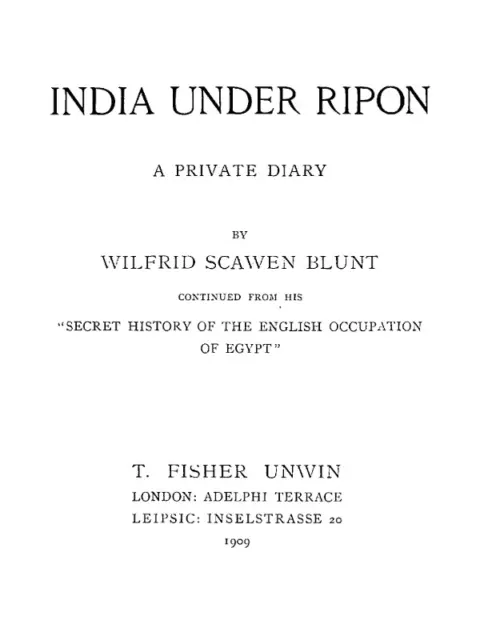
Wilfrid Scawen Blunt

Wilfrid Scawen Blunt
BEHIND THE BOOK
This eBook is for the use of anyone anywhere in the United States and most other parts of the world at no cost and with almost no restrictions whatsoever. You may copy it, give it away or re-use it under the terms of the Project Gutenberg License included with this eBook or online at www.gutenberg.org. If you are not located in the United States, you will have to check the laws of the country where you are located before using this eBook. Read the source licence.
The original source file, including credits and licence, is retained by this library. Request an original-format copy at no charge. Please include the book title and Project Gutenberg identifier #41373.
KEEP YOUR CURIOSITY GOING
Cécile Tormay

Moritz Busch
John L. Ransom
Frances Wright
Cécile Tormay

Mabel Potter Daggett