THE CLASSIC COLLECTION✦My diaries, being a personal narrative of events 1888-1914, Part 2 (1900-1914)CLASSIC FREE BOOKS
My diaries, being a personal narrative of events 1888-1914, Part 2 (1900-1914)
Wilfrid Scawen Blunt
THE CLASSIC COLLECTION · 1922
"Secret History of the English Occupation of Egypt" by Wilfrid Scawen Blunt is a historical account written in the early 20th century. The work focuses on the political intricacies and events surrounding the English occupation of Egypt, particularly during the time of Khedive Ismaïl and the subsequent Egyptian revolution. It aims to provide an insider perspective on the occupation, revealing the motivations and consequences of Britain's involvement in Egyptian affairs. The opening of the book introduces the author’s background and motivations, as well as a historical context for his involvement in Egypt's political landscape. Blunt reflects on his early diplomatic career, his initial perception of Egypt as a traveler, and the socio-political climate of the time, detailing Ismaïl’s lavish reign and the financial mismanagement that contributed to widespread poverty. Through personal anecdotes and observations, he sets the stage for a deeper examination of the events leading up to England's intervention, framing his narrative as an effort to convey an honest account of a tumultuous period that ultimately shaped Egypt's future.
Introduction adapted from the source catalogue; source summaries may be automatically generated.
Free to read · English · 171,514 words · No account needed
MAKE TIME FOR A GOOD BOOK
On by default. Untick to stop anonymous reading totals. Each page counts after 10 seconds in view. How this works.
Anonymous counting is on unless you have switched it off.
The position of things at Alexandria was this: Alexandria, more than any other town in Egypt, was in large part a European city, inhabited, besides the Moslem population, by Greek, Italian and Maltese colonists, all engaged in trade and many of them money-lenders. At no time had there been much love between the two classes and the arrival of the fleets, avowedly with the intention of protecting European interests, greatly increased the ill-feeling. It needed much loyalty, firmness, and tact on the part of the Governor of the town to preserve order, and great discretion on the part of the fleet. Unfortunately the Governor, Omar Pasha Lutfi, was a man entirely opposed to the Nationalist Ministry. He was a Circassian, a member of the Court party, and a partisan of the ex-Khedive Ismaïl's, and at the time of the Circassian plot had done service to Tewfik by entering into communication with the Western Bedouins to gain them to the Khedive's side. He had, therefore, rather encouraged than repressed the element of disorder in the Mohammedan population. The Greeks, on the other hand, had proceeded to arm themselves, with the assistance of the head of their community, Ambroise Sinadino, a rich banker, who was also agent of the Rothschilds in Egypt; and the Maltese, a numerous community, did likewise through the connivance of Cookson, the English Consul. Things, therefore, were all it may be said, prepared for a riot as early as the last week of May, in expectation of that "civil war" which, it will be remembered, the "Pall Mall Gazette" foresaw as an approved alternative, should the Nationalist Ministry refuse to resign and Arabi to accept suppression.
There is no doubt that disturbance, as a proof of anarchy, was a thing looked forward to by our diplomacy at Cairo as probable, and even not undesirable in the interests of their "bottle-holding" policy. That Omar Lutfi had a personal interest in the suppression of Arabi is also easily proved. In the telegrams of the day, when the Ultimatum was about to be launched, a list is given of the purely Circassian and Khedivial Ministry which it was intended should succeed that of Mahmud Sami, and Omar Lutfi is named in it as the probable successor of Arabi at the War Office. Nor was this announcement unfounded, for a few days later we know that Omar Lutfi was, in fact, sent for by the Khedive to the Ismaïlia Palace and offered the post.[16] The Ultimatum was delivered on the 1st of June, and the Ministers resigned on the 2nd, having waited a day because the Khedive had told them he would first telegraph for advice to Constantinople, though on the following morning, when they again came to him, he informed them that his mind was made up to accept the Ultimatum notwithstanding that he had received no answer. When, therefore, on the 3rd the Khedive had been obliged, through the popular demonstration in Arabi's favour, backed by the German and Austrian Consuls, who saw in Arabi the man best capable in Egypt of maintaining order, to rename Arabi Minister of War, the disappointment to Omar Lutfi is easily understood, and the temptation he was under of creating practical proof that the German Consuls were wrong. We have, besides this, evidence that on the 5th of June the Khedive, who, no less than Omar Lutfi, had received a great rebuff, sent him a telegram in the following words: "Arabi has guaranteed public order, and published it in the newspapers, and has made himself responsible to the Consuls; and if he succeeds in his guarantee the Powers will trust him, and our consideration will be lost. Also the fleets of the Powers are in Alexandrian waters, and men's minds are excited, and quarrels are not far off between Europeans and others. Now, therefore, choose for yourself whether you will serve Arabi in his guarantee or whether you will serve us." On this hint Omar Lutfi immediately took his measures. As civil governor he was in command of the Mustafezzin, the semi-military police of Alexandria, and through them directed that quarterstaves, (nabuts) should be collected at the police stations to be served out at the proper moment, and other preparations made for an intended disturbance. Ample proof may be found in the evidence printed in the Blue Books of the complicity of the police in the affair, though a confusion is constantly made by those who give the evidence between these and the regular soldiers by speaking of the police, as is often loosely done in Egypt, as soldiers. The regulars were not under the civil, but the military governors, and took no part in the affair until called in at a late hour by Omar Lutfi when he found the riot had assumed proportions he could not otherwise control. It is to be noted that the chief of the Mustafezzin, Seyd Kandil, a timid adherent of Arabi's, refused to take part in the day's proceedings, excusing himself to Omar Lutfi on the ground of illness.
Your reading position is saved on this browser. Take it to another device with a library code. Reading pages adapt to text, rather than matching a printed edition.
Wilfrid Scawen Blunt
Wilfrid Scawen Blunt
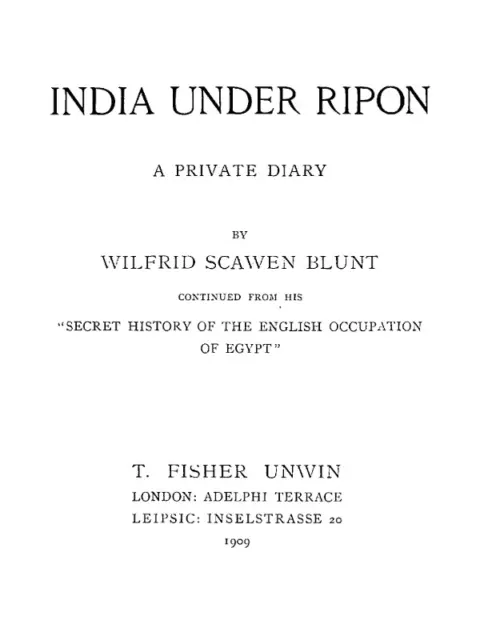
Wilfrid Scawen Blunt

Wilfrid Scawen Blunt
BEHIND THE BOOK
This eBook is for the use of anyone anywhere in the United States and most other parts of the world at no cost and with almost no restrictions whatsoever. You may copy it, give it away or re-use it under the terms of the Project Gutenberg License included with this eBook or online at www.gutenberg.org. If you are not located in the United States, you will have to check the laws of the country where you are located before using this eBook. Read the source licence.
The original source file, including credits and licence, is retained by this library. Request an original-format copy at no charge. Please include the book title and Project Gutenberg identifier #41373.
KEEP YOUR CURIOSITY GOING
Cécile Tormay

Moritz Busch
John L. Ransom
Frances Wright
Cécile Tormay

Mabel Potter Daggett