
A Hermit of Carmel, and Other Poems
George Santayana
THE CLASSIC COLLECTION · 1923
Scepticism and Animal Faith (1923) is a later work by Spanish-born American philosopher George Santayana. He intended it to be "merely the introduction to a new system of philosophy," a work that would later be called The Realms of Being, which constitutes the bulk of his philosophy, along with The Life of Reason.
Scepticism is Santayana's major treatise on epistemology; after its publication, he wrote no more on the topic. His preface begins humbly, with Santayana saying:
Here is one more system of philosophy. If the reader is tempted to smile, I can assure him that I smile with him...I am merely trying to express for the reader the principles to which he appeals when he smiles.
Moreover, he does not claim philosophical supremacy: I do not ask anyone to think in my terms if he prefers others. Let him clean better, if he can, the windows of his soul, that the variety and beauty of the prospect may spread more brightly before him.
While Santayana acknowledges the importance of skepticism to philosophy, and begins by doubting almost everything; from here, he seeks to find some kind of epistemological truths. Idealism is correct, claims Santayana, but is of no consequence. He makes this pragmatic claim by asserting that men do not live by the principles of idealism, even if it is true. We have functioned for eons without adhering to such principles, and may continue, pragmatically, as such. He posits the necessity of the eponymous "Animal Faith", which is belief in that which our senses tell us; "Philosophy begins in medias res", he assures us at the beginning of his treatise. (This summary is from Wikipedia.)
Introduction adapted from the source catalogue; source summaries may be automatically generated.
Free to read · English · 97,423 words · No account needed
MAKE TIME FOR A GOOD BOOK
On by default. Untick to stop anonymous reading totals. Each page counts after 10 seconds in view. How this works.
Anonymous counting is on unless you have switched it off.
All this is sheer sophistry, and limping scepticism. Certainly the vulgar notions of nature, and even the scientific ones, are most questionable; and they may have grown up in the way these critics suggest; in any case they have grown up humanly. But they are not mere images; they are beliefs; and the truth of beliefs hangs on what they assert, not on their origin. The question is whether such an object as they describe lies in fact in the quarter where they assert it to lie; the genealogy of these assertions in the mind of the believer, though interesting, is irrelevant. It is for science and further investigation of the object to pronounce on the truth of any belief. It will remain a mere belief to the end, no matter how much corroborated and corrected; but the fact that it is a belief, far from proving that it must be false, renders it possibly true, as it could not be if it asserted nothing and had no object beyond itself which it pointed to and professed to describe. This whole school criticises knowledge, not by extending knowledge and testing it further, but by reviewing it maliciously, on the tacit assumption that knowledge is impossible. But in that case this review of knowledge and all this shrewd psychology are themselves worthless; and we are reduced, as Hume was in his deeper moments of insight, to a speechless wonder. So that whilst all the animals trust their senses and live, philosophy would persuade man alone not to trust them and, if he was consistent, to stop living.
This tragic conclusion might not have daunted a true philosopher, if like the Indians he had reached it by a massive moral experience rather than by incidental sophistries with no hold on the spirit. In that case the impossibility of knowledge would have seemed but one illustration of the vanity of life in general. That all is vanity was a theme sometimes developed by Christian preachers, and even in some late books of the Bible, with special reservations; but it is an insight contrary to Hebraic religion, which invokes supernatural or moral agencies only in the hope of securing earthly life and prosperity for ever. The wisdom demanded could, therefore, not be negative or merely liberating; and scepticism in Christian climes has always seemed demoralising. When it forced itself on the reluctant mind, people either dismissed it as a game not worth playing and sank back, like Hume, into common sense, though now with a bad conscience; or else they sought some subterfuge or equivocation by which knowledge, acknowledged to be worthless, was nevertheless officially countersigned and passed as legal tender, so that the earnest practice of orthodoxy, religious or worldly, or both at once, might go on without a qualm. Evidently, to secure this result, it was necessary to set up some oracle, independent of natural knowledge, that should represent some deeper reality than natural knowledge could profess to reach; and it was necessary that this oracle itself, by a pious or a wilful oversight, should escape criticism; for otherwise all was lost. It escaped criticism by virtue of the dramatic illusion which always fills the sails of argument, and renders the passing conviction the indignant voice of omniscience and justice. The principle invoked in criticism, whatever it might be, could not be criticised. It did not need to be defended: its credentials were the havoc it wrought among more explicit conventions. And yet, by a mocking fatality, those discredited conventions had to be maintained in practice, since they are inevitable for mankind, and the basis, even by their weaknesses, of the appeal to that higher principle which, in theory, was to revise and reject them. This higher principle was no alternative view of the world, no revelation of further facts or destinies; it was the thinking or dreaming spirit that posited those necessary conventions, and would itself die if it ceased to posit them. In discrediting the fictions of spirit we must, therefore, beware of suspending them. We are not asked to abolish our conception of the natural world, nor even, in our daily life, to cease to believe in it; we are to be idealists only north-north-west, or transcendentally; when the wind is southerly, we are to remain realists. The pronouncements of animal faith have no doubt been reversed in a higher court, but with this singular proviso, that the police and the executioner, while reverently acknowledging the authority of the higher tribunal, must unflinchingly carry out the original sentence passed by the lower. This escape from scepticism by ambiguity, and by introducing only cancelled dogmas, was chosen by German philosophy at the beginning of the nineteenth century, and by modernism and pragmatism at the end of it.
Your reading position is saved on this browser. Take it to another device with a library code. Reading pages adapt to text, rather than matching a printed edition.
George Santayana

George Santayana
George Santayana
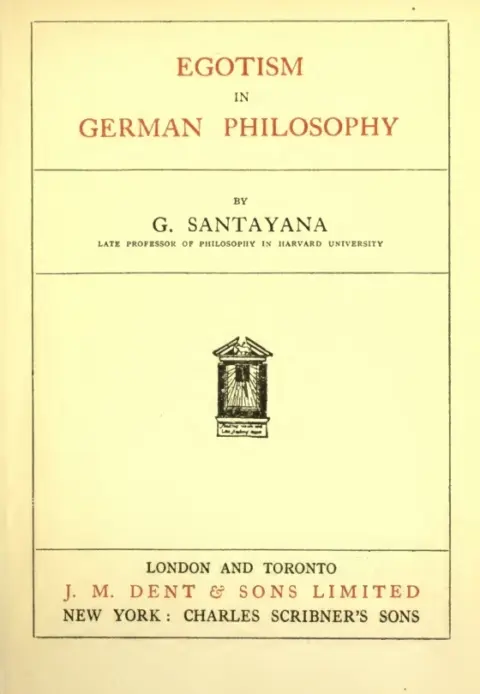
George Santayana
BEHIND THE BOOK
This eBook is for the use of anyone anywhere in the United States and most other parts of the world at no cost and with almost no restrictions whatsoever. You may copy it, give it away or re-use it under the terms of the Project Gutenberg License included with this eBook or online at www.gutenberg.org. If you are not located in the United States, you will have to check the laws of the country where you are located before using this eBook. Read the source licence.
The original source file, including credits and licence, is retained by this library. Request an original-format copy at no charge. Please include the book title and Project Gutenberg identifier #77155.
KEEP YOUR CURIOSITY GOING

Charles G. (Charles Griffith) Ross
Hannah Webster Foster

Emily Lawless
Edwin Hamlin Carr

Charles De Lano Hine
Andrew Ure