
A Hermit of Carmel, and Other Poems
George Santayana
THE CLASSIC COLLECTION · 1923
Scepticism and Animal Faith (1923) is a later work by Spanish-born American philosopher George Santayana. He intended it to be "merely the introduction to a new system of philosophy," a work that would later be called The Realms of Being, which constitutes the bulk of his philosophy, along with The Life of Reason.
Scepticism is Santayana's major treatise on epistemology; after its publication, he wrote no more on the topic. His preface begins humbly, with Santayana saying:
Here is one more system of philosophy. If the reader is tempted to smile, I can assure him that I smile with him...I am merely trying to express for the reader the principles to which he appeals when he smiles.
Moreover, he does not claim philosophical supremacy: I do not ask anyone to think in my terms if he prefers others. Let him clean better, if he can, the windows of his soul, that the variety and beauty of the prospect may spread more brightly before him.
While Santayana acknowledges the importance of skepticism to philosophy, and begins by doubting almost everything; from here, he seeks to find some kind of epistemological truths. Idealism is correct, claims Santayana, but is of no consequence. He makes this pragmatic claim by asserting that men do not live by the principles of idealism, even if it is true. We have functioned for eons without adhering to such principles, and may continue, pragmatically, as such. He posits the necessity of the eponymous "Animal Faith", which is belief in that which our senses tell us; "Philosophy begins in medias res", he assures us at the beginning of his treatise. (This summary is from Wikipedia.)
Introduction adapted from the source catalogue; source summaries may be automatically generated.
Free to read · English · 97,423 words · No account needed
MAKE TIME FOR A GOOD BOOK
On by default. Untick to stop anonymous reading totals. Each page counts after 10 seconds in view. How this works.
Anonymous counting is on unless you have switched it off.
Hume seems to have assumed that every perception perceived itself. He assumed further that these perceptions lay in time and formed certain sequences. Why a given perception belonged to one sequence rather than to another, and why all simultaneous perceptions were not in the same mind, he never considered; the questions were unanswerable, so long as he ignored or denied the existence of bodies. He asserted also that these perceptions were repeated, and that the repetitions were always fainter than the originals—two groundless assertions, unless the transitive force of memory is admitted, and impressions are distinguished from ideas externally, by calling an intuition an impression when caused by a present object, visible to a third person, and calling it an idea when not so caused. Furthermore, he invoked an alleged habit of perceptions always to follow one another in the same order—something flatly contrary to fact; but the notion was made plausible by confusion with the habits of the physical world, where similar events recur when the conditions are similar. Intuitions no doubt follow the same routine; but the conditions for an intuition are not the previous intuitions, but the whole present state of the psyche and of the environment, something of which the previous intuitions were at best prophetic symptoms, symptoms often falsified by the event.
All these haltings and incoherences arose in the attempt to conceive experience divorced from its physical ground and from its natural objects, as a dream going on in vacuo. So artificial an abstraction, however, is hard to maintain consistently, and Hume, by a happy exercise of worldly wit, often described the workings of the mind as our social imagination leads us all vaguely to conceive them. In these inspired moments he made those acute analyses of our notions of material things, of the soul, and of cause, which have given him his name as a sceptic. These analyses are bits of plausible literary psychology, essays on the origin of common sense. They are not accounts of what the notions analysed mean, much less scientific judgements of their truth. They are supposed, however, by Hume and by the whole modern school of idealists, to destroy both the meaning of these notions and the existence of their intended objects. Having explained how, perhaps, early man, or a hypothetical infant, might have reached his first glimmerings of knowledge that material things exist, or souls, or causes, we are supposed to have proved that no causes, no souls, and no material things can exist at all. We are not allowed to ask how, in that case, we have any evidence for the existence of early man, or of the hypothetical infant, or of any general characteristics of the human mind, and its tendencies to feign. The world of literature is sacred to these bookish minds; only the world of nature and science arouses their suspicion and their dislike. They think that “experience,” with the habits of thought and language prevalent in all nations, from Adam down, needs only to be imagined in order to be known truly. All but this imagined experience seems to them the work of imagination. While their method of criticism ought evidently to establish not merely solipsism, but a sort of solipsism of the present datum, yet they never stop to doubt the whole comedy of human intercourse, just as the most uncritical instinct and the most fanciful history represent it to be. How can such a mass of ill-attested and boldly dogmatic assumptions fail to make the critics of science uncomfortable in their own house? Is it because the criticism of dogma in physics, without this dogma in psychology, could never so much as begin? Is not their criticism at bottom a work of edification or of malice, not of philosophic sincerity, so that they reject the claim to knowledge only in respect to certain physical, metaphysical, or religious objects which the modern mind has become suspicious of, and hopes to feel freer without? Meantime, they keep their conventional social assumptions without a qualm, because they need them to justify their moral precepts and to lend a false air of adequacy to their view of the world. Thus we are invited to believe that our notions of material things do not mean what they assert, but being illusions in their deliverance, really signify only the series of perceptions that have preceded them, or that, for some unfathomable reason, may be expected to ensue.
Your reading position is saved on this browser. Take it to another device with a library code. Reading pages adapt to text, rather than matching a printed edition.
George Santayana

George Santayana
George Santayana
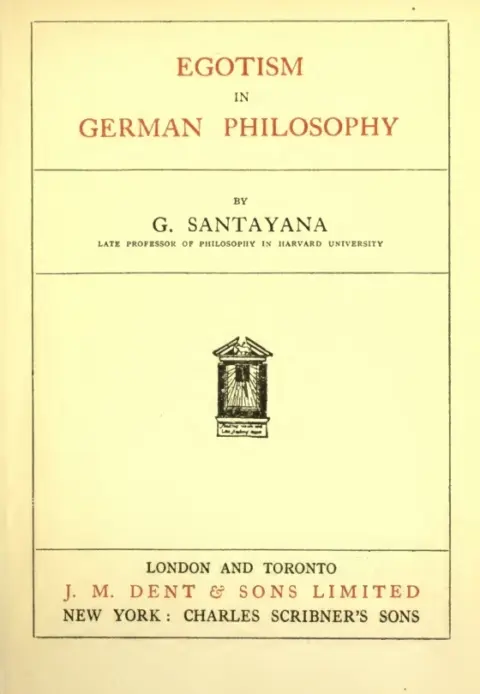
George Santayana
BEHIND THE BOOK
This eBook is for the use of anyone anywhere in the United States and most other parts of the world at no cost and with almost no restrictions whatsoever. You may copy it, give it away or re-use it under the terms of the Project Gutenberg License included with this eBook or online at www.gutenberg.org. If you are not located in the United States, you will have to check the laws of the country where you are located before using this eBook. Read the source licence.
The original source file, including credits and licence, is retained by this library. Request an original-format copy at no charge. Please include the book title and Project Gutenberg identifier #77155.
KEEP YOUR CURIOSITY GOING

Charles G. (Charles Griffith) Ross
Hannah Webster Foster

Emily Lawless
Edwin Hamlin Carr

Charles De Lano Hine
Andrew Ure